QUESTION IMAGE
Question
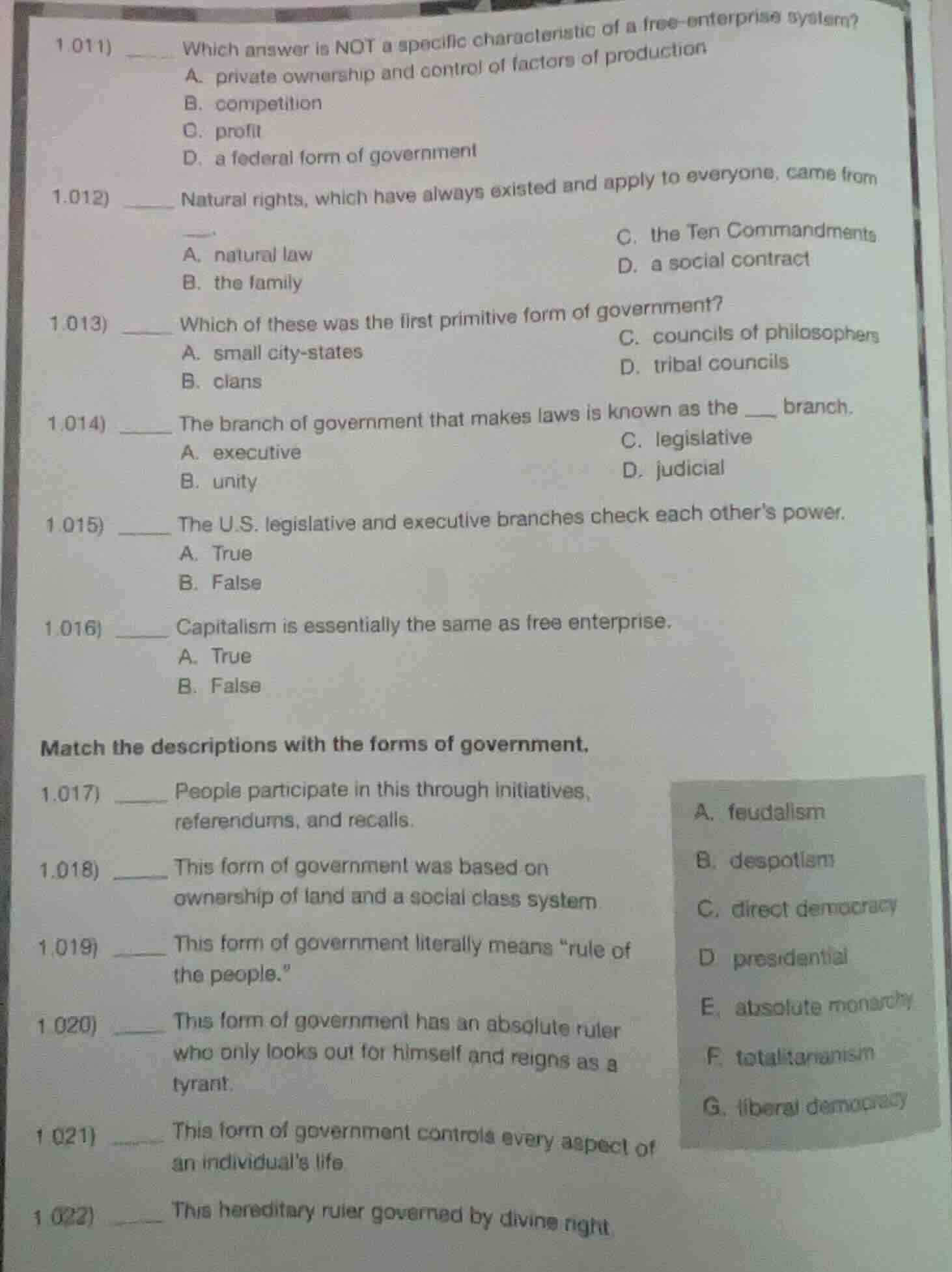
1.011) which answer is not a specific characteristic of a free-enterprise system?
a. private ownership and control of factors of production
b. competition
c. profit
d. a federal form of government
1.012) natural rights, which have always existed and apply to everyone, came from
a. natural law
b. the family
c. the ten commandments
d. a social contract
1.013) which of these was the first primitive form of government?
a. small city-states
b. clans
c. councils of philosophers
d. tribal councils
1.014) the branch of government that makes laws is known as the ___ branch.
a. executive
b. unity
c. legislative
d. judicial
1.015) the u.s. legislative and executive branches check each others power.
a. true
b. false
1.016) capitalism is essentially the same as free enterprise.
a. true
b. false
match the descriptions with the forms of government.
1.017) people participate in this through initiatives, referendums, and recalls.
1.018) this form of government was based on ownership of land and a social class system.
1.019) this form of government literally means
ule of the people.\
1.020) this form of government has an absolute ruler who only looks out for himself and reigns as a tyrant.
1.021) this form of government controls every aspect of an individuals life.
1.022) this hereditary ruler governed by divine right.
a. feudalism
b. despotism
c. direct democracy
d. presidential
e. absolute monarchy
f. totalitarianism
g. liberal democracy
Analyze multiple-choice questions 1.011 to 1.016
- 1.011: A free-enterprise system is defined by private ownership, competition, and profit. A federal form of government is a political structure, not an economic characteristic. Thus, D is correct.
- 1.012: Natural rights are historically derived from natural law, which exists independently of human-made laws. Thus, A is correct.
- 1.013: Historically, clans represent the earliest, most primitive form of human social and political organization before cities or formal councils. Thus, B is correct.
- 1.014: The legislative branch is responsible for making laws. Thus, C is correct.
- 1.015: Under the system of checks and balances, the legislative and executive branches check each other's power. Thus, A (True) is correct.
- 1.016: Capitalism and free enterprise are terms used interchangeably to describe market-driven economies. Thus, A (True) is correct.
Analyze matching questions 1.017 to 1.022
- 1.017: Initiatives, referendums, and recalls are mechanisms of direct citizen participation, which defines direct democracy. Thus, C is correct.
- 1.018: A system based on land ownership and a rigid social class hierarchy is feudalism. Thus, A is correct.
- 1.019: The term "democracy" comes from Greek words meaning "rule of the people." Thus, C is correct (or G, but C is the literal translation).
- 1.020: An absolute ruler who acts as a tyrant is a despot, representing despotism. Thus, B is correct.
- 1.021: A government that controls every aspect of public and private life is totalitarianism. Thus, F is correct.
- 1.022: A hereditary ruler governing by divine right is an absolute monarchy. Thus, E is correct.

Snap & solve any problem in the app
Get step-by-step solutions on Sovi AI
Photo-based solutions with guided steps
Explore more problems and detailed explanations
1.011) (D) a federal form of government
1.012) (A) natural law
1.013) (B) clans
1.014) (C) legislative
1.015) (A) True
1.016) (A) True
1.017) (C) direct democracy
1.018) (A) feudalism
1.019) (C) direct democracy
1.020) (B) despotism
1.021) (F) totalitarianism
1.022) (E) absolute monarchy