QUESTION IMAGE
Question
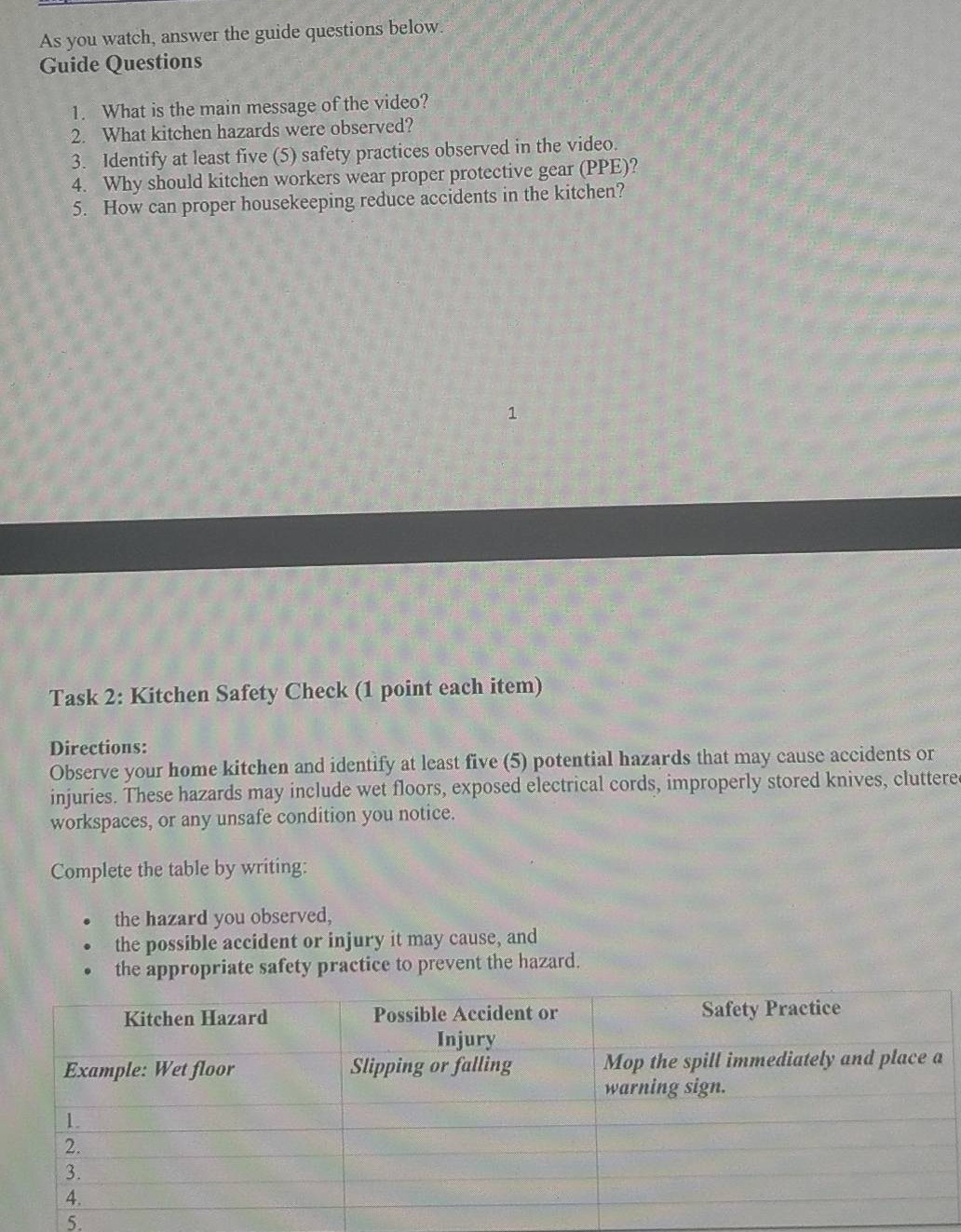
as you watch, answer the guide questions below.
guide questions
- what is the main message of the video?
- what kitchen hazards were observed?
- identify at least five (5) safety practices observed in the video.
- why should kitchen workers wear proper protective gear (ppe)?
- how can proper housekeeping reduce accidents in the kitchen?
1
task 2: kitchen safety check (1 point each item)
directions:
observe your home kitchen and identify at least five (5) potential hazards that may cause accidents or injuries. these hazards may include wet floors, exposed electrical cords, improperly stored knives, cluttered workspaces, or any unsafe condition you notice.
complete the table by writing:
- the hazard you observed,
- the possible accident or injury it may cause, and
- the appropriate safety practice to prevent the hazard.
\
🆕 New Concept Discovered: Kitchen Hazard Identification and Risk Mitigation
Recognizing dangers and applying safety controls
Step 1: Identify Common Kitchen Hazards
To complete the safety check table, we must identify five distinct, realistic hazards commonly found in a home kitchen environment. These hazards typically fall into categories such as physical, chemical, electrical, or thermal dangers.
- Improperly stored knives: Leaving sharp knives loose in a drawer or on the edge of a counter.
- Exposed or frayed electrical cords: Using kitchen appliances with damaged wiring near water sources.
- Cluttered workspaces: Accumulating cutting boards, dishes, and ingredients around active cooking zones.
- Hot pot handles facing outward: Leaving pot handles sticking out over the edge of the stove.
- Grease buildup on the stovetop: Allowing oil and grease residues to accumulate near heating elements.
Step 2: Determine Possible Accidents or Injuries
For each identified hazard, we analyze the direct physical consequence or accident that could occur if the hazard is left unaddressed:
- Improperly stored knives $
ightarrow$ Cuts, lacerations, or puncture wounds when reaching into drawers or if a knife falls.
- Exposed electrical cords $
ightarrow$ Electrical shocks, short circuits, or potential electrical fires.
- Cluttered workspaces $
ightarrow$ Knocking over hot liquids, dropping heavy items, or accidental cuts due to limited maneuverability.
- Hot pot handles facing outward $
ightarrow$ Accidental spills of boiling liquids, leading to severe thermal burns.
- Grease buildup on the stovetop $
ightarrow$ Grease fires, which spread rapidly and are difficult to extinguish with water.
Step 3: Formulate Preventative Safety Practices
For each hazard and associated risk, we establish a practical, preventative action (control measure) to eliminate or minimize the danger:
- For knives: Store knives in a designated wooden knife block, on a magnetic strip, or use protective blade sheaths.
- For electrical cords: Inspect appliance cords regularly, replace damaged appliances, and keep cords away from water and heat sources.
- For cluttered workspaces: Clean as you go, keep only active ingredients on the counter, and put away unused utensils immediately.
- For pot handles: Always turn pot and pan handles inward toward the back or center of the stove while cooking.
- For grease buildup: Wipe down the stovetop and exhaust hood regularly after cooking to prevent flammable residue accumulation.
---

Snap & solve any problem in the app
Get step-by-step solutions on Sovi AI
Photo-based solutions with guided steps
Explore more problems and detailed explanations
Here is the completed table for Task 2: Kitchen Safety Check:
| Kitchen Hazard | Possible Accident or Injury | Safety Practice | |
| :-: | :--- | :--- | :--- |
| Ex. | Wet floor | Slipping or falling | Mop the spill immediately and place a warning sign. |
| 1. | Improperly stored knives | Cuts, lacerations, or puncture wounds | Store knives in a designated knife block, on a magnetic strip, or use protective sheaths. |
| 2. | Exposed or frayed electrical cords | Electrical shock or electrical fire | Inspect cords regularly, replace damaged appliances, and keep cords away from water. |
| 3. | Cluttered workspaces | Knocking over hot items or dropping utensils | Clean as you go, keeping only active ingredients and tools on the countertop. |
| 4. | Hot pot handles facing outward | Accidental spills of hot liquids causing severe burns | Always turn pot and pan handles inward toward the center or back of the stove. |
| 5. | Grease buildup on the stovetop | Grease fires | Wipe down the stovetop and cooking surfaces regularly to remove flammable residues. |