Sovi.AI - AI Math Tutor

Scan to solve math questions

QUESTION IMAGE

you are treating a patient experiencing a stroke who is aphasic. he is …

Question

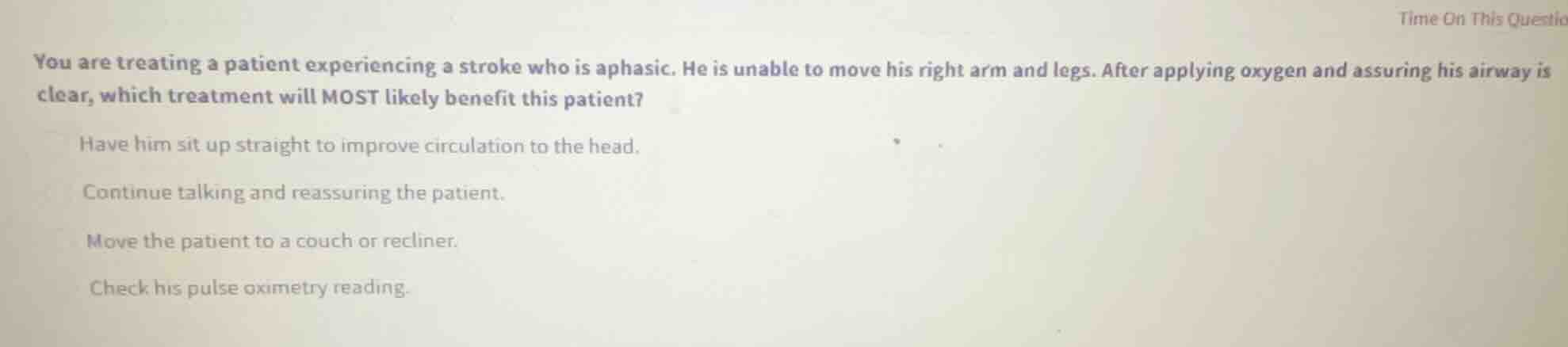
you are treating a patient experiencing a stroke who is aphasic. he is unable to move his right arm and legs. after applying oxygen and assuring his airway is clear, which treatment will most likely benefit this patient?

have him sit up straight to improve circulation to the head.
continue talking and reassuring the patient.
move the patient to a couch or recliner.
check his pulse oximetry reading.

Explanation:

Response

<pre_analysis>
{
"quality": "clear",
"question_count": 1,
"skills_matched": [
"direct_cot",
"multiple_choice_formatter",
"explain_then_answer",
"tutor",
"mastery_adaptive_brevity"
],
"needs_drawing": false,
"concepts_used": [
"Stroke Pathophysiology",
"Therapeutic Communication",
"Stroke Patient Positioning"
],
"new_concepts": [],
"current_concepts": [
"Stroke Pathophysiology",
"Therapeutic Communication",
"Stroke Patient Positioning"
]
}
</pre_analysis>

<reasoning>

Analyze the patient's clinical presentation

Using the Stroke Pathophysiology knowledge point
The patient is experiencing a stroke, presenting with aphasia (inability to understand or express speech) and right-sided hemiplegia (paralysis of the right arm and leg).

Evaluate the therapeutic communication needs

Using the Therapeutic Communication knowledge point
Although the patient is aphasic and cannot speak, they can often still hear, comprehend, and feel anxiety. Continuing to talk and reassure the patient is a vital supportive intervention that reduces stress and establishes trust.

Assess the remaining physical intervention options

Using the Stroke Patient Positioning knowledge point

  • Sitting up straight is contraindicated as it can decrease cerebral perfusion pressure.
  • Moving the patient to a couch or recliner is unnecessary and potentially unsafe.
  • Checking pulse oximetry is already addressed since oxygen has already been applied.

</reasoning>

<answer>
<mcq-option>Have him sit up straight to improve circulation to the head.</mcq-option>
<mcq-correct>Continue talking and reassuring the patient.</mcq-correct>
<mcq-option>Move the patient to a couch or recliner.</mcq-option>
<mcq-option>Check his pulse oximetry reading.</mcq-option>
</answer>

<post_analysis>
{
"subject": "Natural Science",
"question_type": "Multiple Choice",
"knowledge_point": [
"Natural Science",
"Medicine",
"Emergency Medical Services"
]
}
</post_analysis>

Answer:

<pre_analysis>
{
"quality": "clear",
"question_count": 1,
"skills_matched": [
"direct_cot",
"multiple_choice_formatter",
"explain_then_answer",
"tutor",
"mastery_adaptive_brevity"
],
"needs_drawing": false,
"concepts_used": [
"Stroke Pathophysiology",
"Therapeutic Communication",
"Stroke Patient Positioning"
],
"new_concepts": [],
"current_concepts": [
"Stroke Pathophysiology",
"Therapeutic Communication",
"Stroke Patient Positioning"
]
}
</pre_analysis>

<reasoning>

Analyze the patient's clinical presentation

Using the Stroke Pathophysiology knowledge point
The patient is experiencing a stroke, presenting with aphasia (inability to understand or express speech) and right-sided hemiplegia (paralysis of the right arm and leg).

Evaluate the therapeutic communication needs

Using the Therapeutic Communication knowledge point
Although the patient is aphasic and cannot speak, they can often still hear, comprehend, and feel anxiety. Continuing to talk and reassure the patient is a vital supportive intervention that reduces stress and establishes trust.

Assess the remaining physical intervention options

Using the Stroke Patient Positioning knowledge point

  • Sitting up straight is contraindicated as it can decrease cerebral perfusion pressure.
  • Moving the patient to a couch or recliner is unnecessary and potentially unsafe.
  • Checking pulse oximetry is already addressed since oxygen has already been applied.

</reasoning>

<answer>
<mcq-option>Have him sit up straight to improve circulation to the head.</mcq-option>
<mcq-correct>Continue talking and reassuring the patient.</mcq-correct>
<mcq-option>Move the patient to a couch or recliner.</mcq-option>
<mcq-option>Check his pulse oximetry reading.</mcq-option>
</answer>

<post_analysis>
{
"subject": "Natural Science",
"question_type": "Multiple Choice",
"knowledge_point": [
"Natural Science",
"Medicine",
"Emergency Medical Services"
]
}
</post_analysis>