Sovi.AI - AI Math Tutor

Scan to solve math questions

QUESTION IMAGE

you have a patient with hypoglycemia. which of the following signs woul…

Question

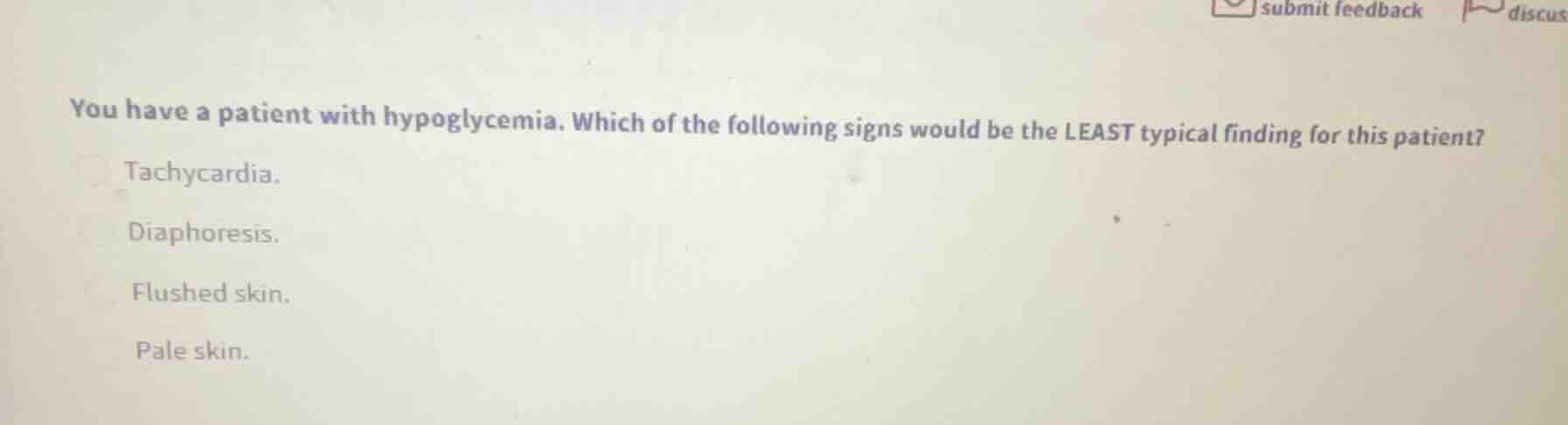
you have a patient with hypoglycemia. which of the following signs would be the least typical finding for this patient?

tachycardia.
diaphoresis.
flushed skin.
pale skin.

Explanation:

Response

<pre_analysis>
{
"quality": "clear",
"question_count": 1,
"skills_matched": [
"direct_cot",
"multiple_choice_formatter",
"explain_then_answer",
"tutor",
"mastery_adaptive_brevity"
],
"needs_drawing": false,
"concepts_used": [
"Hypoglycemia Pathophysiology"
],
"new_concepts": [],
"current_concepts": [
"Hypoglycemia Pathophysiology",
"Diabetic Emergencies Onset"
]
}
</pre_analysis>

<reasoning>

Analyze the physiological response to hypoglycemia

Using the Hypoglycemia Pathophysiology knowledge point

When blood glucose levels drop significantly, the body triggers a compensatory sympathetic nervous system (fight-or-flight) response. This adrenal activation releases epinephrine and norepinephrine to mobilize glucose stores.

Evaluate the clinical signs of sympathetic activation

Using the Hypoglycemia Pathophysiology knowledge point

The release of epinephrine leads to several characteristic clinical signs:

  • Tachycardia: Increased heart rate to maintain perfusion.
  • Diaphoresis: Profuse sweating due to sympathetic stimulation of sweat glands.
  • Pale skin (pallor): Peripheral vasoconstriction shunts blood away from the skin to vital organs.

Identify the least typical finding

Using the Hypoglycemia Pathophysiology knowledge point

Because peripheral vasoconstriction occurs during a hypoglycemic episode, the skin becomes cool, pale, and clammy. Flushed skin (which is warm and red due to vasodilation) is not typical of hypoglycemia. Instead, flushed, dry skin is a classic sign of hyperglycemia or diabetic ketoacidosis (DKA).
</reasoning>

<answer>
<mcq-option>Tachycardia.</mcq-option>
<mcq-option>Diaphoresis.</mcq-option>
<mcq-correct>Flushed skin.</mcq-correct>
<mcq-option>Pale skin.</mcq-option>
</answer>

<post_analysis>
{
"subject": "Natural Science",
"question_type": "Multiple Choice",
"knowledge_point": [
"Natural Science",
"Medicine",
"Hypoglycemia Pathophysiology"
]
}
</post_analysis>

Answer:

<pre_analysis>
{
"quality": "clear",
"question_count": 1,
"skills_matched": [
"direct_cot",
"multiple_choice_formatter",
"explain_then_answer",
"tutor",
"mastery_adaptive_brevity"
],
"needs_drawing": false,
"concepts_used": [
"Hypoglycemia Pathophysiology"
],
"new_concepts": [],
"current_concepts": [
"Hypoglycemia Pathophysiology",
"Diabetic Emergencies Onset"
]
}
</pre_analysis>

<reasoning>

Analyze the physiological response to hypoglycemia

Using the Hypoglycemia Pathophysiology knowledge point

When blood glucose levels drop significantly, the body triggers a compensatory sympathetic nervous system (fight-or-flight) response. This adrenal activation releases epinephrine and norepinephrine to mobilize glucose stores.

Evaluate the clinical signs of sympathetic activation

Using the Hypoglycemia Pathophysiology knowledge point

The release of epinephrine leads to several characteristic clinical signs:

  • Tachycardia: Increased heart rate to maintain perfusion.
  • Diaphoresis: Profuse sweating due to sympathetic stimulation of sweat glands.
  • Pale skin (pallor): Peripheral vasoconstriction shunts blood away from the skin to vital organs.

Identify the least typical finding

Using the Hypoglycemia Pathophysiology knowledge point

Because peripheral vasoconstriction occurs during a hypoglycemic episode, the skin becomes cool, pale, and clammy. Flushed skin (which is warm and red due to vasodilation) is not typical of hypoglycemia. Instead, flushed, dry skin is a classic sign of hyperglycemia or diabetic ketoacidosis (DKA).
</reasoning>

<answer>
<mcq-option>Tachycardia.</mcq-option>
<mcq-option>Diaphoresis.</mcq-option>
<mcq-correct>Flushed skin.</mcq-correct>
<mcq-option>Pale skin.</mcq-option>
</answer>

<post_analysis>
{
"subject": "Natural Science",
"question_type": "Multiple Choice",
"knowledge_point": [
"Natural Science",
"Medicine",
"Hypoglycemia Pathophysiology"
]
}
</post_analysis>