QUESTION IMAGE
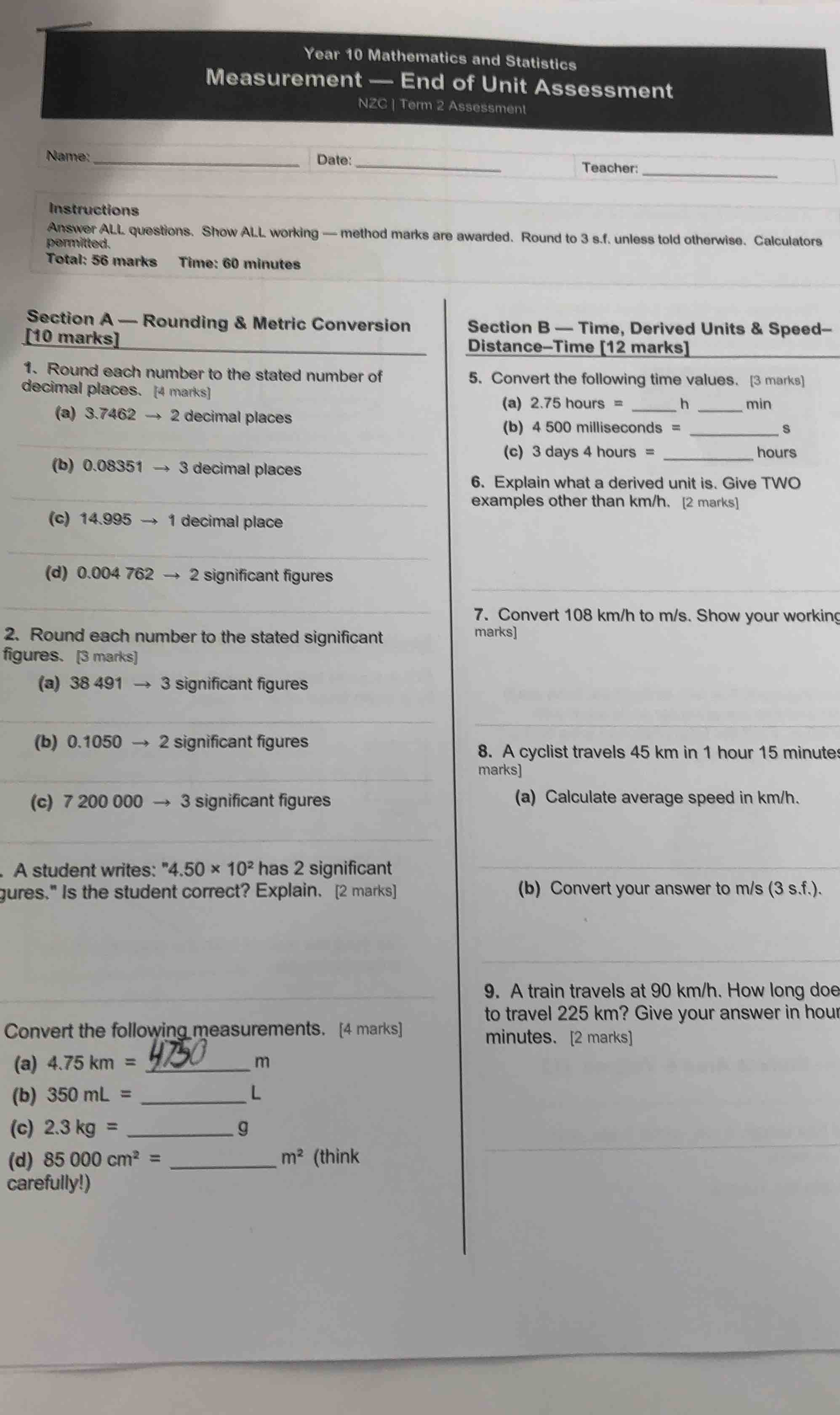
Question
year 10 mathematics and statistics
measurement - end of unit assessment
nzc | term 2 assessment
name:
date:
teacher:
instructions
answer all questions. show all working - method marks are awarded. round to 3 s.f. unless told otherwise. calculators permitted.
total: 56 marks time: 60 minutes
section a - rounding & metric conversion 10 marks
- round each number to the stated number of decimal places. 4 marks
(a) \\(3.7462 \
ightarrow\\) 2 decimal places
(b) \\(0.08351 \
ightarrow\\) 3 decimal places
(c) \\(14.995 \
ightarrow\\) 1 decimal place
(d) \\(0.004\\,762 \
ightarrow\\) 2 significant figures
- round each number to the stated significant figures. 3 marks
(a) \\(38\\,491 \
ightarrow\\) 3 significant figures
(b) \\(0.1050 \
ightarrow\\) 2 significant figures
(c) \\(7\\,200\\,000 \
ightarrow\\) 3 significant figures
- a student writes: \\\(4.50 \times 10^2\\) has 2 significant figures.\ is the student correct? explain. 2 marks
- convert the following measurements. 4 marks
(a) \\(4.75\text{ km} = 4750\text{ m}\\)
(b) \\(350\text{ ml} = \text{ l}\\)
(c) \\(2.3\text{ kg} = \text{ g}\\)
(d) \\(85\\,000\text{ cm}^2 = \text{ m}^2\\) (think carefully!)
section b - time, derived units & speed-distance-time 12 marks
- convert the following time values. 3 marks
(a) \\(2.75\text{ hours} = \text{ h } \text{ min}\\)
(b) \\(4\\,500\text{ milliseconds} = \text{ s}\\)
(c) 3 days 4 hours = \\(\text{ hours}\\)
- explain what a derived unit is. give two examples other than km/h. 2 marks
- convert \\(108\text{ km/h}\\) to m/s. show your working. 2 marks
- a cyclist travels 45 km in 1 hour 15 minutes. 3 marks
(a) calculate average speed in km/h.
(b) convert your answer to m/s (3 s.f.).
- a train travels at \\(90\text{ km/h}\\). how long does it take to travel 225 km? give your answer in hours and minutes. 2 marks
1. 数值四舍五入与有效数字保留
对 Section A 中的第 1、2、3 题进行计算:
- 1(a) \(3.7462\) 保留两位小数:看第三位小数 \(6 \ge 5\),进位得 \(3.75\)。
- 1(b) \(0.08351\) 保留三位小数:看第四位小数 \(5 \ge 5\),进位得 \(0.084\)。
- 1(c) \(14.995\) 保留一位小数:看第二位小数 \(9 \ge 5\),进位得 \(15.0\)。
- 1(d) \(0.004762\) 保留两位有效数字:从第一个非零数字 \(4\) 开始数,第二位是 \(7\),看第三位 \(6 \ge 5\),进位得 \(0.0048\)。
- 2(a) \(38491\) 保留三位有效数字:前三位是 \(3, 8, 4\),第四位 \(9 \ge 5\),进位得 \(38500\)。
- 2(b) \(0.1050\) 保留两位有效数字:从第一个非零数字 \(1\) 开始,第二位是 \(0\),第三位 \(5 \ge 5\),进位得 \(0.11\)。
- 2(c) \(7200000\) 保留三位有效数字:前三位是 \(7, 2, 0\),第四位是 \(0 < 5\),写成科学记数法或保持原样但明确有效位数,通常表示为 \(7.20 \times 10^6\)。
- 3 学生的说法不正确。\(4.50 \times 10^2\) 中,系数 \(4.50\) 的所有数字都是有效数字,因此有 3 位有效数字(末尾的 \(0\) 在小数部分是有意义的)。
2. 常用度量衡单位换算
对 Section A 中的第 4 题进行计算:
- 4(a) \(4.75\text{ km} = 4.75 \times 1000\text{ m} = 4750\text{ m}\)。
- 4(b) \(350\text{ mL} = 350 \div 1000\text{ L} = 0.35\text{ L}\)。
- 4(c) \(2.3\text{ kg} = 2.3 \times 1000\text{ g} = 2300\text{ g}\)。
- 4(d) 因为 \(1\text{ m} = 100\text{ cm}\),所以 \(1\text{ m}^2 = 10000\text{ cm}^2\)。\(85000\text{ cm}^2 = 85000 \div 10000\text{ m}^2 = 8.5\text{ m}^2\)。
3. 时间单位与导出单位换算
对 Section B 中的第 5、6、7 题进行计算:
- 5(a) \(2.75\text{ 小时} = 2\text{ 小时} + 0.75 \times 60\text{ 分钟} = 2\text{ 小时 } 45\text{ 分钟}\)。
- 5(b) \(4500\text{ 毫秒} = 4500 \div 1000\text{ 秒} = 4.5\text{ 秒}\)。
- 5(c) \(3\text{ 天 } 4\text{ 小时} = 3 \times 24 + 4 = 76\text{ 小时}\)。
- 6 导出单位是由基本单位(如米、千克、秒)通过乘或除的数学运算组合而成的单位。例如:\({\text{m/s}^2}\)(加速度)、\({\text{g/cm}^3}\)(密度)。
- 7 \(108\text{ km/h} = \frac{108 \times 1000\text{ m}}{3600\text{ s}} = 30\text{ m/s}\)。
4. 速度、路程与时间计算
对 Section B 中的第 8、9 题进行计算:
- 8(a) 时间 \(t = 1\text{ 小时 } 15\text{ 分钟} = 1.25\text{ 小时}\)。平均速度 \(v = \frac{45\text{ km}}{1.25\text{ h}} = 36\text{ km/h}\)。
- 8(b) 将 \(36\text{ km/h}\) 转换为 \(\text{m/s}\):\(36 \div 3.6 = 10\text{ m/s}\)。保留 3 位有效数字为 \(10.0\text{ m/s}\)。
- 9 时间 \(t = \frac{\text{路程}}{\text{速度}} = \frac{225\text{ km}}{90\text{ km/h}} = 2.5\text{ 小时}\)。转换成小时和分钟为 \(2\text{ 小时 } 30\text{ 分钟}\)。

Snap & solve any problem in the app
Get step-by-step solutions on Sovi AI
Photo-based solutions with guided steps
Explore more problems and detailed explanations
Section A — Rounding & Metric Conversion
Question 1
(a) \(3.75\)
(b) \(0.084\)
(c) \(15.0\)
(d) \(0.0048\)
Question 2
(a) \(38500\)
(b) \(0.11\)
(c) \(7.20 \times 10^6\)(或 \(7200000\),保留3位有效数字)
Question 3
不正确。因为在科学记数法中,系数 \(4.50\) 的所有数字都是有效的,末尾的 \(0\) 表示精确度,所以它有 3 位有效数字。
Question 4
(a) \(4750\text{ m}\)
(b) \(0.35\text{ L}\)
(c) \(2300\text{ g}\)
(d) \(8.5\text{ m}^2\)
---
Section B — Time, Derived Units & Speed-Distance-Time
Question 5
(a) \(2\text{ h } 45\text{ min}\)
(b) \(4.5\text{ s}\)
(c) \(76\text{ hours}\)
Question 6
导出单位是由两个或多个基本物理量单位组合而成的单位。
例如:\(\text{m/s}^2\)(加速度单位)、\(\text{g/cm}^3\)(密度单位)。
Question 7
Question 8
(a) \(36\text{ km/h}\)
(b) \(10.0\text{ m/s}\)
Question 9
\(2\text{ 小时 } 30\text{ 分钟}\)