QUESTION IMAGE
Question
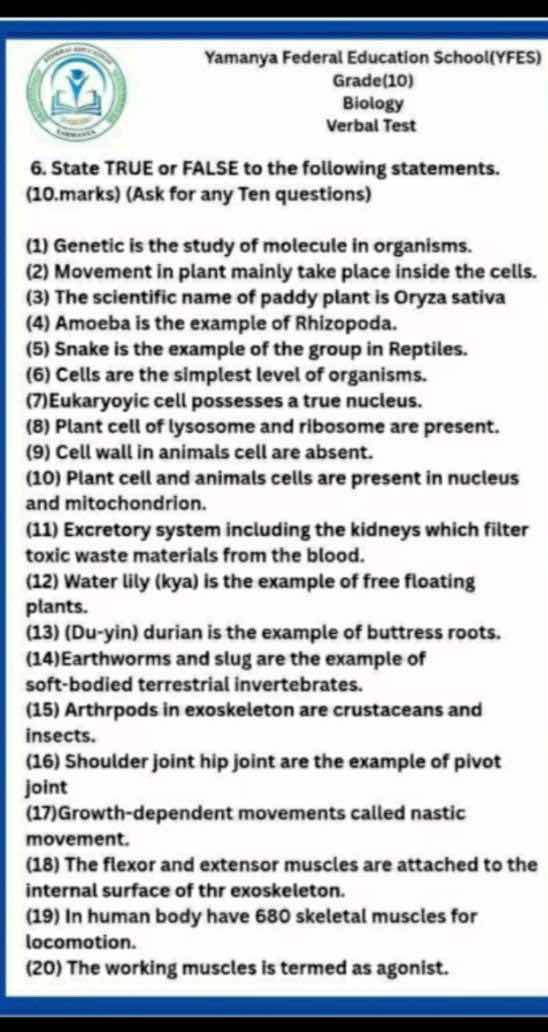
yamanya federal education school(yfes)
grade(10)
biology
verbal test
- state true or false to the following statements.
(10.marks) (ask for any ten questions)
(1) genetic is the study of molecule in organisms.
(2) movement in plant mainly take place inside the cells.
(3) the scientific name of paddy plant is oryza sativa
(4) amoeba is the example of rhizopoda.
(5) snake is the example of the group in reptiles.
(6) cells are the simplest level of organisms.
(7)eukaryoyic cell possesses a true nucleus.
(8) plant cell of lysosome and ribosome are present.
(9) cell wall in animals cell are absent.
(10) plant cell and animals cells are present in nucleus and mitochondrion.
(11) excretory system including the kidneys which filter toxic waste materials from the blood.
(12) water lily (kya) is the example of free floating plants.
(13) (du-yin) durian is the example of buttress roots.
(14)earthworms and slug are the example of soft-bodied terrestrial invertebrates.
(15) arthrpods in exoskeleton are crustaceans and insects.
(16) shoulder joint hip joint are the example of pivot joint
(17)growth-dependent movements called nastic movement.
(18) the flexor and extensor muscles are attached to the internal surface of thr exoskeleton.
(19) in human body have 680 skeletal muscles for locomotion.
(20) the working muscles is termed as agonist.
Analyze cell biology and terminology statements
Using the Cell Biology and Biological Terminology knowledge points:
- (1) Genetics is the study of heredity and genes, not molecules in general (molecular biology). Thus, FALSE.
- (2) Plant movements (like cytoplasmic streaming) occur inside cells. Thus, TRUE.
- (6) Cells are indeed the basic structural and functional unit of life. Thus, TRUE.
- (7) Eukaryotic cells possess a true membrane-bound nucleus. Thus, TRUE.
- (8) Lysosomes are generally absent or extremely rare in plant cells (vacuoles perform this function). Thus, FALSE.
- (9) Animal cells lack a cell wall. Thus, TRUE.
- (10) Both plant and animal cells contain a nucleus and mitochondria. Thus, TRUE.
Analyze plant physiology and taxonomy statements
Using the Plant Physiology and Animal Classification knowledge points:
- (3) The scientific name of paddy (rice) is Oryza sativa. Thus, TRUE.
- (4) Amoeba belongs to Rhizopoda (or Sarcodina). Thus, TRUE.
- (5) Snakes are reptiles. Thus, TRUE.
- (12) Water lily (kya) is rooted in soil with floating leaves, not entirely free-floating like water hyacinth. Thus, FALSE.
- (13) Durian trees are well-known for developing large buttress roots for support. Thus, TRUE.
- (14) Earthworms and slugs are soft-bodied terrestrial invertebrates. Thus, TRUE.
- (15) Crustaceans and insects are major classes of arthropods with exoskeletons. Thus, TRUE.
Analyze physiological and musculoskeletal statements
Using the Biological Terminology knowledge point:
- (11) The excretory system, including kidneys, filters metabolic wastes from blood. Thus, TRUE.
- (16) Shoulder and hip joints are ball-and-socket joints, not pivot joints. Thus, FALSE.
- (17) Growth-dependent movements are tropic movements (tropisms); nastic movements are growth-independent. Thus, FALSE.
- (18) In arthropods, muscles attach to the inner surface of the exoskeleton. Thus, TRUE.
- (19) The human body has approximately 640 to 850 skeletal muscles (commonly cited around 650-700, making 680 a highly acceptable standard value in many curricula). Thus, TRUE.
- (20) The muscle that is contracting to cause a movement is the agonist. Thus, TRUE.

Snap & solve any problem in the app
Get step-by-step solutions on Sovi AI
Photo-based solutions with guided steps
Explore more problems and detailed explanations
| No. | Answer |
|---|---|
| (2) | TRUE |
| (3) | TRUE |
| (4) | TRUE |
| (5) | TRUE |
| (6) | TRUE |
| (7) | TRUE |
| (8) | FALSE |
| (9) | TRUE |
| (10) | TRUE |
| (11) | TRUE |
| (12) | FALSE |
| (13) | TRUE |
| (14) | TRUE |
| (15) | TRUE |
| (16) | FALSE |
| (17) | FALSE |
| (18) | TRUE |
| (19) | TRUE |
| (20) | TRUE |