QUESTION IMAGE
Question
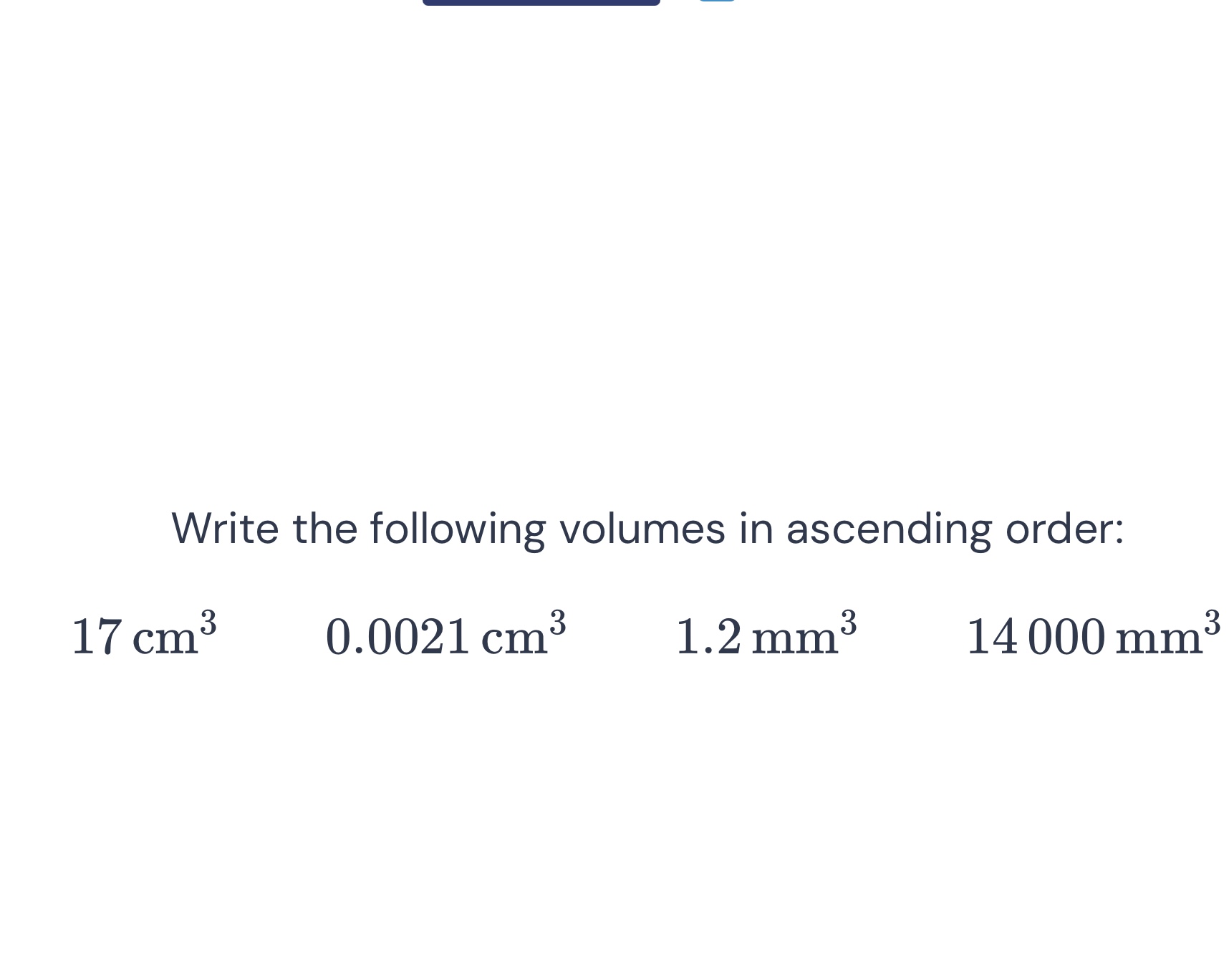
write the following volumes in ascending order:
\\(17\text{ cm}^3\\) \\(0.0021\text{ cm}^3\\) \\(1.2\text{ mm}^3\\) \\(14\\,000\text{ mm}^3\\)
🆕 New Concept Discovered: Converting Cubic Units
Converting volume units requires cubing the linear conversion factor.
Step 1: Identify the conversion factor
To compare the volumes, we need to convert them all to the same unit. Let's convert everything to cubic millimeters (\(\text{mm}^3\)).
We know the linear relationship between centimeters and millimeters:
Since volume is three-dimensional, we cube this conversion factor to convert cubic units:
This means to convert from \(\text{cm}^3\) to \(\text{mm}^3\), we multiply by \(1000\).
Step 2: Convert all values to cubic millimeters
Now, we convert each value given in \(\text{cm}^3\) into \(\text{mm}^3\):
- First value: \(17\text{ cm}^3\)
- Second value: \(0.0021\text{ cm}^3\)
- Third value: \(1.2\text{ mm}^3\) (already in \(\text{mm}^3\))
- Fourth value: \(14\,000\text{ mm}^3\) (already in \(\text{mm}^3\))
Step 3: Order the values from smallest to largest
Now we compare the values in \(\text{mm}^3\):
Replacing them with their original forms:
- \(1.2\text{ mm}^3\)
- \(0.0021\text{ cm}^3\) (which is \(2.1\text{ mm}^3\))
- \(14\,000\text{ mm}^3\)
- \(17\text{ cm}^3\) (which is \(17\,000\text{ mm}^3\))

Snap & solve any problem in the app
Get step-by-step solutions on Sovi AI
Photo-based solutions with guided steps
Explore more problems and detailed explanations