QUESTION IMAGE
Question
write the equation of the polynomial below.
write the equation of the polynomial by writing all the factors:
\\(p(x) = \\)
⚡ Using what you learned: Zeros and Multiplicity
Step 1: Identify the zeros and their multiplicities
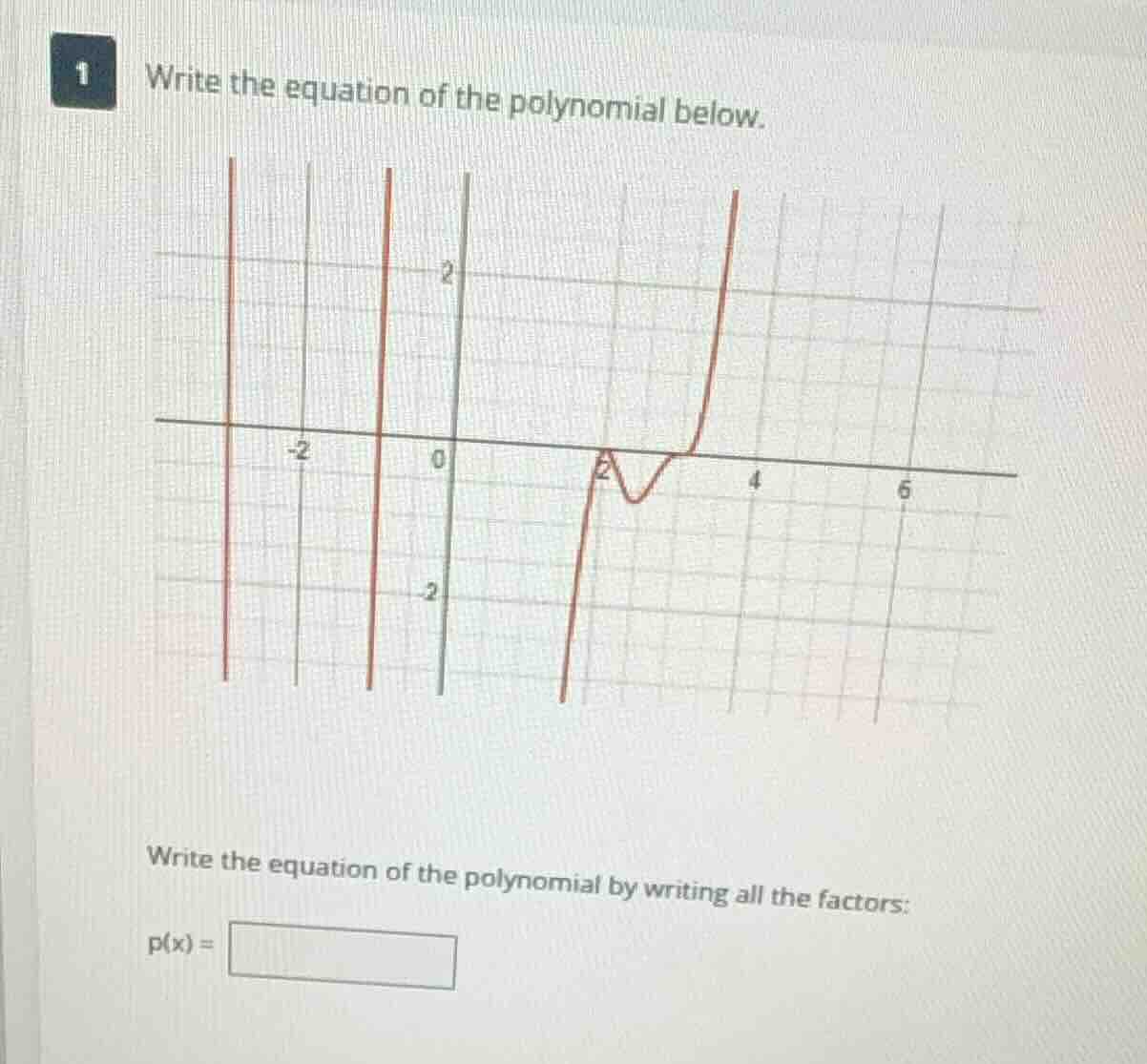
From the graph, we observe the behavior of the polynomial \( p(x) \) at its \( x \)-intercepts (zeros):
- At \( x = 2 \), the graph touches the \( x \)-axis and turns around. This indicates a zero of even multiplicity, typically \( 2 \).
- Factor: \( (x - 2)^2 \)
- At \( x = 3 \), the graph crosses the \( x \)-axis while flattening out (inflection point). This indicates a zero of odd multiplicity greater than 1, typically \( 3 \).
- Factor: \( (x - 3)^3 \)
Step 2: Identify the vertical asymptotes
The graph has vertical asymptotes, which means this is a rational function rather than a standard polynomial. Let's identify the locations of these vertical asymptotes:
- There is a vertical asymptote at \( x = -3 \).
- Factor in the denominator: \( (x + 3) \)
- There is a vertical asymptote at \( x = -1 \).
- Factor in the denominator: \( (x + 1) \)
Since the graph goes in opposite directions on either side of each asymptote (from \( -\infty \) to \( +\infty \)), these asymptotes have an odd multiplicity, typically \( 1 \).
Step 3: Write the general form of the function
Combining the factors of the numerator (zeros) and the denominator (asymptotes):
Step 4: Determine the leading coefficient
Let's find a clear point on the graph to determine the constant \( a \).
Looking at the \( y \)-intercept where \( x = 0 \):
The graph passes through \( (0, 12) \). Let's substitute \( x = 0 \) and \( p(0) = 12 \) into our equation:
Step 5: Write the final equation
Substituting \( a = -\frac{1}{3} \) back into the function:

Snap & solve any problem in the app
Get step-by-step solutions on Sovi AI
Photo-based solutions with guided steps
Explore more problems and detailed explanations