QUESTION IMAGE
Question
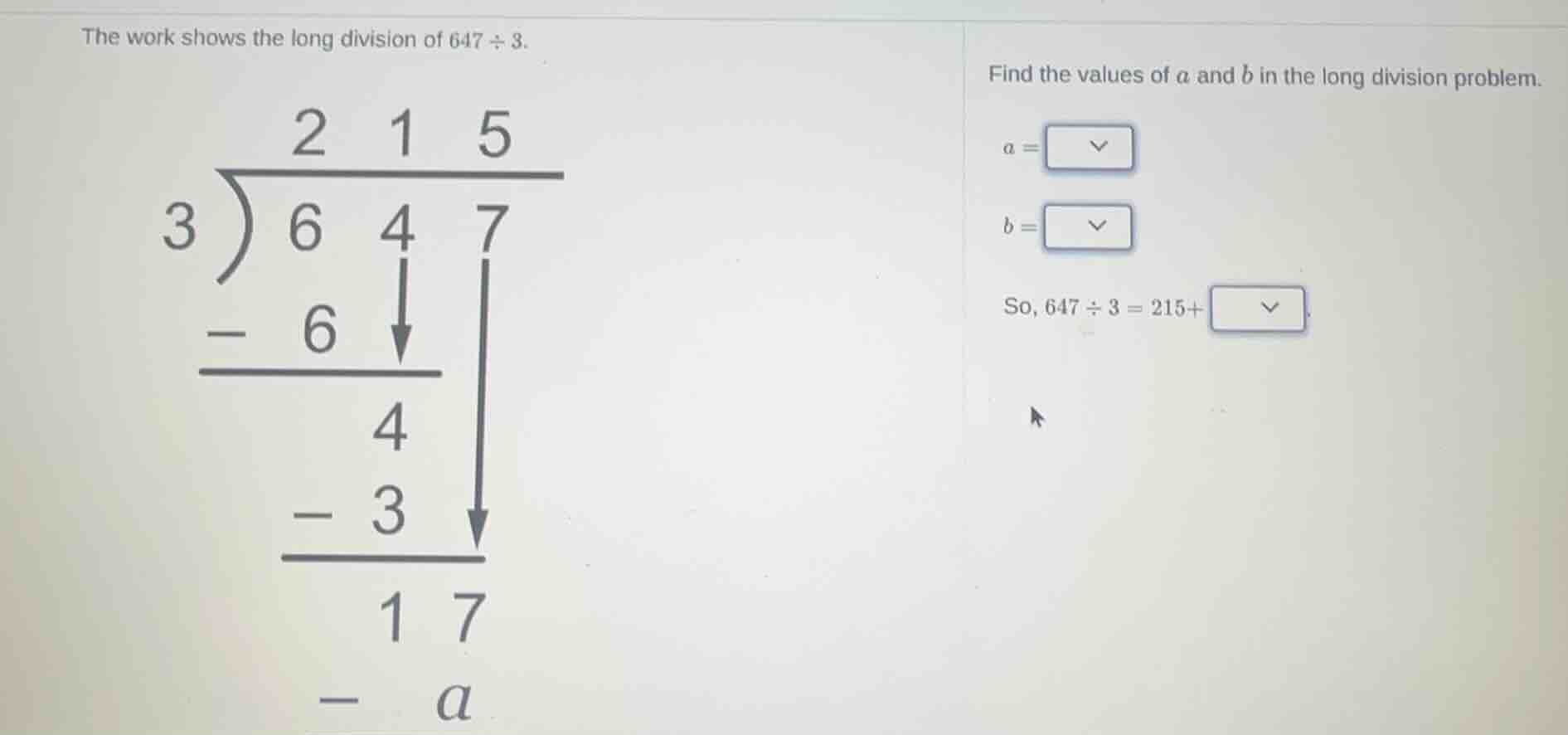
the work shows the long division of \\(647 \div 3\\).
find the values of \\(a\\) and \\(b\\) in the long division problem.
\\(a = \\)
\\(b = \\)
so, \\(647 \div 3 = 215 + \\)
<pre_analysis>
{
"quality": "clear",
"question_count": 1,
"skills_matched": [
"step_cot",
"blank_filling_formatter",
"explain_then_answer",
"tutor"
],
"needs_drawing": false,
"concepts_used": [],
"new_concepts": [
"Long Division Algorithm",
"Division with Remainders"
],
"current_concepts": [
"Long Division Algorithm",
"Division with Remainders"
]
}
</pre_analysis>
<reasoning>
Analyze the final step of long division
To find the value of \(a\), we look at the last division step. We are dividing \(17\) by the divisor \(3\). The quotient digit above this step is \(5\). We multiply the divisor by this quotient digit:
\[
3 \times 5 = 15
\]
Thus, the value subtracted from \(17\) is \(a = 15\).
Calculate the remainder
To find the value of \(b\), which represents the remainder of the division, we subtract \(a\) from \(17\):
\[
b = 17 - a = 17 - 15 = 2
\]
Thus, the remainder is \(b = 2\).
Express the division with a fractional remainder
The division of \(647\) by \(3\) yields a quotient of \(215\) and a remainder of \(2\). We write this as:
\[
647 \div 3 = 215 + \frac{2}{3}
\]
Thus, the missing term in the equation is \(\frac{2}{3}\).
</reasoning>
<answer>
Find the values of \(a\) and \(b\) in the long division problem.
\(a =\) <blank>15</blank>
\(b =\) <blank>2</blank>
So, \(647 \div 3 = 215+\) <blank>\(\frac{2}{3}\)</blank>
</answer>
<post_analysis>
{
"subject": "Mathematics",
"question_type": "Fill-in-the-blank",
"knowledge_point": [
"Mathematics",
"Arithmetic",
"Long Division"
]
}
</post_analysis>
Snap & solve any problem in the app
Get step-by-step solutions on Sovi AI
Photo-based solutions with guided steps
Explore more problems and detailed explanations
<pre_analysis>
{
"quality": "clear",
"question_count": 1,
"skills_matched": [
"step_cot",
"blank_filling_formatter",
"explain_then_answer",
"tutor"
],
"needs_drawing": false,
"concepts_used": [],
"new_concepts": [
"Long Division Algorithm",
"Division with Remainders"
],
"current_concepts": [
"Long Division Algorithm",
"Division with Remainders"
]
}
</pre_analysis>
<reasoning>
Analyze the final step of long division
To find the value of \(a\), we look at the last division step. We are dividing \(17\) by the divisor \(3\). The quotient digit above this step is \(5\). We multiply the divisor by this quotient digit:
\[
3 \times 5 = 15
\]
Thus, the value subtracted from \(17\) is \(a = 15\).
Calculate the remainder
To find the value of \(b\), which represents the remainder of the division, we subtract \(a\) from \(17\):
\[
b = 17 - a = 17 - 15 = 2
\]
Thus, the remainder is \(b = 2\).
Express the division with a fractional remainder
The division of \(647\) by \(3\) yields a quotient of \(215\) and a remainder of \(2\). We write this as:
\[
647 \div 3 = 215 + \frac{2}{3}
\]
Thus, the missing term in the equation is \(\frac{2}{3}\).
</reasoning>
<answer>
Find the values of \(a\) and \(b\) in the long division problem.
\(a =\) <blank>15</blank>
\(b =\) <blank>2</blank>
So, \(647 \div 3 = 215+\) <blank>\(\frac{2}{3}\)</blank>
</answer>
<post_analysis>
{
"subject": "Mathematics",
"question_type": "Fill-in-the-blank",
"knowledge_point": [
"Mathematics",
"Arithmetic",
"Long Division"
]
}
</post_analysis>