QUESTION IMAGE
Question
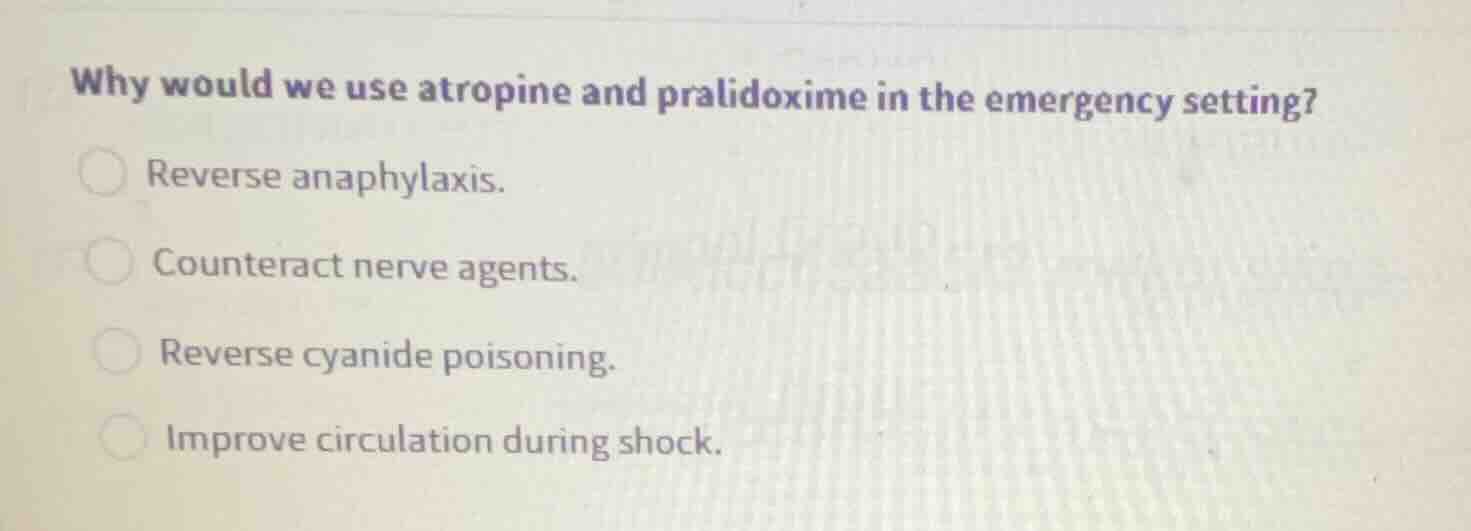
why would we use atropine and pralidoxime in the emergency setting?
reverse anaphylaxis.
counteract nerve agents.
reverse cyanide poisoning.
improve circulation during shock.
Identify the clinical indications of the medications
Atropine and pralidoxime chloride (2-PAM) are administered together, often via an auto-injector kit like the Mark I NAAK or DuoDote, in emergency medicine. We need to determine which specific toxicological emergency or clinical condition these two drugs are designed to treat.
Analyze the mechanism of action
Using the Toxicological Emergencies knowledge point:
- Atropine is an anticholinergic drug that blocks acetylcholine receptors, counteracting excess acetylcholine.
- Pralidoxime reactivates acetylcholinesterase, the enzyme responsible for breaking down acetylcholine.
- Together, they reverse the life-threatening cholinergic crisis caused by organophosphates and nerve agents (such as sarin, soman, or VX).
Evaluate the given options
- Reverse anaphylaxis: Epinephrine is the primary treatment, not atropine/pralidoxime.
- Counteract nerve agents: This matches the combined mechanism of atropine and pralidoxime.
- Reverse cyanide poisoning: Treated with hydroxocobalamin or a cyanide antidote kit (amyl nitrite, sodium nitrite, sodium thiosulfate).
- Improve circulation during shock: Treated with fluids, vasopressors, or epinephrine depending on the type of shock.

Snap & solve any problem in the app
Get step-by-step solutions on Sovi AI
Photo-based solutions with guided steps
Explore more problems and detailed explanations
- Reverse anaphylaxis.
- Counteract nerve agents. (Correct answer)
- Reverse cyanide poisoning.
- Improve circulation during shock.