QUESTION IMAGE
Question
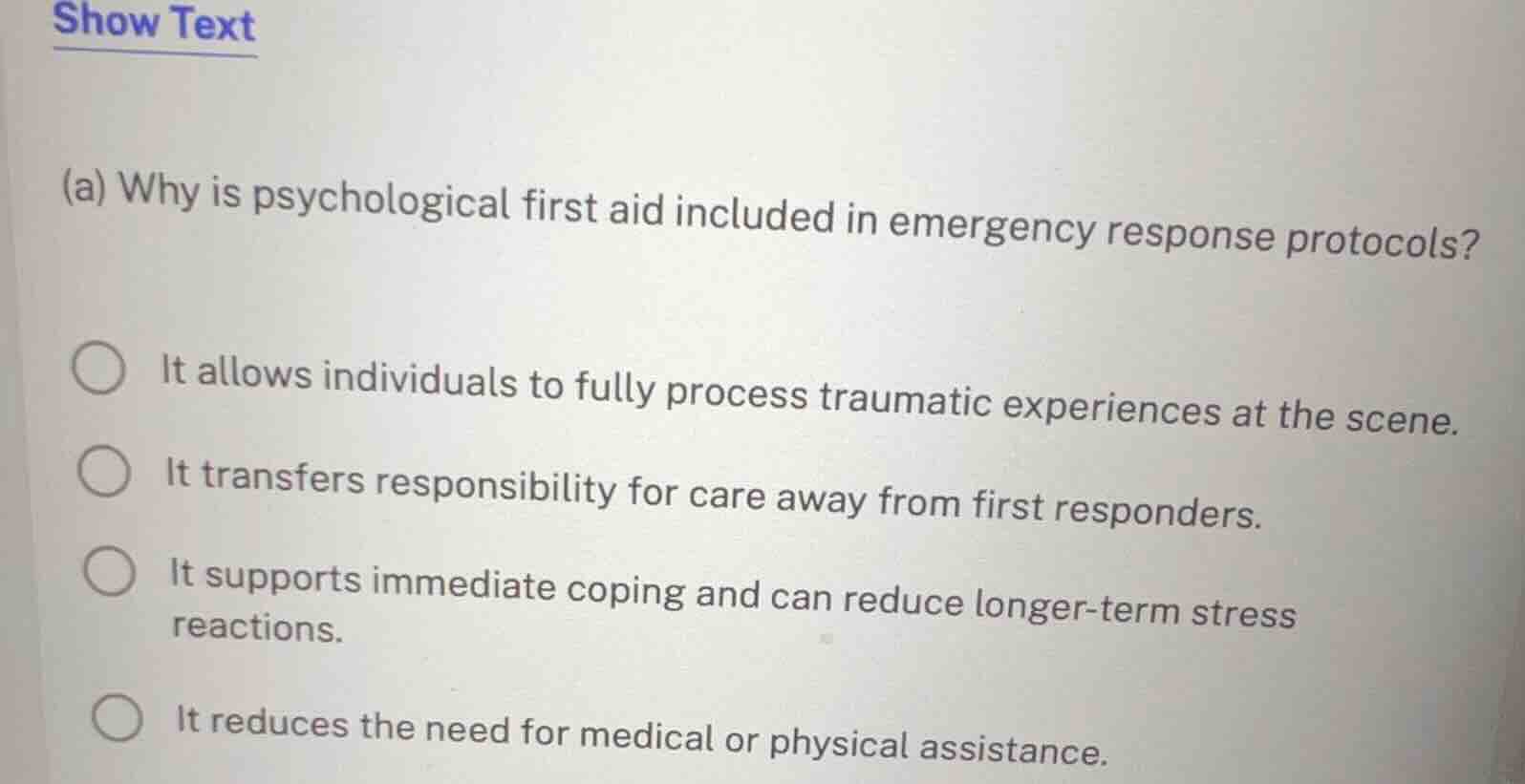
(a) why is psychological first aid included in emergency response protocols?
it allows individuals to fully process traumatic experiences at the scene.
it transfers responsibility for care away from first responders.
it supports immediate coping and can reduce longer-term stress reactions.
it reduces the need for medical or physical assistance.
<pre_analysis>
{
"quality": "clear",
"question_count": 1,
"skills_matched": [
"direct_cot",
"multiple_choice_formatter",
"explain_then_answer",
"tutor",
"mastery_adaptive_brevity"
],
"needs_drawing": false,
"concepts_used": [
"Psychological First Aid",
"Emergency Response Protocols"
],
"new_concepts": [],
"current_concepts": [
"Psychological First Aid",
"Emergency Response Protocols",
"Coping Mechanisms"
]
}
</pre_analysis>
<reasoning>
Define the purpose of psychological first aid
Using the Psychological First Aid and Emergency Response Protocols knowledge points
- Psychological First Aid (PFA) is designed to reduce the initial distress caused by traumatic events.
- It fosters short- and long-term adaptive functioning and coping.
Evaluate the given options
Using the Coping Mechanisms knowledge point
- Option 1: Processing trauma fully at the scene is unrealistic and not the goal of immediate crisis intervention.
- Option 2: PFA does not shift responsibility away from first responders; it is a tool they often use.
- Option 3: Supporting immediate coping and reducing long-term stress reactions directly matches the core objective of PFA.
- Option 4: PFA does not replace or reduce the need for necessary medical or physical assistance.
</reasoning>
<answer>
<mcq-option>(A) It allows individuals to fully process traumatic experiences at the scene.</mcq-option>
<mcq-option>(B) It transfers responsibility for care away from first responders.</mcq-option>
<mcq-correct>(C) It supports immediate coping and can reduce longer-term stress reactions.</mcq-correct>
<mcq-option>(D) It reduces the need for medical or physical assistance.</mcq-option>
</answer>
<post_analysis>
{
"subject": "Social Science",
"question_type": "Multiple Choice",
"knowledge_point": [
"Social Science",
"Psychology",
"Psychological First Aid"
]
}
</post_analysis>
Snap & solve any problem in the app
Get step-by-step solutions on Sovi AI
Photo-based solutions with guided steps
Explore more problems and detailed explanations
<pre_analysis>
{
"quality": "clear",
"question_count": 1,
"skills_matched": [
"direct_cot",
"multiple_choice_formatter",
"explain_then_answer",
"tutor",
"mastery_adaptive_brevity"
],
"needs_drawing": false,
"concepts_used": [
"Psychological First Aid",
"Emergency Response Protocols"
],
"new_concepts": [],
"current_concepts": [
"Psychological First Aid",
"Emergency Response Protocols",
"Coping Mechanisms"
]
}
</pre_analysis>
<reasoning>
Define the purpose of psychological first aid
Using the Psychological First Aid and Emergency Response Protocols knowledge points
- Psychological First Aid (PFA) is designed to reduce the initial distress caused by traumatic events.
- It fosters short- and long-term adaptive functioning and coping.
Evaluate the given options
Using the Coping Mechanisms knowledge point
- Option 1: Processing trauma fully at the scene is unrealistic and not the goal of immediate crisis intervention.
- Option 2: PFA does not shift responsibility away from first responders; it is a tool they often use.
- Option 3: Supporting immediate coping and reducing long-term stress reactions directly matches the core objective of PFA.
- Option 4: PFA does not replace or reduce the need for necessary medical or physical assistance.
</reasoning>
<answer>
<mcq-option>(A) It allows individuals to fully process traumatic experiences at the scene.</mcq-option>
<mcq-option>(B) It transfers responsibility for care away from first responders.</mcq-option>
<mcq-correct>(C) It supports immediate coping and can reduce longer-term stress reactions.</mcq-correct>
<mcq-option>(D) It reduces the need for medical or physical assistance.</mcq-option>
</answer>
<post_analysis>
{
"subject": "Social Science",
"question_type": "Multiple Choice",
"knowledge_point": [
"Social Science",
"Psychology",
"Psychological First Aid"
]
}
</post_analysis>