Sovi.AI - AI Math Tutor

Scan to solve math questions

QUESTION IMAGE

why should at least one family member stay with a geriatric patient dur…

Question

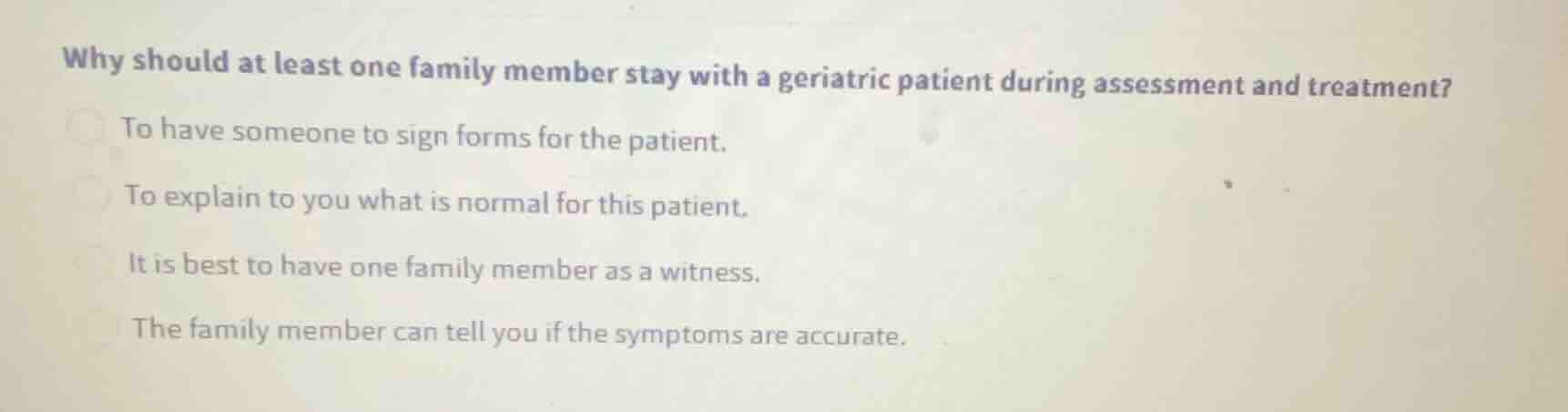
why should at least one family member stay with a geriatric patient during assessment and treatment?

to have someone to sign forms for the patient.
to explain to you what is normal for this patient.
it is best to have one family member as a witness.
the family member can tell you if the symptoms are accurate.

Explanation:

Response

<pre_analysis>
{
"quality": "clear",
"question_count": 1,
"skills_matched": [
"direct_cot",
"multiple_choice_formatter",
"explain_then_answer",
"tutor"
],
"needs_drawing": false,
"concepts_used": [
"Medical History Taking"
],
"new_concepts": [
"Geriatric Patient Assessment",
"Baseline Mental Status"
],
"current_concepts": [
"Medical History Taking",
"Geriatric Patient Assessment",
"Baseline Mental Status"
]
}
</pre_analysis>

<reasoning>

Identify the clinical challenge in geriatric assessment

Geriatric patients often present with complex medical histories, chronic conditions, and baseline cognitive or sensory impairments. When assessing these patients, determining their baseline mental status and normal physical capabilities is critical to identifying acute changes.

Evaluate the role of family members

Using Medical History Taking principles, a family member or primary caregiver is invaluable because they know the patient's daily baseline. They can immediately clarify whether a finding (such as confusion, slurred speech, or weakness) is a chronic condition or a new, acute development.

Analyze the given options

  • To have someone to sign forms for the patient: While administrative tasks are important, they are not the primary clinical reason for assessment and treatment.
  • To explain to you what is normal for this patient: This is correct. Family members provide crucial baseline information to help differentiate chronic issues from acute emergencies.
  • It is best to have one family member as a witness: Legal protection is a secondary concern, not the primary clinical objective.
  • The family member can tell you if the symptoms are accurate: Symptoms are subjective experiences of the patient; a family member cannot validate the accuracy of what the patient feels, but they can identify changes from baseline.

</reasoning>

<answer>
<mcq-option>To have someone to sign forms for the patient.</mcq-option>
<mcq-correct>To explain to you what is normal for this patient.</mcq-correct>
<mcq-option>It is best to have one family member as a witness.</mcq-option>
<mcq-option>The family member can tell you if the symptoms are accurate.</mcq-option>
</answer>

<post_analysis>
{
"subject": "Natural Science",
"question_type": "Multiple Choice",
"knowledge_point": [
"Natural Science",
"Medicine and Health",
"Geriatric Patient Assessment"
]
}
</post_analysis>

Answer:

<pre_analysis>
{
"quality": "clear",
"question_count": 1,
"skills_matched": [
"direct_cot",
"multiple_choice_formatter",
"explain_then_answer",
"tutor"
],
"needs_drawing": false,
"concepts_used": [
"Medical History Taking"
],
"new_concepts": [
"Geriatric Patient Assessment",
"Baseline Mental Status"
],
"current_concepts": [
"Medical History Taking",
"Geriatric Patient Assessment",
"Baseline Mental Status"
]
}
</pre_analysis>

<reasoning>

Identify the clinical challenge in geriatric assessment

Geriatric patients often present with complex medical histories, chronic conditions, and baseline cognitive or sensory impairments. When assessing these patients, determining their baseline mental status and normal physical capabilities is critical to identifying acute changes.

Evaluate the role of family members

Using Medical History Taking principles, a family member or primary caregiver is invaluable because they know the patient's daily baseline. They can immediately clarify whether a finding (such as confusion, slurred speech, or weakness) is a chronic condition or a new, acute development.

Analyze the given options

  • To have someone to sign forms for the patient: While administrative tasks are important, they are not the primary clinical reason for assessment and treatment.
  • To explain to you what is normal for this patient: This is correct. Family members provide crucial baseline information to help differentiate chronic issues from acute emergencies.
  • It is best to have one family member as a witness: Legal protection is a secondary concern, not the primary clinical objective.
  • The family member can tell you if the symptoms are accurate: Symptoms are subjective experiences of the patient; a family member cannot validate the accuracy of what the patient feels, but they can identify changes from baseline.

</reasoning>

<answer>
<mcq-option>To have someone to sign forms for the patient.</mcq-option>
<mcq-correct>To explain to you what is normal for this patient.</mcq-correct>
<mcq-option>It is best to have one family member as a witness.</mcq-option>
<mcq-option>The family member can tell you if the symptoms are accurate.</mcq-option>
</answer>

<post_analysis>
{
"subject": "Natural Science",
"question_type": "Multiple Choice",
"knowledge_point": [
"Natural Science",
"Medicine and Health",
"Geriatric Patient Assessment"
]
}
</post_analysis>