QUESTION IMAGE
Question
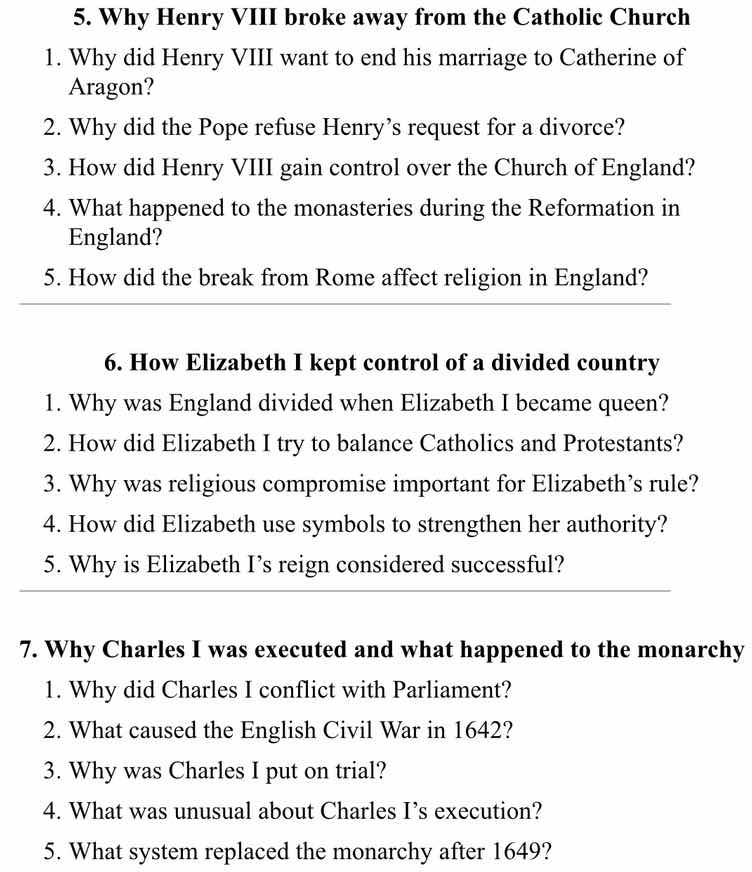
- why henry viii broke away from the catholic church
- why did henry viii want to end his marriage to catherine of aragon?
- why did the pope refuse henrys request for a divorce?
- how did henry viii gain control over the church of england?
- what happened to the monasteries during the reformation in england?
- how did the break from rome affect religion in england?
- how elizabeth i kept control of a divided country
- why was england divided when elizabeth i became queen?
- how did elizabeth i try to balance catholics and protestants?
- why was religious compromise important for elizabeths rule?
- how did elizabeth use symbols to strengthen her authority?
- why is elizabeth is reign considered successful?
- why charles i was executed and what happened to the monarchy
- why did charles i conflict with parliament?
- what caused the english civil war in 1642?
- why was charles i put on trial?
- what was unusual about charles is execution?
- what system replaced the monarchy after 1649?
Henry VIII and the Break from Rome
Using the English Reformation knowledge point
- Henry VIII needed a male heir to secure the Tudor succession, which Catherine of Aragon could not provide, prompting him to seek an annulment.
- Pope Clement VII refused the annulment due to political pressure from Catherine's nephew, Holy Roman Emperor Charles V.
- Henry passed the Act of Supremacy (1534), declaring himself the Supreme Head of the Church of England.
- He dissolved the monasteries, seizing their wealth and lands to enrich the crown and secure political loyalty.
- The break established a national church, shifting religious authority from Rome to the English monarch.
Elizabeth I and Religious Settlement
Using the Elizabethan Settlement knowledge point
- England was deeply divided between Catholics and Protestants following the reigns of Edward VI and Mary I.
- Elizabeth established a "Middle Way" via the Act of Supremacy and Act of Uniformity (1559) to appease both sides.
- Religious compromise was vital to prevent civil war, foreign invasion, and domestic rebellion.
- She used portraits, royal progresses, and the image of the "Virgin Queen" to build national unity and authority.
- Her reign is considered successful because she brought long-term stability, defeated the Spanish Armada, and fostered a golden age.
Charles I and the English Civil War
Using the English Civil War knowledge point
- Charles I clashed with Parliament over taxation, royal prerogative, and his high-church religious policies.
- The war in 1642 was triggered by Charles's attempt to arrest five MPs and his refusal to share military control.
- Charles was tried for high treason against his own people after refusing to compromise following his military defeat.
- His execution was unprecedented because a reigning monarch was publicly tried and beheaded by his own Parliament.
- The monarchy was replaced by a republic known as the Commonwealth, led eventually by Oliver Cromwell as Lord Protector.

Snap & solve any problem in the app
Get step-by-step solutions on Sovi AI
Photo-based solutions with guided steps
Explore more problems and detailed explanations
Question 5: Why Henry VIII broke away from the Catholic Church
- Why did Henry VIII want to end his marriage to Catherine of Aragon?
Henry VIII wanted to secure a male heir to ensure the Tudor succession, which Catherine of Aragon had been unable to provide, and he had fallen in love with Anne Boleyn.
- Why did the Pope refuse Henry’s request for a divorce?
Pope Clement VII was under the military and political control of Holy Roman Emperor Charles V, who was Catherine of Aragon's nephew and strongly opposed the annulment.
- How did Henry VIII gain control over the Church of England?
Henry used Parliament to pass a series of laws, culminating in the Act of Supremacy in 1534, which declared the king to be the Supreme Head of the Church of England.
- What happened to the monasteries during the Reformation in England?
Henry dissolved the monasteries, closed them down, confiscated their vast lands and wealth, and sold or gifted them to the English gentry to secure their loyalty.
- How did the break from Rome affect religion in England?
It ended papal authority in England, established a national Protestant church, and initiated decades of religious instability and shifting doctrines between Protestantism and Catholicism.
---
Question 6: How Elizabeth I kept control of a divided country
- Why was England divided when Elizabeth I became queen?
The country was deeply fractured by the extreme religious swings of the previous reigns: the radical Protestantism of Edward VI and the violent Catholic restoration under Mary I.
- How did Elizabeth I try to balance Catholics and Protestants?
She established the Elizabethan Religious Settlement of 1559, which created a Protestant church structure but retained some traditional Catholic rituals and appearances.
- Why was religious compromise important for Elizabeth’s rule?
Compromise was essential to maintain domestic peace, prevent religious civil war, and present a united front against hostile Catholic powers like Spain and France.
- How did Elizabeth use symbols to strengthen her authority?
She carefully managed her public image through symbolic portraits, royal progresses across the country, and promoting herself as the "Virgin Queen" dedicated entirely to her nation.
- Why is Elizabeth I’s reign considered successful?
She brought political and religious stability to England, successfully defended the realm against the Spanish Armada, and presided over a flourishing cultural golden age.
---
Question 7: Why Charles I was executed and what happened to the monarchy
- Why did Charles I conflict with Parliament?
Charles believed in the Divine Right of Kings, ruled without Parliament for eleven years ("Personal Rule"), and raised taxes without parliamentary consent.
- What caused the English Civil War in 1642?
The war was caused by deep religious tensions, Charles's attempt to arrest five members of Parliament, and a fundamental struggle over who held ultimate authority in England.
- Why was Charles I put on trial?
After his defeat in the civil wars, Charles refused to negotiate in good faith and secretly plotted with foreign powers and the Scots to start a second war against Parliament.
- What was unusual about Charles I’s execution?
It was the first time in European history that a reigning monarch was put on trial, found guilty of treason against his own subjects, and publicly executed by his own government.
- What system replaced the monarchy after 1649?
The monarchy was abolished and replaced by a republic called the Commonwealth of England, which later became a military dictatorship under Oliver Cromwell as Lord Protector.