QUESTION IMAGE
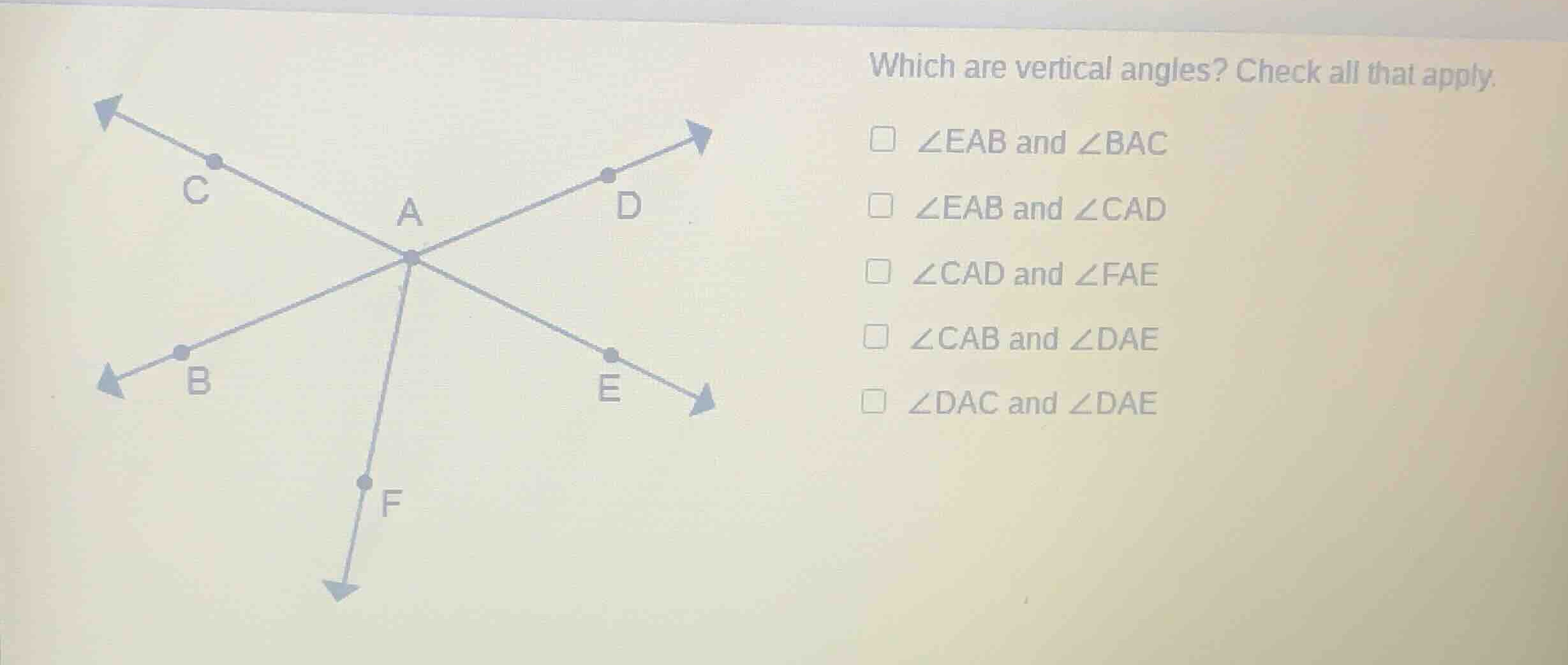
Question
which are vertical angles? check all that apply.
\\(\angle eab\\) and \\(\angle bac\\)
\\(\angle eab\\) and \\(\angle cad\\)
\\(\angle cad\\) and \\(\angle fae\\)
\\(\angle cab\\) and \\(\angle dae\\)
\\(\angle dac\\) and \\(\angle dae\\)
Identify intersecting lines
To find vertical angles, we look for two straight lines that intersect at a single point. In the given diagram, lines \(CE\) and \(BD\) intersect at point \(A\). The ray \(AF\) is an extra ray and does not form a continuous straight line through \(A\).
Define vertical angles
Vertical angles are pairs of opposite angles formed by intersecting lines. They share a common vertex and their sides form two pairs of opposite rays.
Analyze each option
- \(\angle EAB\) and \(\angle BAC\): These angles share the ray \(AB\) and are adjacent, not vertical.
- \(\angle EAB\) and \(\angle CAD\): The sides of \(\angle EAB\) are rays \(AE\) and \(AB\). The sides of \(\angle CAD\) are rays \(AC\) and \(AD\). Since ray \(AC\) is opposite to ray \(AE\), and ray \(AD\) is opposite to ray \(AB\), these two angles are opposite each other formed by the intersection of lines \(CE\) and \(BD\). Thus, they are vertical angles.
- \(\angle CAD\) and \(\angle FAE\): Ray \(AF\) is not opposite to ray \(AC\) or \(AD\). These are not vertical angles.
- \(\angle CAB\) and \(\angle DAE\): The sides of \(\angle CAB\) are rays \(AC\) and \(AB\). The sides of \(\angle DAE\) are rays \(AD\) and \(AE\). Since ray \(AD\) is opposite to ray \(AB\), and ray \(AE\) is opposite to ray \(AC\), these two angles are opposite each other formed by the intersecting lines. Thus, they are vertical angles.
- \(\angle DAC\) and \(\angle DAE\): These angles share the ray \(AD\) and are adjacent, not vertical.

Snap & solve any problem in the app
Get step-by-step solutions on Sovi AI
Photo-based solutions with guided steps
Explore more problems and detailed explanations
- \(\angle EAB\) and \(\angle BAC\)
- \(\angle EAB\) and \(\angle CAD\) (Correct answer)
- \(\angle CAD\) and \(\angle FAE\)
- \(\angle CAB\) and \(\angle DAE\) (Correct answer)
- \(\angle DAC\) and \(\angle DAE\)