QUESTION IMAGE
Question
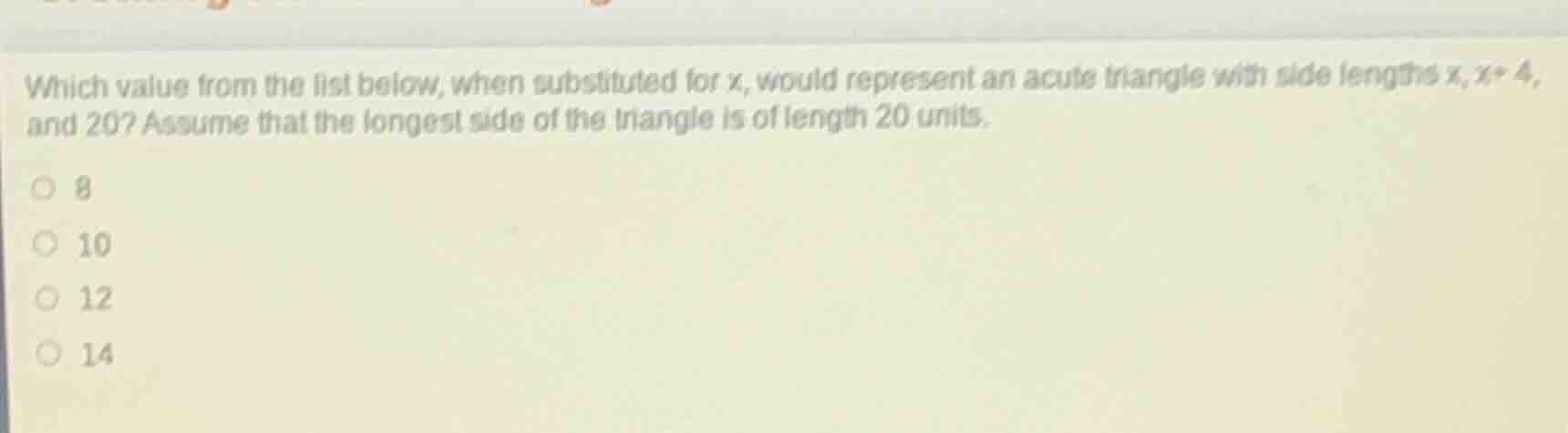
which value from the list below, when substituted for x, would represent an acute triangle with side lengths x, x + 4, and 20? assume that the longest side of the triangle is of length 20 units. 8 10 12 14
Step1: Apply triangle inequality
For sides $x$, $x+4$, 20 (longest side), the sum of the two shorter sides must exceed the longest side:
$x + (x+4) > 20$
Simplify: $2x + 4 > 20 \implies 2x > 16 \implies x > 8$
Step2: Apply acute triangle condition
For an acute triangle with longest side $c$, $a^2 + b^2 > c^2$. Here $a=x$, $b=x+4$, $c=20$:
$x^2 + (x+4)^2 > 20^2$
Expand: $x^2 + x^2 + 8x + 16 > 400$
Simplify: $2x^2 + 8x - 384 > 0 \implies x^2 + 4x - 192 > 0$
Solve quadratic equation $x^2 + 4x - 192 = 0$ using quadratic formula $x=\frac{-b\pm\sqrt{b^2-4ac}}{2a}$ where $a=1$, $b=4$, $c=-192$:
$$x=\frac{-4\pm\sqrt{16 + 768}}{2}=\frac{-4\pm\sqrt{784}}{2}=\frac{-4\pm28}{2}$$
Take positive root: $x=\frac{24}{2}=12$
So $x > 12$ (since the quadratic opens upwards, the inequality holds for $x>12$)
Step3: Ensure 20 is longest side
$x+4 \leq 20 \implies x \leq 16$
Step4: Match with options
From $12 < x \leq 16$, the only valid option is 14.

Snap & solve any problem in the app
Get step-by-step solutions on Sovi AI
Photo-based solutions with guided steps
Explore more problems and detailed explanations
14