QUESTION IMAGE
Question
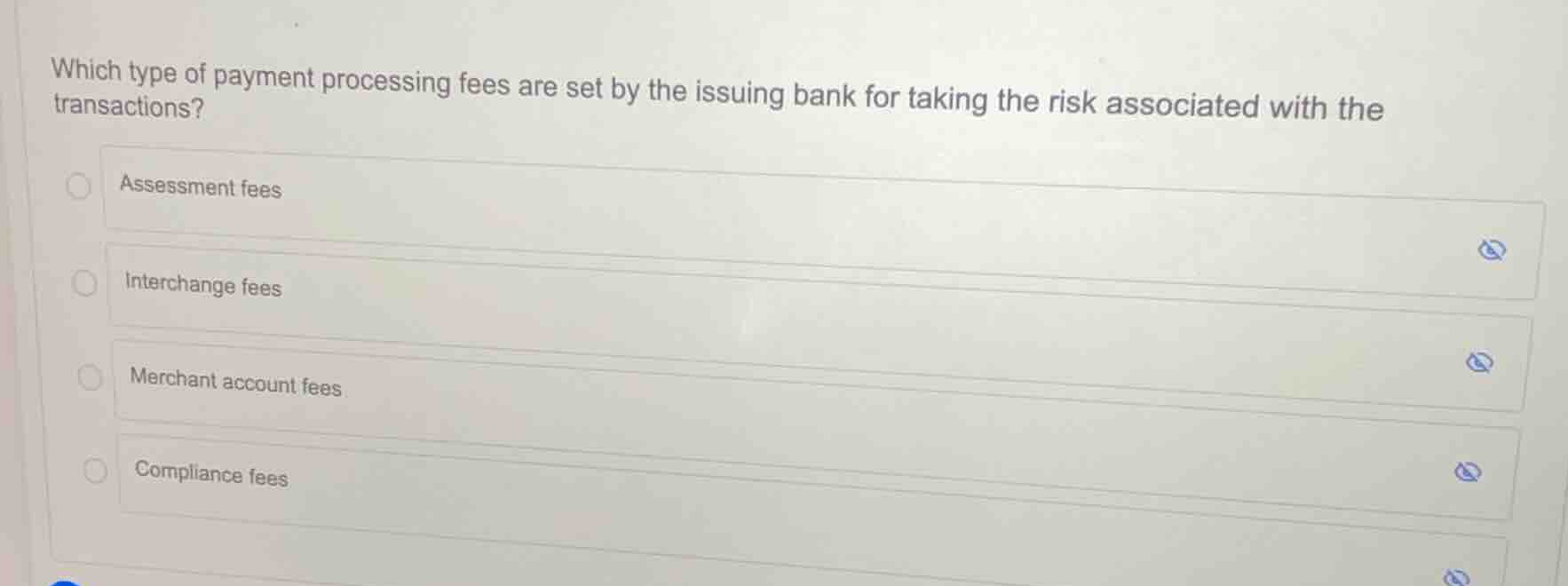
which type of payment processing fees are set by the issuing bank for taking the risk associated with the transactions?
assessment fees
interchange fees
merchant account fees
compliance fees
Identify the core question
The question asks for the type of payment processing fees set by the issuing bank to cover the risk associated with transactions.
Analyze the options
- Assessment fees: These are charged directly by the card brands (Visa, Mastercard, etc.) for operating their networks, not by the issuing bank.
- Interchange fees: These are set by the card networks but paid directly to the issuing bank (the customer's bank) to compensate for transaction risks, handling costs, and interest-free grace periods.
- Merchant account fees: These are charged by the merchant acquirer or payment processor for maintaining the merchant's account.
- Compliance fees: These are administrative fees charged to ensure PCI compliance or other regulatory standards.
Connect to mastered concepts
Using the Credit Card Processing knowledge point, we know that the transaction flow involves multiple parties: the merchant, the acquiring bank, the card network, and the issuing bank. The issuing bank takes on the primary credit and fraud risk when a cardholder makes a purchase. To compensate for this risk, the issuing bank receives the interchange fee, which is a percentage of each transaction.
Formulate the final conclusion
Interchange fees are the specific fees set by card networks but paid to the issuing bank to cover transaction risks and processing costs.

Snap & solve any problem in the app
Get step-by-step solutions on Sovi AI
Photo-based solutions with guided steps
Explore more problems and detailed explanations
- Assessment fees
- Interchange fees (Correct answer)
- Merchant account fees
- Compliance fees