Sovi.AI - AI Math Tutor

Scan to solve math questions

QUESTION IMAGE

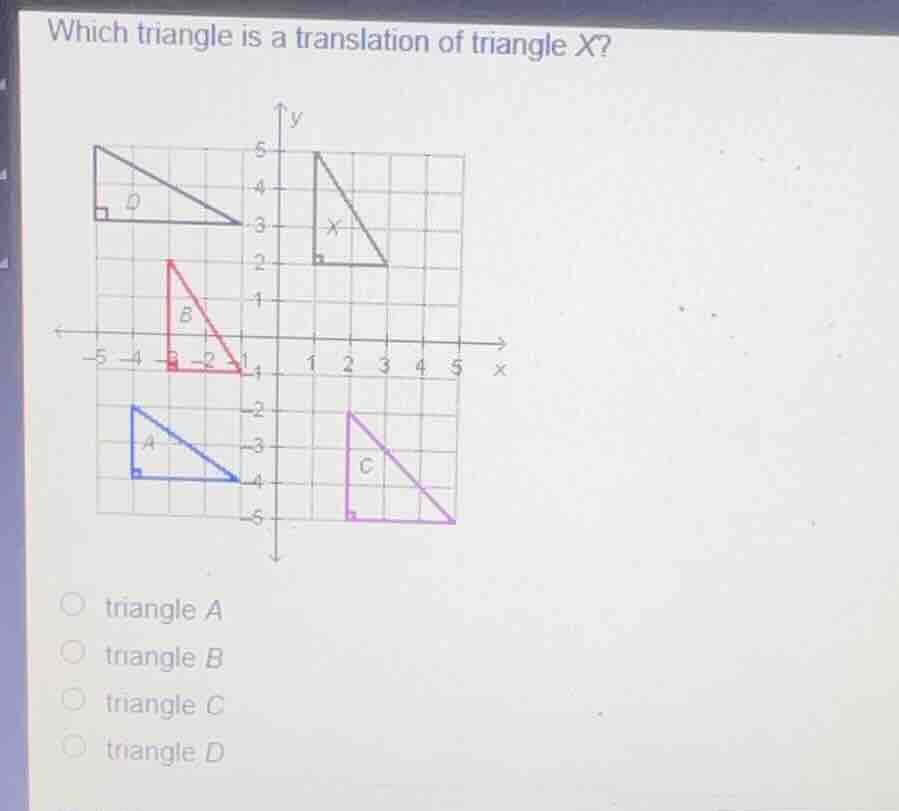
which triangle is a translation of triangle x? triangle a triangle b tr…

Question

which triangle is a translation of triangle x?
triangle a
triangle b
triangle c
triangle d

Explanation:

Response

<pre_analysis>
{
"quality": "clear",
"question_count": 1,
"skills_matched": [
"step_cot",
"multiple_choice_formatter",
"explain_then_answer",
"tutor"
],
"needs_drawing": false,
"concepts_used": [
"Translation Rule",
"Coordinate Transformations"
],
"new_concepts": [],
"current_concepts": [
"Translation Rule",
"Coordinate Transformations",
"Geometric Transformations"
]
}
</pre_analysis>

<reasoning>

Identify properties of triangle X

We first analyze the original triangle \(X\).

  • It is a right-angled triangle.
  • The right angle is located at the vertex \((1, 2)\).
  • The vertical leg goes from \((1, 2)\) to \((1, 5)\), which has a length of \(3\) units.
  • The horizontal leg goes from \((1, 2)\) to \((3, 2)\), which has a length of \(2\) units.
  • The orientation has the vertical leg on the left and the horizontal leg on the bottom.

Analyze translation properties

Using the Translation Rule and Coordinate Transformations concepts, a translation slides a figure in any direction without rotating, reflecting, or changing its size.

  • The translated triangle must be congruent to triangle \(X\).
  • It must have a vertical leg of length \(3\) and a horizontal leg of length \(2\).
  • It must maintain the exact same orientation (the right angle must be at the bottom-left of the triangle).

Evaluate the options

Let's check each candidate triangle:

  • Triangle A:
  • The right angle is at \((-4, -4)\).
  • The vertical leg goes from \((-4, -4)\) to \((-4, -2)\), length = \(2\).
  • The horizontal leg goes from \((-4, -4)\) to \((-1, -4)\), length = \(3\).
  • Since the dimensions are changed (rotated/reflected/resized), this is not a translation.
  • Triangle B:
  • The right angle is at \((-3, -1)\).
  • The vertical leg goes from \((-3, -1)\) to \((-3, 2)\), length = \(3\).
  • The horizontal leg goes from \((-3, -1)\) to \((-1, -1)\), length = \(2\).
  • The right angle is at the bottom-left, matching the orientation of \(X\).
  • Let's check the translation vector from \(X\) to \(B\):
  • Right-angle vertex of \(X\): \((1, 2)\)
  • Right-angle vertex of \(B\): \((-3, -1)\)
  • Translation: \((x, y)

ightarrow (x - 4, y - 3)\).

  • Applying this to all vertices of \(X\):
  • \((1, 2)

ightarrow (-3, -1)\)

  • \((1, 5)

ightarrow (-3, 2)\)

  • \((3, 2)

ightarrow (-1, -1)\)

  • These match the vertices of triangle \(B\) perfectly.
  • Triangle C:
  • The right angle is at \((2, -5)\).
  • The vertical leg has length \(3\) and horizontal leg has length \(3\). This is not congruent to \(X\).
  • Triangle D:
  • The right angle is at \((-5, 3)\).
  • The vertical leg has length \(2\) and horizontal leg has length \(4\). This is not congruent to \(X\).

Conclusion

Triangle B is the only triangle that is a direct translation of triangle X.
</reasoning>

<answer>
<mcq-option>triangle A</mcq-option>
<mcq-correct>triangle B</mcq-correct>
<mcq-option>triangle C</mcq-option>
<mcq-option>triangle D</mcq-option>
</answer>

<post_analysis>
{
"subject": "Mathematics",
"question_type": "Multiple Choice",
"knowledge_point": [
"Mathematics",
"Geometry",
"Coordinate Transformations"
]
}
</post_analysis>

Answer:

<pre_analysis>
{
"quality": "clear",
"question_count": 1,
"skills_matched": [
"step_cot",
"multiple_choice_formatter",
"explain_then_answer",
"tutor"
],
"needs_drawing": false,
"concepts_used": [
"Translation Rule",
"Coordinate Transformations"
],
"new_concepts": [],
"current_concepts": [
"Translation Rule",
"Coordinate Transformations",
"Geometric Transformations"
]
}
</pre_analysis>

<reasoning>

Identify properties of triangle X

We first analyze the original triangle \(X\).

  • It is a right-angled triangle.
  • The right angle is located at the vertex \((1, 2)\).
  • The vertical leg goes from \((1, 2)\) to \((1, 5)\), which has a length of \(3\) units.
  • The horizontal leg goes from \((1, 2)\) to \((3, 2)\), which has a length of \(2\) units.
  • The orientation has the vertical leg on the left and the horizontal leg on the bottom.

Analyze translation properties

Using the Translation Rule and Coordinate Transformations concepts, a translation slides a figure in any direction without rotating, reflecting, or changing its size.

  • The translated triangle must be congruent to triangle \(X\).
  • It must have a vertical leg of length \(3\) and a horizontal leg of length \(2\).
  • It must maintain the exact same orientation (the right angle must be at the bottom-left of the triangle).

Evaluate the options

Let's check each candidate triangle:

  • Triangle A:
  • The right angle is at \((-4, -4)\).
  • The vertical leg goes from \((-4, -4)\) to \((-4, -2)\), length = \(2\).
  • The horizontal leg goes from \((-4, -4)\) to \((-1, -4)\), length = \(3\).
  • Since the dimensions are changed (rotated/reflected/resized), this is not a translation.
  • Triangle B:
  • The right angle is at \((-3, -1)\).
  • The vertical leg goes from \((-3, -1)\) to \((-3, 2)\), length = \(3\).
  • The horizontal leg goes from \((-3, -1)\) to \((-1, -1)\), length = \(2\).
  • The right angle is at the bottom-left, matching the orientation of \(X\).
  • Let's check the translation vector from \(X\) to \(B\):
  • Right-angle vertex of \(X\): \((1, 2)\)
  • Right-angle vertex of \(B\): \((-3, -1)\)
  • Translation: \((x, y)

ightarrow (x - 4, y - 3)\).

  • Applying this to all vertices of \(X\):
  • \((1, 2)

ightarrow (-3, -1)\)

  • \((1, 5)

ightarrow (-3, 2)\)

  • \((3, 2)

ightarrow (-1, -1)\)

  • These match the vertices of triangle \(B\) perfectly.
  • Triangle C:
  • The right angle is at \((2, -5)\).
  • The vertical leg has length \(3\) and horizontal leg has length \(3\). This is not congruent to \(X\).
  • Triangle D:
  • The right angle is at \((-5, 3)\).
  • The vertical leg has length \(2\) and horizontal leg has length \(4\). This is not congruent to \(X\).

Conclusion

Triangle B is the only triangle that is a direct translation of triangle X.
</reasoning>

<answer>
<mcq-option>triangle A</mcq-option>
<mcq-correct>triangle B</mcq-correct>
<mcq-option>triangle C</mcq-option>
<mcq-option>triangle D</mcq-option>
</answer>

<post_analysis>
{
"subject": "Mathematics",
"question_type": "Multiple Choice",
"knowledge_point": [
"Mathematics",
"Geometry",
"Coordinate Transformations"
]
}
</post_analysis>