QUESTION IMAGE
Question
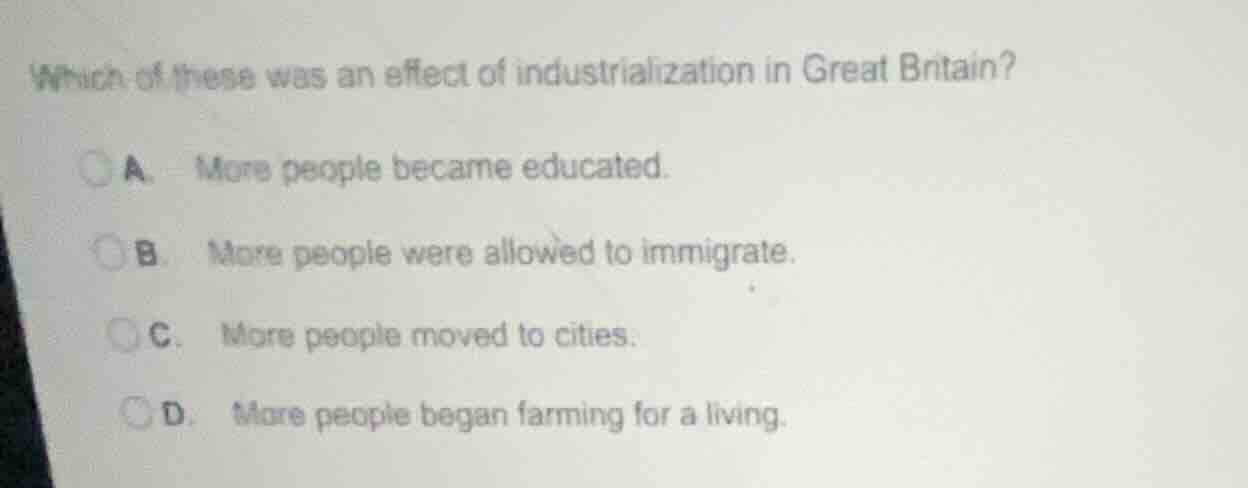
which of these was an effect of industrialization in great britain?
a. more people became educated.
b. more people were allowed to immigrate.
c. more people moved to cities.
d. more people began farming for a living.
<pre_analysis>
{
"quality": "clear",
"question_count": 1,
"skills_matched": [
"direct_cot",
"multiple_choice_formatter",
"explain_then_answer",
"tutor",
"mastery_adaptive_brevity"
],
"needs_drawing": false,
"concepts_used": [
"Urbanization Effects"
],
"new_concepts": [
"Industrial Revolution",
"British Industrialization"
],
"current_concepts": [
"Urbanization Effects",
"Industrial Revolution",
"British Industrialization"
]
}
</pre_analysis>
<reasoning>
Analyze the historical context of industrialization
The Industrial Revolution in Great Britain, beginning in the late 18th century, shifted the economy from manual labor and agriculture to machine-driven manufacturing. This transition required a massive workforce concentrated around newly built factories.
Evaluate the demographic shifts
Using the Urbanization Effects knowledge point
\[
\text{Rural-to-urban migration} \implies \text{Rapid growth of industrial cities}
\]
As factory jobs multiplied in urban centers, millions of agricultural workers left rural areas to find employment in cities, a process known as urbanization.
Assess the incorrect options
- Option A: While literacy eventually improved, widespread education was not an immediate, direct primary effect of early industrialization.
- Option B: Immigration policies were not the primary demographic driver compared to internal migration.
- Option D: Industrialization led to a decrease in the proportion of people farming for a living, as people transitioned to industrial labor.
</reasoning>
<answer>
<mcq-option>(A) More people became educated.</mcq-option>
<mcq-option>(B) More people were allowed to immigrate.</mcq-correct>
<mcq-correct>(C) More people moved to cities.</mcq-correct>
<mcq-option>(D) More people began farming for a living.</mcq-option>
</answer>
<post_analysis>
{
"subject": "Social Science",
"question_type": "Multiple Choice",
"knowledge_point": [
"Social Science",
"History",
"Industrial Revolution"
]
}
</post_analysis>
Snap & solve any problem in the app
Get step-by-step solutions on Sovi AI
Photo-based solutions with guided steps
Explore more problems and detailed explanations
<pre_analysis>
{
"quality": "clear",
"question_count": 1,
"skills_matched": [
"direct_cot",
"multiple_choice_formatter",
"explain_then_answer",
"tutor",
"mastery_adaptive_brevity"
],
"needs_drawing": false,
"concepts_used": [
"Urbanization Effects"
],
"new_concepts": [
"Industrial Revolution",
"British Industrialization"
],
"current_concepts": [
"Urbanization Effects",
"Industrial Revolution",
"British Industrialization"
]
}
</pre_analysis>
<reasoning>
Analyze the historical context of industrialization
The Industrial Revolution in Great Britain, beginning in the late 18th century, shifted the economy from manual labor and agriculture to machine-driven manufacturing. This transition required a massive workforce concentrated around newly built factories.
Evaluate the demographic shifts
Using the Urbanization Effects knowledge point
\[
\text{Rural-to-urban migration} \implies \text{Rapid growth of industrial cities}
\]
As factory jobs multiplied in urban centers, millions of agricultural workers left rural areas to find employment in cities, a process known as urbanization.
Assess the incorrect options
- Option A: While literacy eventually improved, widespread education was not an immediate, direct primary effect of early industrialization.
- Option B: Immigration policies were not the primary demographic driver compared to internal migration.
- Option D: Industrialization led to a decrease in the proportion of people farming for a living, as people transitioned to industrial labor.
</reasoning>
<answer>
<mcq-option>(A) More people became educated.</mcq-option>
<mcq-option>(B) More people were allowed to immigrate.</mcq-correct>
<mcq-correct>(C) More people moved to cities.</mcq-correct>
<mcq-option>(D) More people began farming for a living.</mcq-option>
</answer>
<post_analysis>
{
"subject": "Social Science",
"question_type": "Multiple Choice",
"knowledge_point": [
"Social Science",
"History",
"Industrial Revolution"
]
}
</post_analysis>