QUESTION IMAGE
Question
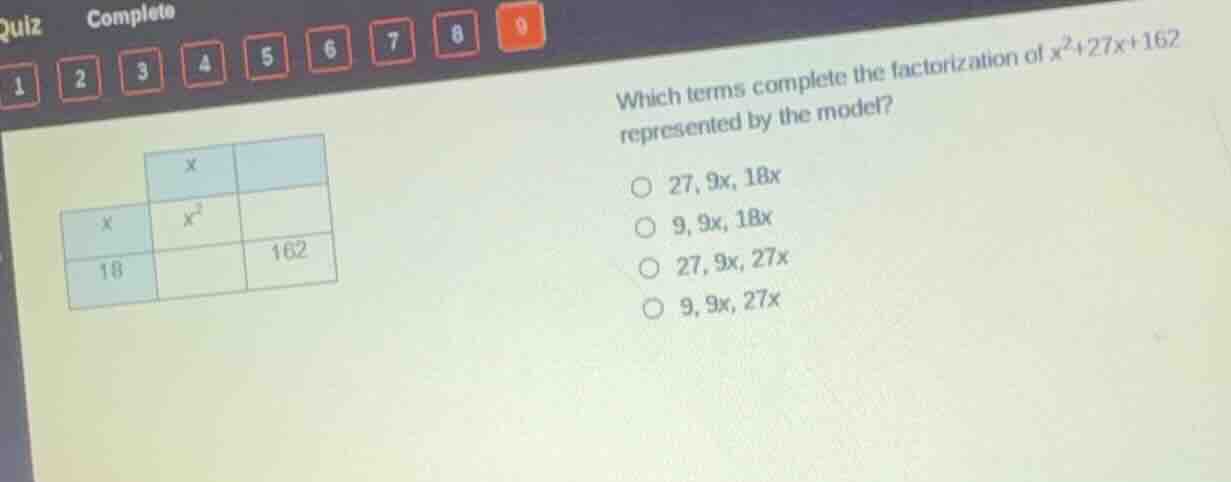
which terms complete the factorization of \\(x^2 + 27x + 162\\) represented by the model?
- 27, 9x, 18x
- 9, 9x, 18x
- 27, 9x, 27x
- 9, 9x, 27x
<pre_analysis>
{
"quality": "clear",
"question_count": 1,
"skills_matched": [
"step_cot",
"multiple_choice_formatter",
"explain_then_answer",
"quick"
],
"needs_drawing": false,
"concepts_used": [
"Area Model Multiplication",
"Factoring Trinomials"
],
"new_concepts": [],
"current_concepts": [
"Area Model Multiplication",
"Factoring Trinomials"
]
}
</pre_analysis>
<reasoning>
Analyze the area model structure
The area model represents the multiplication of two binomials to form the trinomial \(x^2 + 27x + 162\).
The row headers are on the left: \(x\) and \(18\).
The column headers are on the top: \(x\) and an unknown constant \(a\).
The cells inside the grid represent the products of the row and column headers:
- Top-left cell: \(x \cdot x = x^2\)
- Bottom-right cell: \(18 \cdot a = 162\)
Find the missing column header
Using the bottom-right cell:
\[
18 \cdot a = 162 \implies a = \frac{162}{18} = 9
\]
Thus, the missing term at the top is \(9\).
Find the remaining product cells
The two remaining cells represent the \(x\)-terms that sum to the middle term \(27x\):
- Bottom-left cell: \(18 \cdot x = 18x\)
- Top-right cell: \(x \cdot a = 9x\)
The terms that complete the factorization model are the missing header \(9\) and the two partial product terms \(9x\) and \(18x\).
</reasoning>
<answer>
<mcq-option>O 27, 9x, 18x</mcq-option>
<mcq-correct>O 9, 9x, 18x</mcq-correct>
<mcq-option>O 27, 9x, 27x</mcq-option>
<mcq-option>O 9, 9x, 27x</mcq-option>
</answer>
<post_analysis>
{
"subject": "Mathematics",
"question_type": "Multiple Choice",
"knowledge_point": [
"Mathematics",
"Algebra",
"Area Model Multiplication"
]
}
</post_analysis>
Snap & solve any problem in the app
Get step-by-step solutions on Sovi AI
Photo-based solutions with guided steps
Explore more problems and detailed explanations
<pre_analysis>
{
"quality": "clear",
"question_count": 1,
"skills_matched": [
"step_cot",
"multiple_choice_formatter",
"explain_then_answer",
"quick"
],
"needs_drawing": false,
"concepts_used": [
"Area Model Multiplication",
"Factoring Trinomials"
],
"new_concepts": [],
"current_concepts": [
"Area Model Multiplication",
"Factoring Trinomials"
]
}
</pre_analysis>
<reasoning>
Analyze the area model structure
The area model represents the multiplication of two binomials to form the trinomial \(x^2 + 27x + 162\).
The row headers are on the left: \(x\) and \(18\).
The column headers are on the top: \(x\) and an unknown constant \(a\).
The cells inside the grid represent the products of the row and column headers:
- Top-left cell: \(x \cdot x = x^2\)
- Bottom-right cell: \(18 \cdot a = 162\)
Find the missing column header
Using the bottom-right cell:
\[
18 \cdot a = 162 \implies a = \frac{162}{18} = 9
\]
Thus, the missing term at the top is \(9\).
Find the remaining product cells
The two remaining cells represent the \(x\)-terms that sum to the middle term \(27x\):
- Bottom-left cell: \(18 \cdot x = 18x\)
- Top-right cell: \(x \cdot a = 9x\)
The terms that complete the factorization model are the missing header \(9\) and the two partial product terms \(9x\) and \(18x\).
</reasoning>
<answer>
<mcq-option>O 27, 9x, 18x</mcq-option>
<mcq-correct>O 9, 9x, 18x</mcq-correct>
<mcq-option>O 27, 9x, 27x</mcq-option>
<mcq-option>O 9, 9x, 27x</mcq-option>
</answer>
<post_analysis>
{
"subject": "Mathematics",
"question_type": "Multiple Choice",
"knowledge_point": [
"Mathematics",
"Algebra",
"Area Model Multiplication"
]
}
</post_analysis>