QUESTION IMAGE
Question
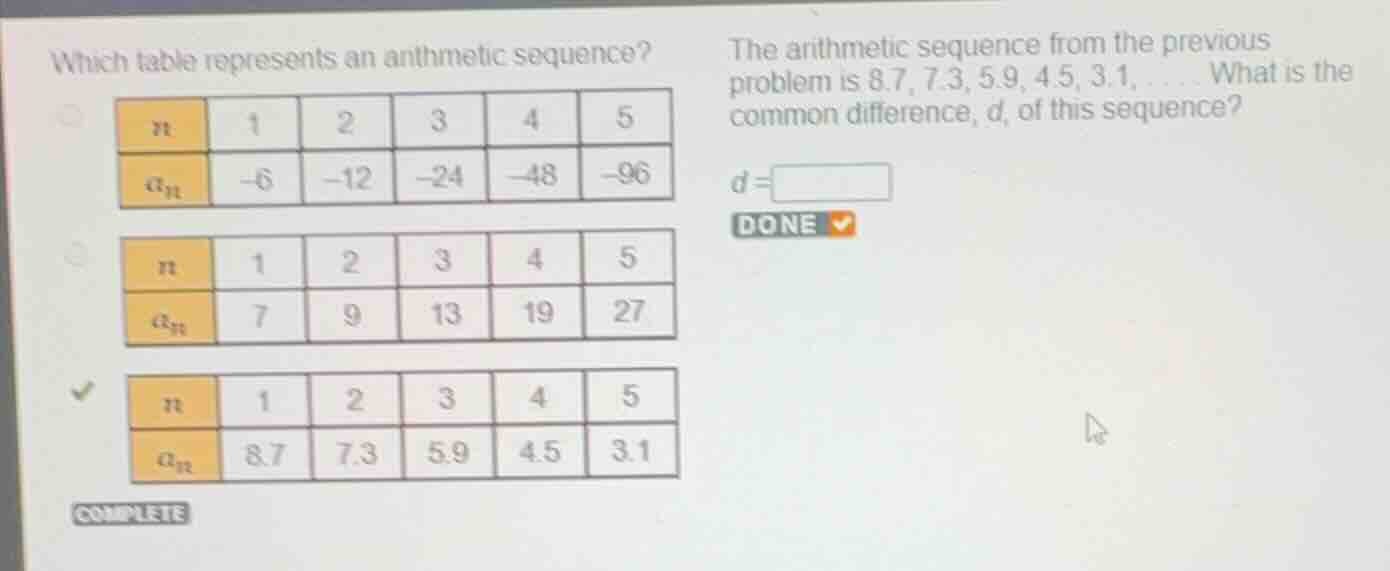
which table represents an arithmetic sequence?
table 1:
\\(n\\) | 1 | 2 | 3 | 4 | 5
\\(a_n\\) | -6 | -12 | -24 | -48 | -96
table 2:
\\(n\\) | 1 | 2 | 3 | 4 | 5
\\(a_n\\) | 7 | 9 | 13 | 19 | 27
table 3:
\\(n\\) | 1 | 2 | 3 | 4 | 5
\\(a_n\\) | 8.7 | 7.3 | 5.9 | 4.5 | 3.1
the arithmetic sequence from the previous problem is 8.7, 7.3, 5.9, 4.5, 3.1, ... what is the common difference, \\(d\\), of this sequence?
\\(d = \\)
Identify the arithmetic sequence table
Using the Arithmetic Sequences knowledge point
- Table 1: The terms are \(-6, -12, -24, -48, -96\). The ratio between consecutive terms is constant (\(r = 2\)), representing a geometric sequence.
- Table 2: The terms are \(7, 9, 13, 19, 27\). The differences are \(2, 4, 6, 8\), which are not constant.
- Table 3: The terms are \(8.7, 7.3, 5.9, 4.5, 3.1\). The differences are:
Since the difference is constant, this table represents an arithmetic sequence.
Calculate the common difference
Using the Arithmetic Sequences knowledge point
- The sequence is \(8.7, 7.3, 5.9, 4.5, 3.1, \dots\)
- Calculate the common difference \(d\) by subtracting the first term from the second term:

Snap & solve any problem in the app
Get step-by-step solutions on Sovi AI
Photo-based solutions with guided steps
Explore more problems and detailed explanations
Question 1
The table that represents an arithmetic sequence is the third table:
| \(n\) | 1 | 2 | 3 | 4 | 5 |
|---|
Question 2
\(d =\) <blank>-1.4</blank>