QUESTION IMAGE
Question
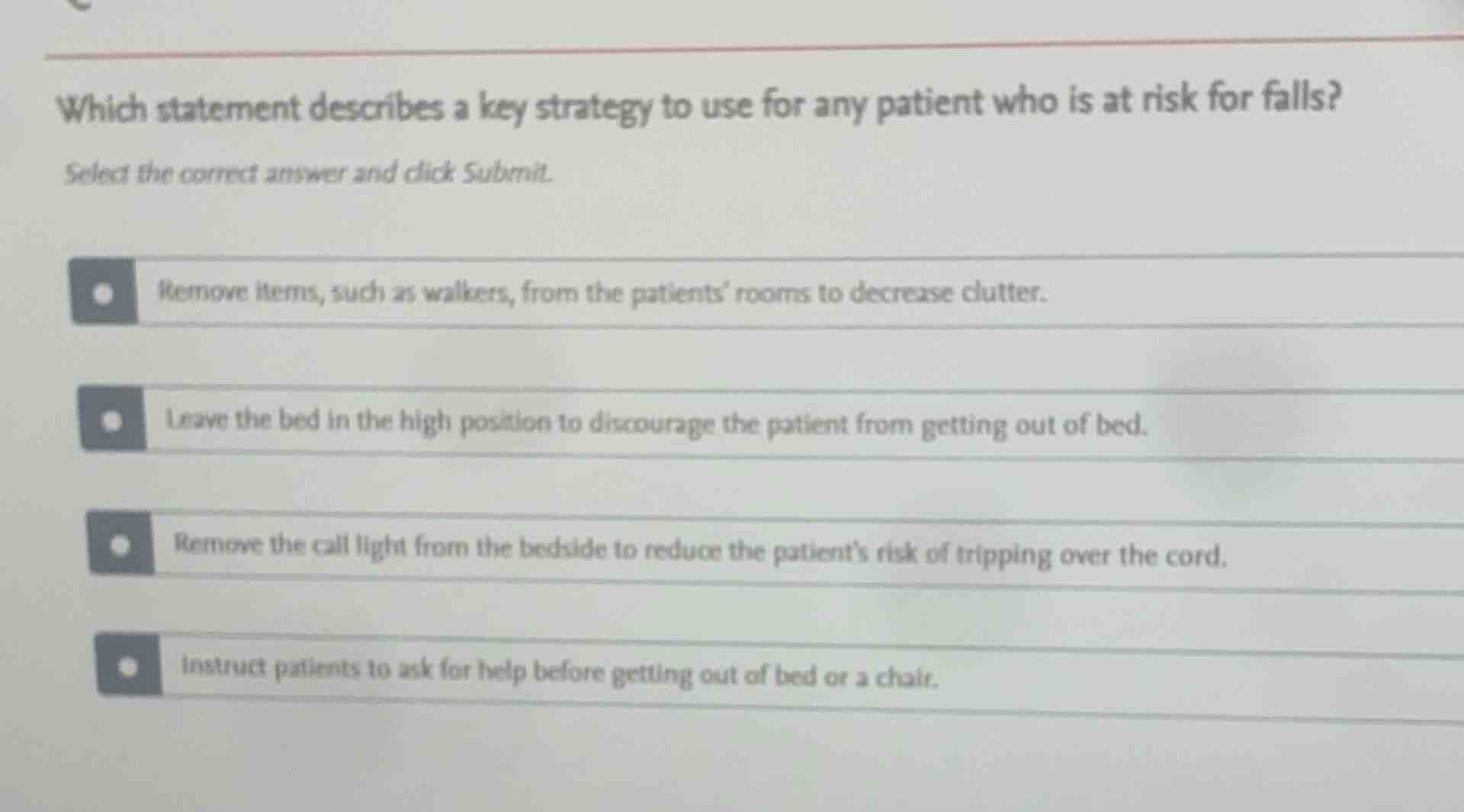
which statement describes a key strategy to use for any patient who is at risk for falls?
select the correct answer and click submit.
- remove items, such as walkers, from the patients rooms to decrease clutter.
- leave the bed in the high position to discourage the patient from getting out of bed.
- remove the call light from the bedside to reduce the patients risk of tripping over the cord.
- instruct patients to ask for help before getting out of bed or a chair.
<pre_analysis>
{
"quality": "clear",
"question_count": 1,
"skills_matched": [
"direct_cot",
"multiple_choice_formatter",
"explain_then_answer",
"quick"
],
"needs_drawing": false,
"concepts_used": [
"Fall Prevention Strategies"
],
"new_concepts": [],
"current_concepts": [
"Fall Prevention Strategies",
"Patient Safety Priorities"
]
}
</pre_analysis>
<reasoning>
Analyze standard fall prevention protocols
- Walkers are essential assistive devices and must remain accessible to the patient, not removed.
- Beds should always be kept in the lowest position to minimize injury if a fall occurs.
- The call light must remain within reach at all times so the patient can summon assistance.
- Instructing patients to ask for help before transferring is a universal, standard safety strategy.
</reasoning>
<answer>
<mcq-option>Remove items, such as walkers, from the patients' rooms to decrease clutter.</mcq-option>
<mcq-option>Leave the bed in the high position to discourage the patient from getting out of bed.</mcq-option>
<mcq-option>Remove the call light from the bedside to reduce the patient's risk of tripping over the cord.</mcq-option>
<mcq-correct>Instruct patients to ask for help before getting out of bed or a chair.</mcq-correct>
</answer>
<post_analysis>
{
"subject": "Natural Science",
"question_type": "Multiple Choice",
"knowledge_point": [
"Natural Science",
"Medicine and Health Sciences",
"Nursing and Patient Safety"
]
}
</post_analysis>
Snap & solve any problem in the app
Get step-by-step solutions on Sovi AI
Photo-based solutions with guided steps
Explore more problems and detailed explanations
<pre_analysis>
{
"quality": "clear",
"question_count": 1,
"skills_matched": [
"direct_cot",
"multiple_choice_formatter",
"explain_then_answer",
"quick"
],
"needs_drawing": false,
"concepts_used": [
"Fall Prevention Strategies"
],
"new_concepts": [],
"current_concepts": [
"Fall Prevention Strategies",
"Patient Safety Priorities"
]
}
</pre_analysis>
<reasoning>
Analyze standard fall prevention protocols
- Walkers are essential assistive devices and must remain accessible to the patient, not removed.
- Beds should always be kept in the lowest position to minimize injury if a fall occurs.
- The call light must remain within reach at all times so the patient can summon assistance.
- Instructing patients to ask for help before transferring is a universal, standard safety strategy.
</reasoning>
<answer>
<mcq-option>Remove items, such as walkers, from the patients' rooms to decrease clutter.</mcq-option>
<mcq-option>Leave the bed in the high position to discourage the patient from getting out of bed.</mcq-option>
<mcq-option>Remove the call light from the bedside to reduce the patient's risk of tripping over the cord.</mcq-option>
<mcq-correct>Instruct patients to ask for help before getting out of bed or a chair.</mcq-correct>
</answer>
<post_analysis>
{
"subject": "Natural Science",
"question_type": "Multiple Choice",
"knowledge_point": [
"Natural Science",
"Medicine and Health Sciences",
"Nursing and Patient Safety"
]
}
</post_analysis>