QUESTION IMAGE
Question
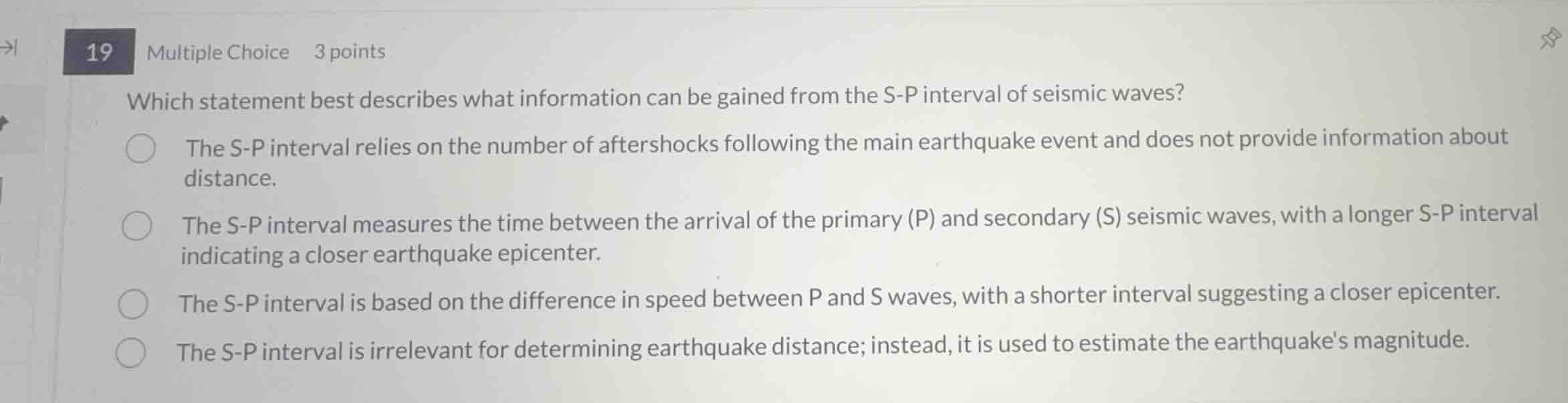
which statement best describes what information can be gained from the s-p interval of seismic waves?
the s-p interval relies on the number of aftershocks following the main earthquake event and does not provide information about distance.
the s-p interval measures the time between the arrival of the primary (p) and secondary (s) seismic waves, with a longer s-p interval indicating a closer earthquake epicenter.
the s-p interval is based on the difference in speed between p and s waves, with a shorter interval suggesting a closer epicenter.
the s-p interval is irrelevant for determining earthquake distance; instead, it is used to estimate the earthquakes magnitude.
Define the S-P interval and wave speeds
Primary (P) waves travel faster than secondary (S) waves. The S-P interval is the time difference between the arrival of these two waves at a seismograph station.
Relate interval duration to epicenter distance
Because P-waves travel faster, the gap in arrival time (S-P interval) increases as the waves travel farther from the origin. Therefore, a shorter S-P interval indicates a closer epicenter, while a longer interval indicates a more distant epicenter.
Evaluate the given options
- Option 1: Incorrect. The S-P interval is directly related to distance and does not rely on the number of aftershocks.
- Option 2: Incorrect. A longer S-P interval indicates a farther epicenter, not a closer one.
- Option 3: Correct. It correctly states that the interval is based on the speed difference, with a shorter interval suggesting a closer epicenter.
- Option 4: Incorrect. The S-P interval is the primary tool for determining distance to the epicenter, not magnitude.

Snap & solve any problem in the app
Get step-by-step solutions on Sovi AI
Photo-based solutions with guided steps
Explore more problems and detailed explanations
- (A) The S-P interval relies on the number of aftershocks following the main earthquake event and does not provide information about distance.
- (B) The S-P interval measures the time between the arrival of the primary (P) and secondary (S) seismic waves, with a longer S-P interval indicating a closer earthquake epicenter.
- (C) The S-P interval is based on the difference in speed between P and S waves, with a shorter interval suggesting a closer epicenter. (Correct answer)
- (D) The S-P interval is irrelevant for determining earthquake distance; instead, it is used to estimate the earthquake's magnitude.