QUESTION IMAGE
Question
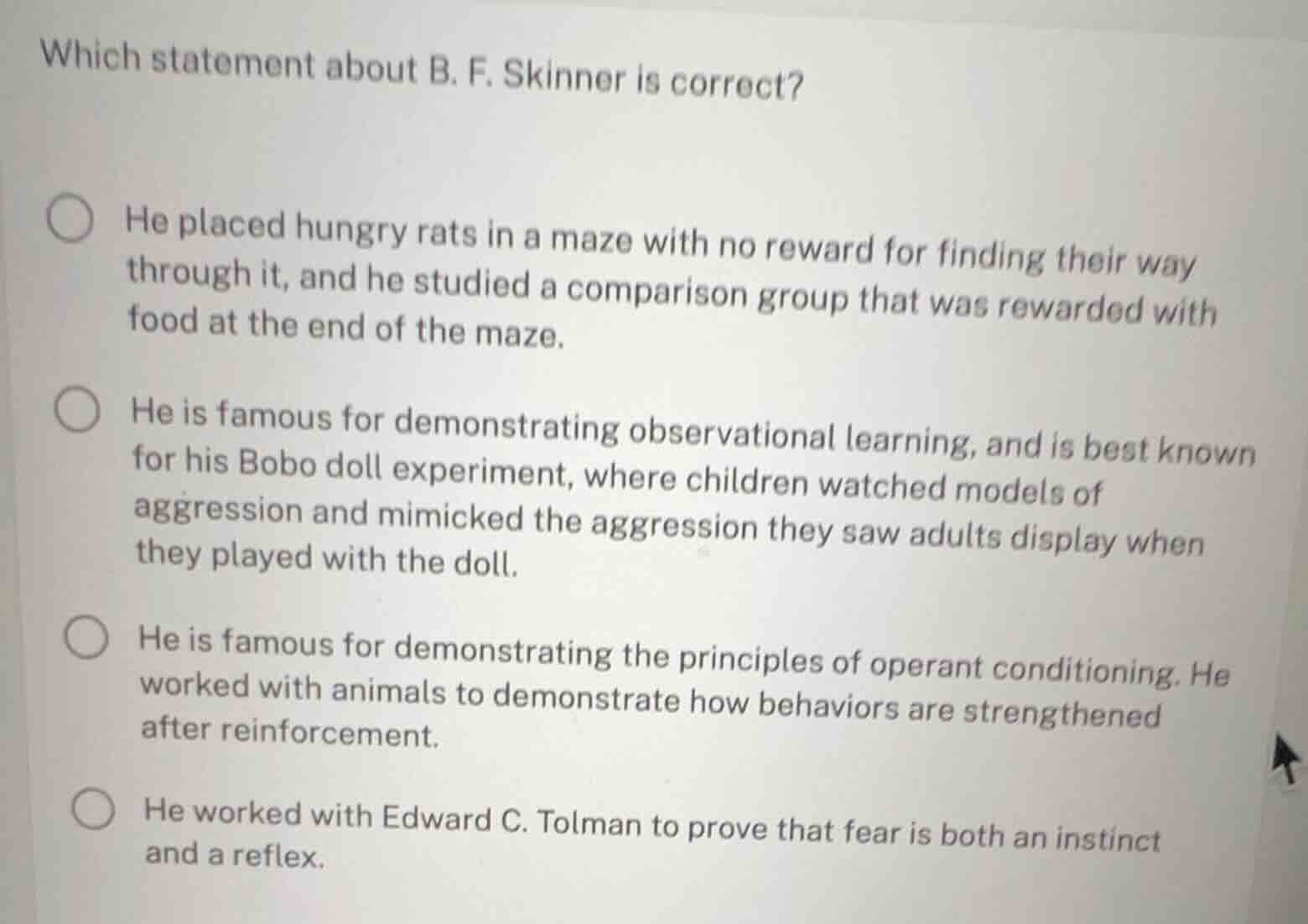
which statement about b. f. skinner is correct?
he placed hungry rats in a maze with no reward for finding their way through it, and he studied a comparison group that was rewarded with food at the end of the maze.
he is famous for demonstrating observational learning, and is best known for his bobo doll experiment, where children watched models of aggression and mimicked the aggression they saw adults display when they played with the doll.
he is famous for demonstrating the principles of operant conditioning. he worked with animals to demonstrate how behaviors are strengthened after reinforcement.
he worked with edward c. tolman to prove that fear is both an instinct and a reflex.
<pre_analysis>
{
"quality": "clear",
"question_count": 1,
"skills_matched": [
"direct_cot",
"multiple_choice_formatter",
"explain_then_answer",
"tutor",
"mastery_adaptive_brevity"
],
"needs_drawing": false,
"concepts_used": [
"Operant Conditioning",
"Bobo Doll Experiment",
"Latent Learning"
],
"new_concepts": [
"B. F. Skinner Contributions"
],
"current_concepts": [
"Operant Conditioning",
"Bobo Doll Experiment",
"Latent Learning",
"B. F. Skinner Contributions"
]
}
</pre_analysis>
<reasoning>
Analyze the first statement
Using the Latent Learning knowledge point
The first statement describes Edward C. Tolman's classic maze experiments with rats, which demonstrated latent learning, not the work of B. F. Skinner.
Analyze the second statement
Using the Bobo Doll Experiment knowledge point
The second statement describes Albert Bandura's famous Bobo doll experiment on observational learning, not B. F. Skinner's work.
Analyze the third statement
Using the Operant Conditioning knowledge point
The third statement correctly identifies B. F. Skinner's primary contribution: demonstrating the principles of operant conditioning using reinforcement with animals (such as rats and pigeons in a Skinner box).
Analyze the fourth statement
The fourth statement claims he worked with Edward C. Tolman to prove fear is an instinct and a reflex, which is historically inaccurate and does not represent Skinner's behaviorist framework.
</reasoning>
<answer>
<mcq-option>(A) He placed hungry rats in a maze with no reward for finding their way through it, and he studied a comparison group that was rewarded with food at the end of the maze.</mcq-option>
<mcq-option>(B) He is famous for demonstrating observational learning, and is best known for his Bobo doll experiment, where children watched models of aggression and mimicked the aggression they saw adults display when they played with the doll.</mcq-option>
<mcq-correct>(C) He is famous for demonstrating the principles of operant conditioning. He worked with animals to demonstrate how behaviors are strengthened after reinforcement.</mcq-correct>
<mcq-option>(D) He worked with Edward C. Tolman to prove that fear is both an instinct and a reflex.</mcq-option>
</answer>
<post_analysis>
{
"subject": "Social Science",
"question_type": "Multiple Choice",
"knowledge_point": [
"Social Science",
"Psychology",
"Learning Theories"
]
}
</post_analysis>
Snap & solve any problem in the app
Get step-by-step solutions on Sovi AI
Photo-based solutions with guided steps
Explore more problems and detailed explanations
<pre_analysis>
{
"quality": "clear",
"question_count": 1,
"skills_matched": [
"direct_cot",
"multiple_choice_formatter",
"explain_then_answer",
"tutor",
"mastery_adaptive_brevity"
],
"needs_drawing": false,
"concepts_used": [
"Operant Conditioning",
"Bobo Doll Experiment",
"Latent Learning"
],
"new_concepts": [
"B. F. Skinner Contributions"
],
"current_concepts": [
"Operant Conditioning",
"Bobo Doll Experiment",
"Latent Learning",
"B. F. Skinner Contributions"
]
}
</pre_analysis>
<reasoning>
Analyze the first statement
Using the Latent Learning knowledge point
The first statement describes Edward C. Tolman's classic maze experiments with rats, which demonstrated latent learning, not the work of B. F. Skinner.
Analyze the second statement
Using the Bobo Doll Experiment knowledge point
The second statement describes Albert Bandura's famous Bobo doll experiment on observational learning, not B. F. Skinner's work.
Analyze the third statement
Using the Operant Conditioning knowledge point
The third statement correctly identifies B. F. Skinner's primary contribution: demonstrating the principles of operant conditioning using reinforcement with animals (such as rats and pigeons in a Skinner box).
Analyze the fourth statement
The fourth statement claims he worked with Edward C. Tolman to prove fear is an instinct and a reflex, which is historically inaccurate and does not represent Skinner's behaviorist framework.
</reasoning>
<answer>
<mcq-option>(A) He placed hungry rats in a maze with no reward for finding their way through it, and he studied a comparison group that was rewarded with food at the end of the maze.</mcq-option>
<mcq-option>(B) He is famous for demonstrating observational learning, and is best known for his Bobo doll experiment, where children watched models of aggression and mimicked the aggression they saw adults display when they played with the doll.</mcq-option>
<mcq-correct>(C) He is famous for demonstrating the principles of operant conditioning. He worked with animals to demonstrate how behaviors are strengthened after reinforcement.</mcq-correct>
<mcq-option>(D) He worked with Edward C. Tolman to prove that fear is both an instinct and a reflex.</mcq-option>
</answer>
<post_analysis>
{
"subject": "Social Science",
"question_type": "Multiple Choice",
"knowledge_point": [
"Social Science",
"Psychology",
"Learning Theories"
]
}
</post_analysis>