QUESTION IMAGE
Question
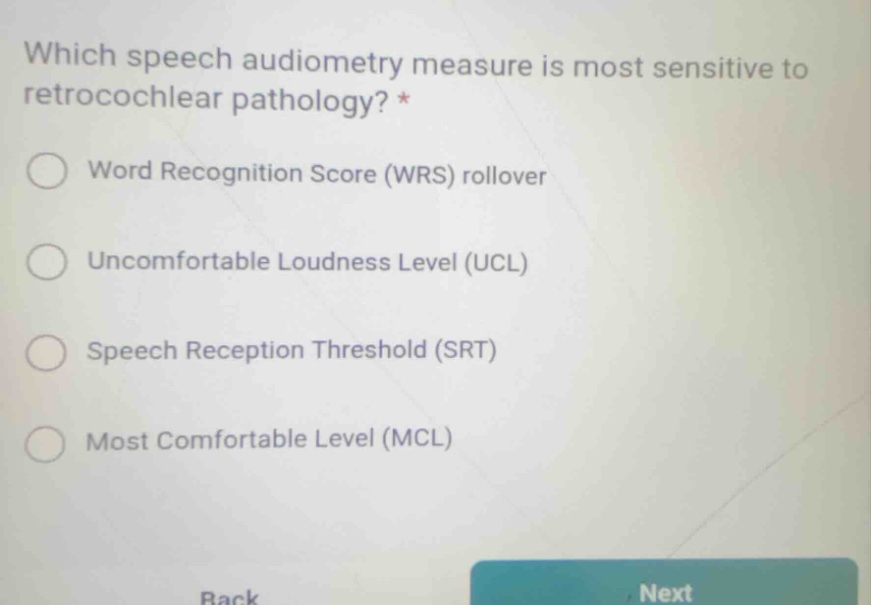
which speech audiometry measure is most sensitive to retrocochlear pathology? *
word recognition score (wrs) rollover
uncomfortable loudness level (ucl)
speech reception threshold (srt)
most comfortable level (mcl)
<pre_analysis>
{
"quality": "clear",
"question_count": 1,
"skills_matched": [
"direct_cot",
"multiple_choice_formatter",
"explain_then_answer",
"quick"
],
"needs_drawing": false,
"concepts_used": [],
"new_concepts": [
"Speech Audiometry",
"WRS Rollover",
"Retrocochlear Pathology"
],
"current_concepts": [
"Retrocochlear Pathology",
"Speech Audiometry",
"WRS Rollover"
]
}
</pre_analysis>
<reasoning>
Define retrocochlear pathology and speech measures
Retrocochlear pathology refers to disorders occurring beyond the cochlea, primarily affecting the auditory nerve (eighth cranial nerve) or central auditory pathways. Speech audiometry measures include Word Recognition Score (WRS), Uncomfortable Loudness Level (UCL), Speech Reception Threshold (SRT), and Most Comfortable Level (MCL).
Analyze the sensitivity of each option
- WRS rollover: This phenomenon occurs when word recognition performance decreases significantly as the presentation level of speech increases beyond the patient's optimal listening level. This is a classic diagnostic indicator highly sensitive to retrocochlear lesions (such as vestibular schwannomas).
- UCL, SRT, and MCL: These measures assess loudness tolerance, speech hearing thresholds, and preferred listening levels, respectively. While they provide useful clinical information, they are not highly sensitive or specific diagnostic indicators for retrocochlear pathology.
</reasoning>
<answer>
<mcq-correct>(A) Word Recognition Score (WRS) rollover</mcq-correct>
<mcq-option>(B) Uncomfortable Loudness Level (UCL)</mcq-option>
<mcq-option>(C) Speech Reception Threshold (SRT)</mcq-option>
<mcq-option>(D) Most Comfortable Level (MCL)</mcq-option>
</answer>
<post_analysis>
{
"subject": "Natural Science",
"question_type": "Multiple Choice",
"knowledge_point": [
"Natural Science",
"Medicine",
"Audiology"
]
}
</post_analysis>
Snap & solve any problem in the app
Get step-by-step solutions on Sovi AI
Photo-based solutions with guided steps
Explore more problems and detailed explanations
<pre_analysis>
{
"quality": "clear",
"question_count": 1,
"skills_matched": [
"direct_cot",
"multiple_choice_formatter",
"explain_then_answer",
"quick"
],
"needs_drawing": false,
"concepts_used": [],
"new_concepts": [
"Speech Audiometry",
"WRS Rollover",
"Retrocochlear Pathology"
],
"current_concepts": [
"Retrocochlear Pathology",
"Speech Audiometry",
"WRS Rollover"
]
}
</pre_analysis>
<reasoning>
Define retrocochlear pathology and speech measures
Retrocochlear pathology refers to disorders occurring beyond the cochlea, primarily affecting the auditory nerve (eighth cranial nerve) or central auditory pathways. Speech audiometry measures include Word Recognition Score (WRS), Uncomfortable Loudness Level (UCL), Speech Reception Threshold (SRT), and Most Comfortable Level (MCL).
Analyze the sensitivity of each option
- WRS rollover: This phenomenon occurs when word recognition performance decreases significantly as the presentation level of speech increases beyond the patient's optimal listening level. This is a classic diagnostic indicator highly sensitive to retrocochlear lesions (such as vestibular schwannomas).
- UCL, SRT, and MCL: These measures assess loudness tolerance, speech hearing thresholds, and preferred listening levels, respectively. While they provide useful clinical information, they are not highly sensitive or specific diagnostic indicators for retrocochlear pathology.
</reasoning>
<answer>
<mcq-correct>(A) Word Recognition Score (WRS) rollover</mcq-correct>
<mcq-option>(B) Uncomfortable Loudness Level (UCL)</mcq-option>
<mcq-option>(C) Speech Reception Threshold (SRT)</mcq-option>
<mcq-option>(D) Most Comfortable Level (MCL)</mcq-option>
</answer>
<post_analysis>
{
"subject": "Natural Science",
"question_type": "Multiple Choice",
"knowledge_point": [
"Natural Science",
"Medicine",
"Audiology"
]
}
</post_analysis>