QUESTION IMAGE
Question
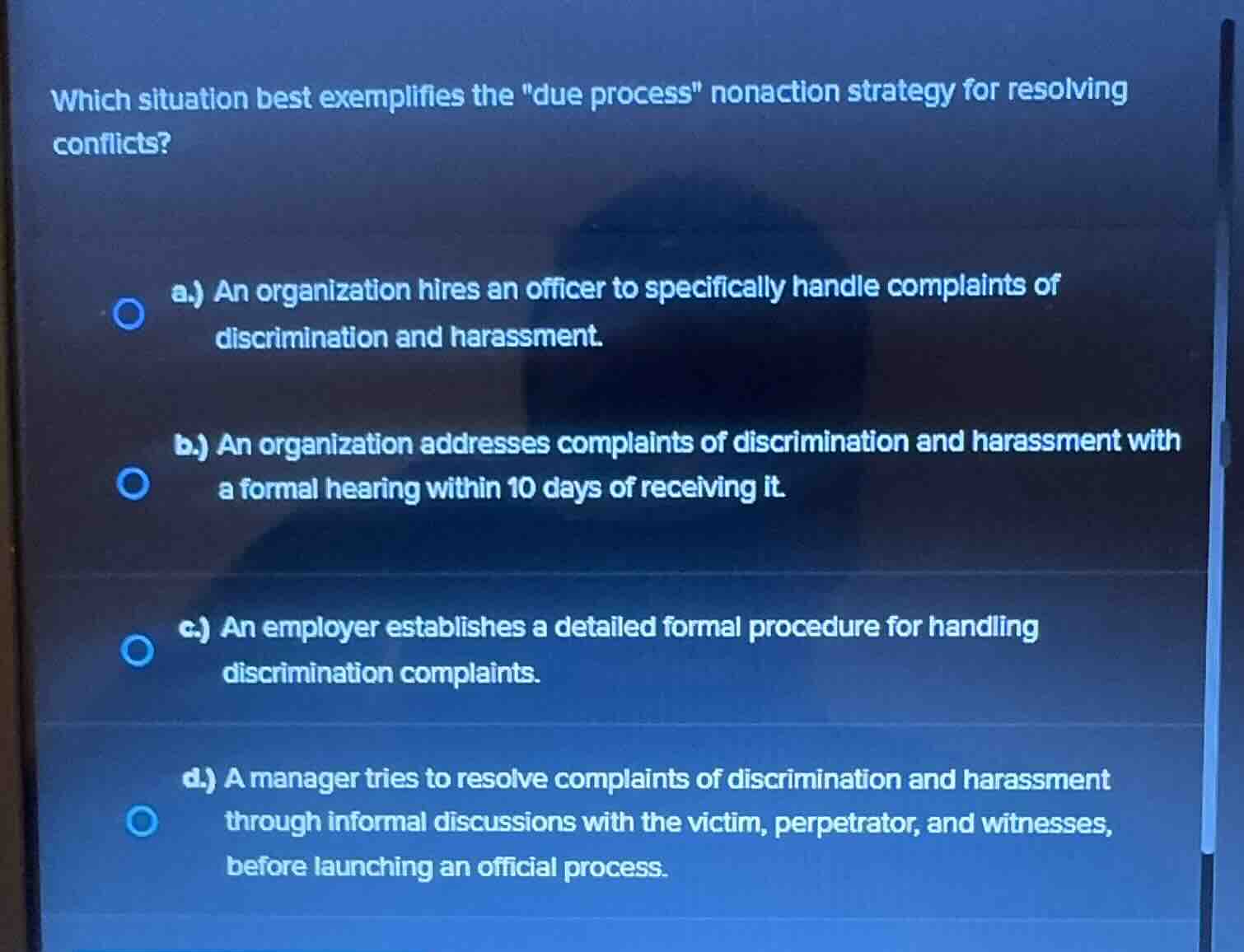
which situation best exemplifies the \due process\ nonaction strategy for resolving conflicts?
a.) an organization hires an officer to specifically handle complaints of discrimination and harassment.
b.) an organization addresses complaints of discrimination and harassment with a formal hearing within 10 days of receiving it.
c.) an employer establishes a detailed formal procedure for handling discrimination complaints.
d.) a manager tries to resolve complaints of discrimination and harassment through informal discussions with the victim, perpetrator, and witnesses, before launching an official process.
Define the "due process" nonaction strategy
In organizational behavior and conflict management, "nonaction" strategies are methods used to avoid taking direct, immediate action to resolve a conflict. The "due process" nonaction strategy occurs when an organization sets up an incredibly detailed, complex, or formal procedure for handling complaints. While it appears to address the issue, the sheer complexity and length of the procedure often delay resolution, wear down the complainant, or discourage people from filing complaints in the first place, effectively serving as a form of nonaction or avoidance.
Evaluate the given options
- Option a: Hiring a specific officer to handle complaints is a structural change (often associated with the "character assassination" or "personnel change" strategies, or a proactive structural intervention), rather than setting up a procedural hurdle.
- Option b: Setting a strict timeline (a formal hearing within 10 days) represents a prompt, active resolution mechanism rather than a delaying nonaction strategy.
- Option c: Establishing a detailed, highly formal procedure for handling complaints perfectly matches the definition of the "due process" nonaction strategy, as the elaborate procedure itself becomes a bureaucratic barrier that delays or avoids direct resolution.
- Option d: Trying to resolve complaints through informal discussions before an official process is an informal, direct conflict resolution approach, not a formal "due process" nonaction strategy.
Identify the correct option
Based on the evaluation, Option c is the correct choice because establishing a detailed, formal procedure is the classic implementation of the "due process" nonaction strategy.

Snap & solve any problem in the app
Get step-by-step solutions on Sovi AI
Photo-based solutions with guided steps
Explore more problems and detailed explanations
- a.) An organization hires an officer to specifically handle complaints of discrimination and harassment.
- b.) An organization addresses complaints of discrimination and harassment with a formal hearing within 10 days of receiving it.
- c.) An employer establishes a detailed formal procedure for handling discrimination complaints. (Correct answer)
- d.) A manager tries to resolve complaints of discrimination and harassment through informal discussions with the victim, perpetrator, and witnesses, before launching an official process.