QUESTION IMAGE
Question
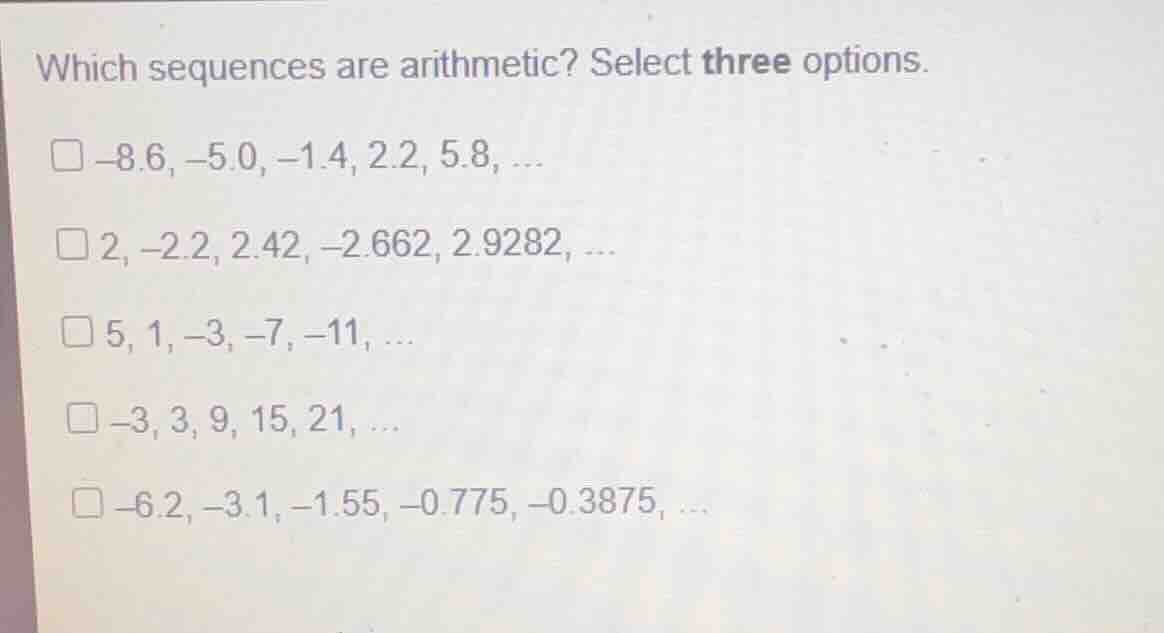
which sequences are arithmetic? select three options.
\\(\square\\) \\(-8.6, -5.0, -1.4, 2.2, 5.8, \dots\\)
\\(\square\\) \\(2, -2.2, 2.42, -2.662, 2.9282, \dots\\)
\\(\square\\) \\(5, 1, -3, -7, -11, \dots\\)
\\(\square\\) \\(-3, 3, 9, 15, 21, \dots\\)
\\(\square\\) \\(-6.2, -3.1, -1.55, -0.775, -0.3875, \dots\\)
Define arithmetic sequences
An arithmetic sequence is a sequence of numbers in which the difference between consecutive terms is constant. This constant difference is called the common difference, denoted as \(d\). We can check if a sequence is arithmetic by calculating the difference between successive terms:
If this difference is the same for all consecutive pairs, the sequence is arithmetic.
Analyze the first sequence
Let's examine the first sequence: \(-8.6, -5.0, -1.4, 2.2, 5.8, \dots\)
Calculate the differences between consecutive terms:
Since the difference is constantly \(3.6\), this is an arithmetic sequence.
Analyze the second sequence
Let's examine the second sequence: \(2, -2.2, 2.42, -2.662, 2.9282, \dots\)
Calculate the differences between consecutive terms:
Since the differences are not equal (\(-4.2
eq 4.62\)), this is not an arithmetic sequence. (It is a geometric sequence with a common ratio of \(-1.1\)).
Analyze the third sequence
Let's examine the third sequence: \(5, 1, -3, -7, -11, \dots\)
Calculate the differences between consecutive terms:
Since the difference is constantly \(-4\), this is an arithmetic sequence.
Analyze the fourth and fifth sequences
Let's examine the fourth sequence: \(-3, 3, 9, 15, 21, \dots\)
Calculate the differences:
Since the difference is constantly \(6\), this is an arithmetic sequence.
Let's examine the fifth sequence: \(-6.2, -3.1, -1.5, -0.775, -0.3875, \dots\)
Calculate the differences:
Since the differences are not equal, this is not an arithmetic sequence. (It is a geometric sequence with a common ratio of \(0.5\)).

Snap & solve any problem in the app
Get step-by-step solutions on Sovi AI
Photo-based solutions with guided steps
Explore more problems and detailed explanations
- (A) \(-8.6, -5.0, -1.4, 2.2, 5.8, \dots\) (Correct answer)
- (B) \(2, -2.2, 2.42, -2.662, 2.9282, \dots\)
- (C) \(5, 1, -3, -7, -11, \dots\) (Correct answer)
- (D) \(-3, 3, 9, 15, 21, \dots\) (Correct answer)
- (E) \(-6.2, -3.1, -1.55, -0.775, -0.3875, \dots\)