QUESTION IMAGE
Question
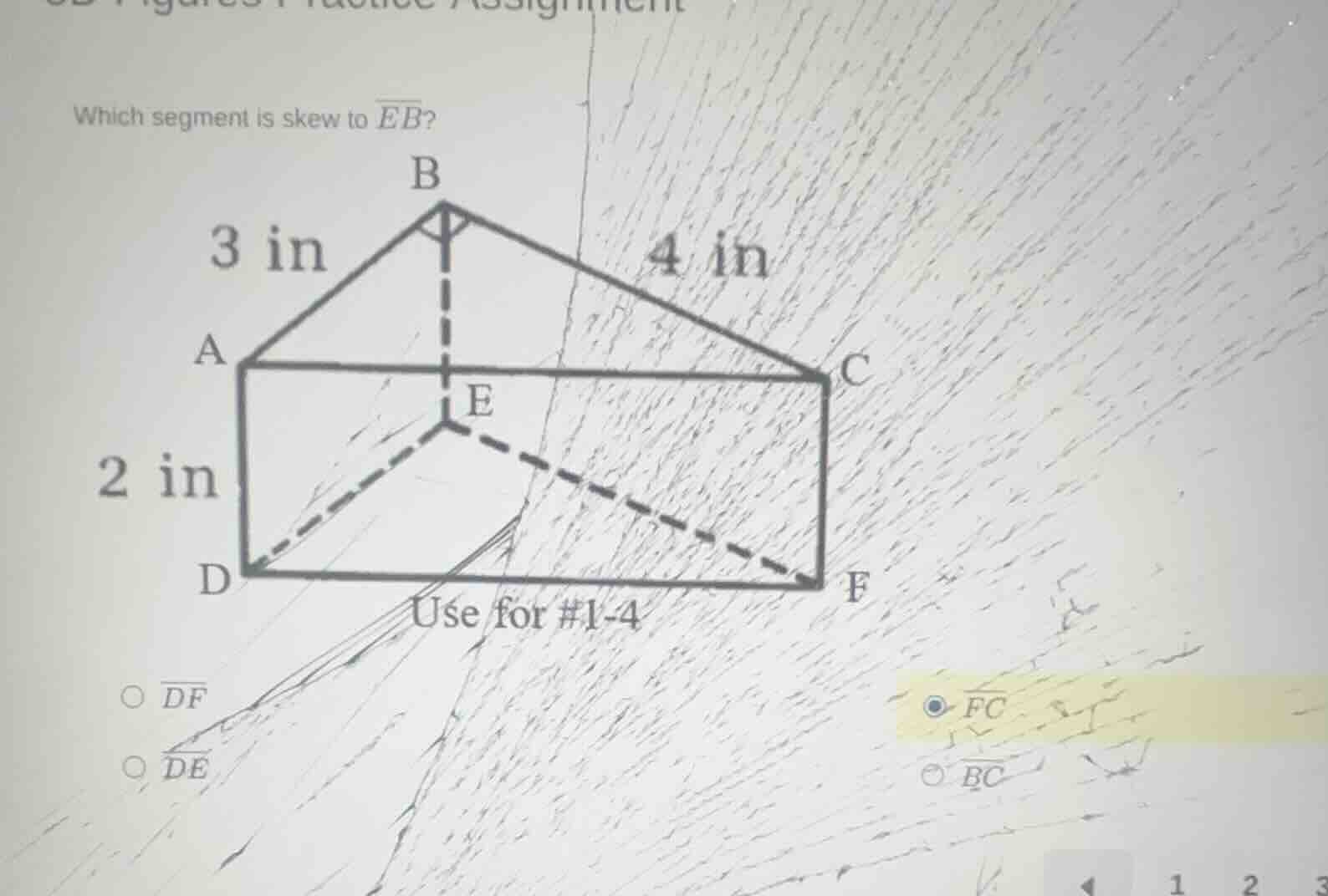
which segment is skew to \\(\overline{eb}\\)?
use for #1-4
\\(\bigcirc\\) \\(\overline{df}\\)
\\(\bigcirc\\) \\(\overline{de}\\)
\\(\bigcirc\\) \\(\overline{fc}\\)
\\(\bigcirc\\) \\(\overline{bc}\\)
🆕 New Concept Discovered: Skew Lines in 3D Space
Lines that never cross and are not parallel.
Step 1: Understand skew lines
In three-dimensional geometry, two line segments are skew if they satisfy two conditions:
- They do not intersect (they never touch).
- They are not parallel (they go in different directions).
This means they must lie in completely different, non-parallel planes.
Step 2: Analyze the target segment
We are looking for a segment skew to \(\overline{EB}\).
Let's locate \(\overline{EB}\) on the triangular prism:
- It is a vertical dashed segment connecting the back-bottom vertex \(E\) to the top vertex \(B\).
Step 3: Evaluate the given options
- \(\overline{DF}\): This is a horizontal segment along the bottom front. It lies in a completely different plane from \(\overline{EB}\), does not intersect \(\overline{EB}\), and is not parallel to it. Therefore, \(\overline{DF}\) is skew to \(\overline{EB}\).
- \(\overline{DE}\): This segment shares the vertex \(E\) with \(\overline{EB}\), meaning they intersect. Thus, they cannot be skew.
- \(\overline{FC}\): This is a vertical segment on the right side. Since \(\overline{EB}\) is also a vertical segment, \(\overline{FC}\) is parallel to \(\overline{EB}\). Thus, they cannot be skew.
- \(\overline{BC}\): This segment shares the vertex \(B\) with \(\overline{EB}\), meaning they intersect. Thus, they cannot be skew.

Snap & solve any problem in the app
Get step-by-step solutions on Sovi AI
Photo-based solutions with guided steps
Explore more problems and detailed explanations
\(\overline{DF}\)