QUESTION IMAGE
Question
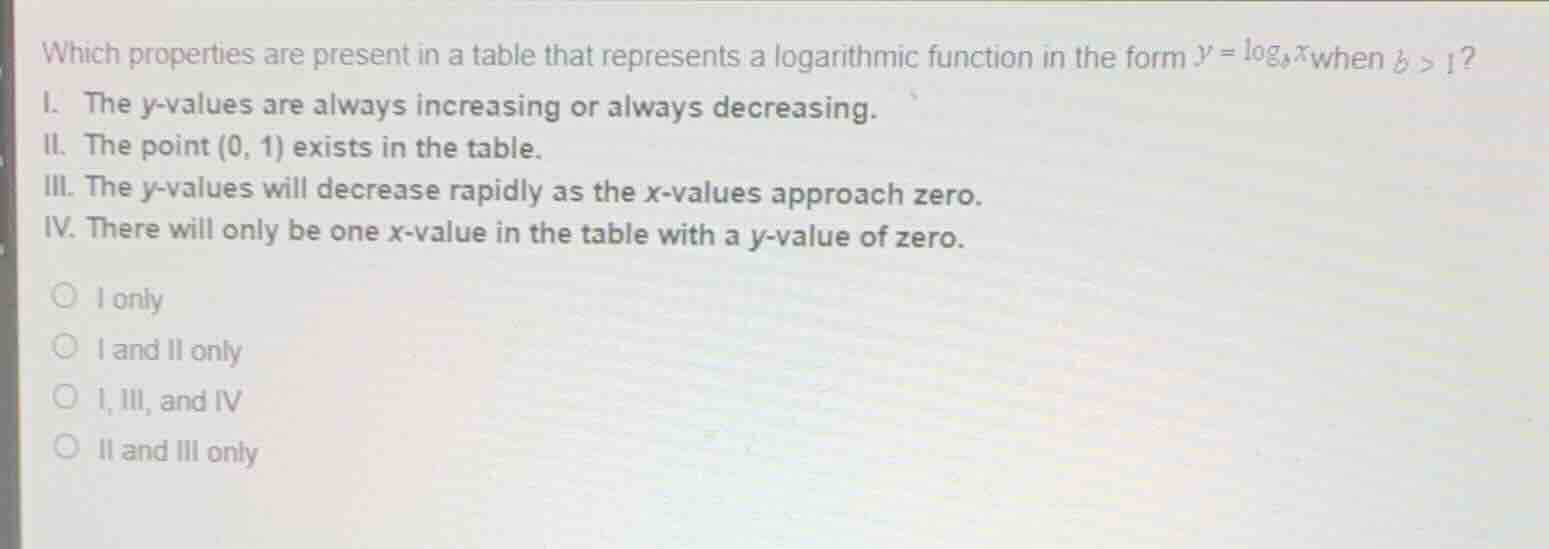
which properties are present in a table that represents a logarithmic function in the form (y = \log_b x) when (b > 1)?
i. the (y)-values are always increasing or always decreasing.
ii. the point ((0, 1)) exists in the table.
iii. the (y)-values will decrease rapidly as the (x)-values approach zero.
iv. there will only be one (x)-value in the table with a (y)-value of zero.
- i only
- i and ii only
- i, iii, and iv
- ii and iii only
Analyze Statement I
Using the Logarithmic Functions knowledge point
For \(y = \log_b x\) with \(b > 1\), the function is strictly increasing on its domain \((0, \infty)\). Therefore, as \(x\) increases, the \(y\)-values are always increasing. This makes Statement I true.
Analyze Statement II
Using the Logarithmic Intercepts knowledge point
For \(y = \log_b x\), the domain is \(x > 0\). Thus, \(x = 0\) is not in the domain, and the point \((0, 1)\) cannot exist. Instead, the point \((1, 0)\) exists. This makes Statement II false.
Analyze Statement III
Using the Asymptotic Behavior of Logarithms knowledge point
As \(x \to 0^+\) for \(b > 1\), \(y = \log_b x \to -\infty\). This means the \(y\)-values decrease rapidly (heading towards negative infinity) as \(x\)-values approach zero. This makes Statement III true.
Analyze Statement IV
Using the Logarithmic Intercepts knowledge point
The equation \(y = \log_b x = 0\) has exactly one solution, which is \(x = b^0 = 1\). Since logarithmic functions are one-to-one, there is only one \(x\)-value with a \(y\)-value of zero. This makes Statement IV true.
Determine the Correct Option
Combining the evaluations, Statements I, III, and IV are true, while Statement II is false. Thus, the correct choice is "I, III, and IV".

Snap & solve any problem in the app
Get step-by-step solutions on Sovi AI
Photo-based solutions with guided steps
Explore more problems and detailed explanations
- I only
- I and II only
- I, III, and IV (Correct answer)
- II and III only