QUESTION IMAGE
Question
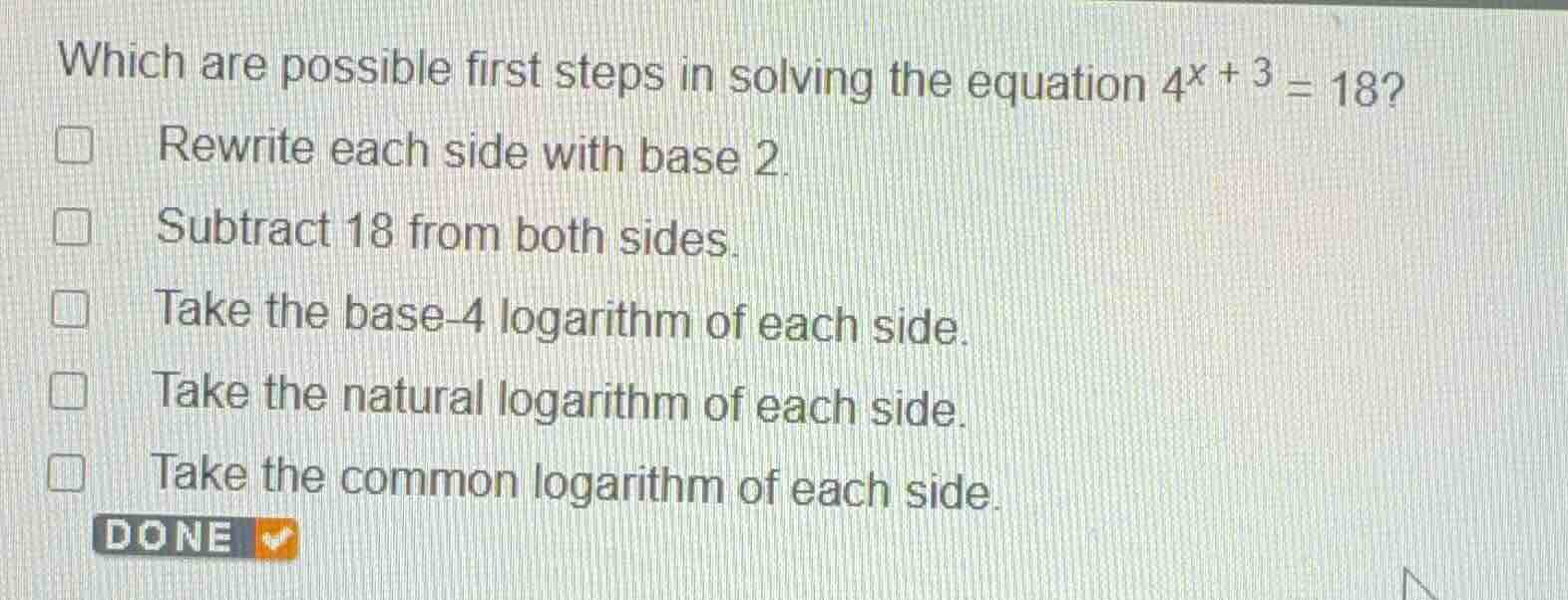
which are possible first steps in solving the equation \\(4^{x + 3} = 18\\)?
rewrite each side with base 2.
subtract 18 from both sides.
take the base-4 logarithm of each side.
take the natural logarithm of each side.
take the common logarithm of each side.
Analyze the given equation
Using the Solving Exponential Equations Algebraically knowledge point
Evaluate each proposed step
- Rewrite each side with base 2:
The left side can be written as \((2^2)^{x+3} = 2^{2x+6}\). However, \(18\) is not an integer power of \(2\) (\(18 = 2 \cdot 3^2\)), so we cannot easily rewrite both sides with a common base of \(2\) to solve it algebraically. Thus, this is not a practical first step.
- Subtract 18 from both sides:
This yields \(4^{x+3} - 18 = 0\). While mathematically valid, it does not help isolate the variable \(x\) from the exponent, so it is not a standard or helpful first step for solving.
- Take the base-4 logarithm of each side:
Applying \(\log_4\) to both sides:
This successfully isolates the linear exponent, making it a valid and helpful first step.
- Take the natural logarithm of each side:
Applying \(\ln\) to both sides:
This allows us to solve for \(x\) using the power rule of logarithms, making it a valid and helpful first step.
- Take the common logarithm of each side:
Applying \(\log_{10}\) (or \(\log\)) to both sides:
This also allows us to solve for \(x\) using the power rule of logarithms, making it a valid and helpful first step.

Snap & solve any problem in the app
Get step-by-step solutions on Sovi AI
Photo-based solutions with guided steps
Explore more problems and detailed explanations
- Rewrite each side with base 2.
- Subtract 18 from both sides.
- Take the base-4 logarithm of each side. (Correct answer)
- Take the natural logarithm of each side. (Correct answer)
- Take the common logarithm of each side. (Correct answer)