QUESTION IMAGE
Question
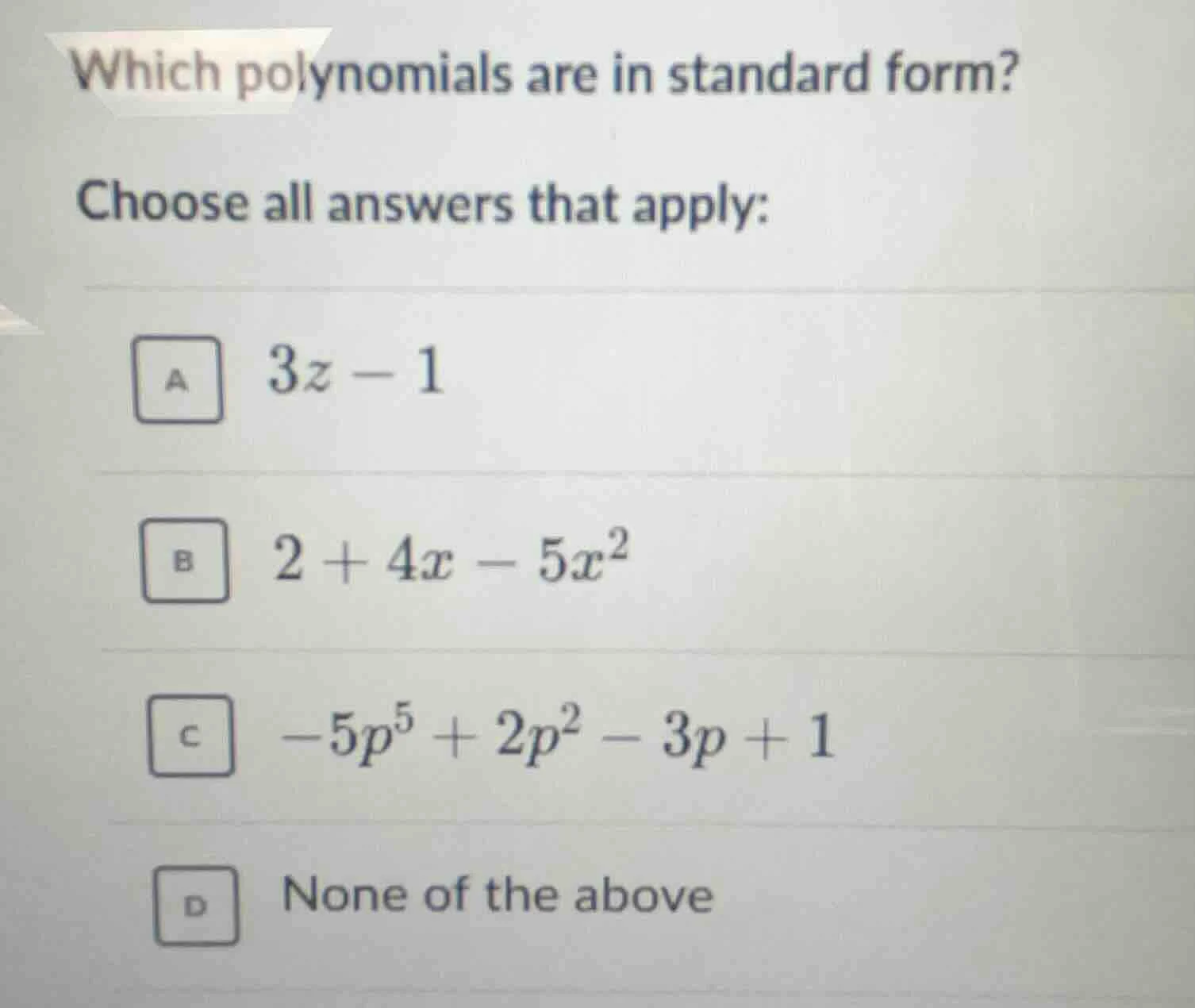
which polynomials are in standard form? choose all answers that apply: a $3z - 1$ b $2 + 4x - 5x^2$ c $-5p^5 + 2p^2 - 3p + 1$ d none of the above
Step1: Recall polynomial standard form
A polynomial in standard form is written with the terms in descending order of their exponents (degrees). For a single - variable polynomial \(a_nx^n + a_{n - 1}x^{n-1}+\cdots+a_1x + a_0\), the exponents of \(x\) should be in decreasing order from left to right.
Step2: Analyze Option A
For the polynomial \(3z - 1\), the term with \(z\) has an exponent of \(1\) and the constant term has an exponent of \(0\) (since \( - 1=-1z^0\)). The exponents are in descending order (\(1>0\)), so \(3z - 1\) is in standard form.
Step3: Analyze Option B
For the polynomial \(2 + 4x-5x^2\), let's look at the exponents of \(x\). The term \(2\) has an exponent of \(0\) ( \(2 = 2x^0\)), the term \(4x\) has an exponent of \(1\), and the term \(- 5x^2\) has an exponent of \(2\). The exponents are \(0,1,2\) which is in ascending order, not descending order. So \(2 + 4x - 5x^2\) is not in standard form. If we rewrite it in standard form, it should be \(-5x^2+4x + 2\).
Step4: Analyze Option C
For the polynomial \(-5p^5+2p^2 - 3p + 1\), the exponents of \(p\) are \(5,2,1,0\) (the constant term \(1 = 1p^0\)). The exponents are in descending order (\(5>2>1>0\)), so \(-5p^5 + 2p^2-3p + 1\) is in standard form.

Snap & solve any problem in the app
Get step-by-step solutions on Sovi AI
Photo-based solutions with guided steps
Explore more problems and detailed explanations
A. \(3z - 1\)
C. \(-5p^5 + 2p^2-3p + 1\)