QUESTION IMAGE
Question
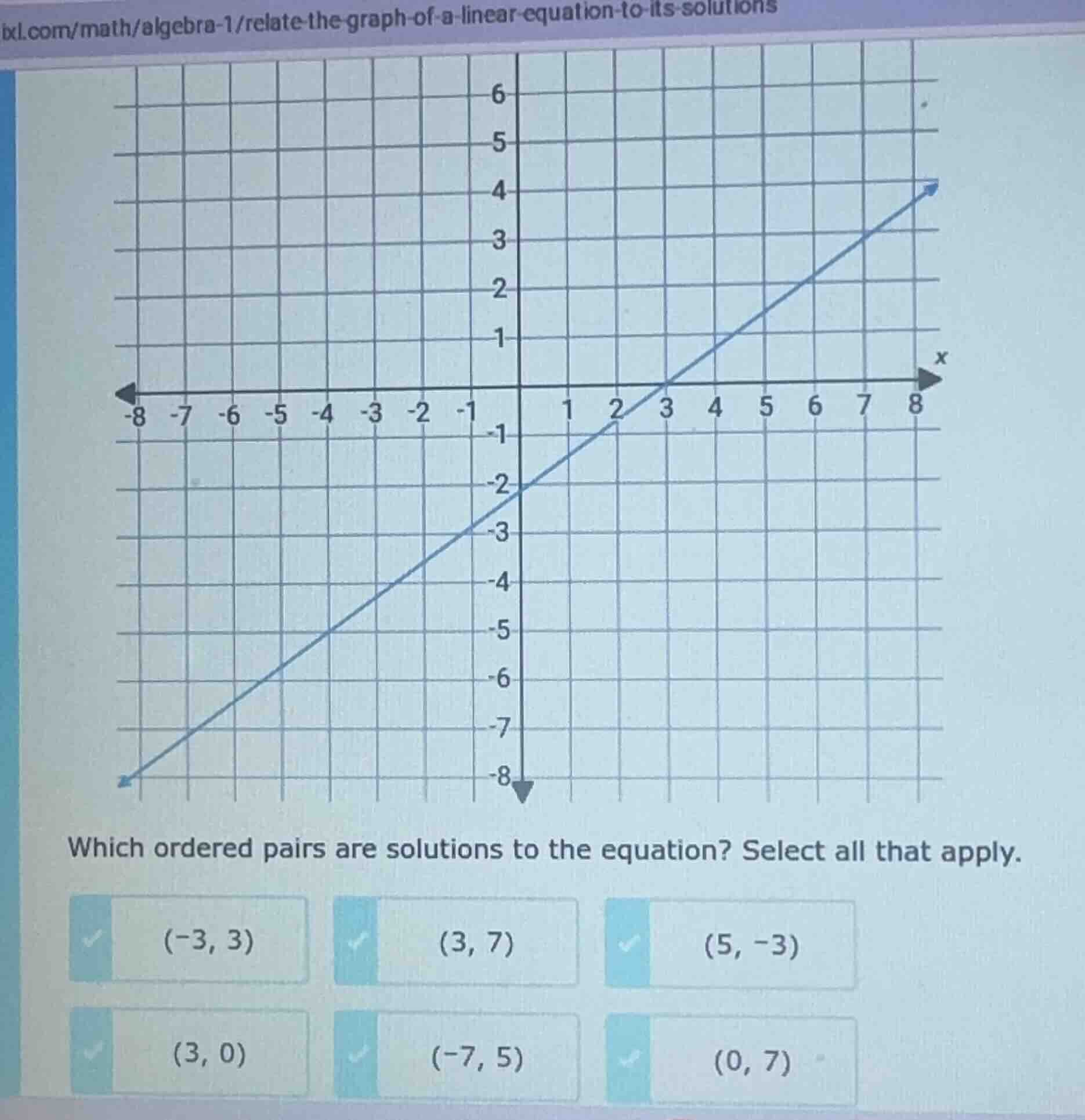
which ordered pairs are solutions to the equation? select all that apply. (-3, 3) (3, 7) (5, -3) (3, 0) (-7, 5) (0, 7)
Step1: Find the equation of the line
First, we identify two points on the line. From the graph, we can see that the line passes through \((0, -2)\) (the y - intercept) and \((3, 0)\). The slope \(m\) of a line passing through two points \((x_1,y_1)\) and \((x_2,y_2)\) is given by \(m=\frac{y_2 - y_1}{x_2 - x_1}\). Using \((0,-2)\) as \((x_1,y_1)\) and \((3,0)\) as \((x_2,y_2)\), we have \(m=\frac{0-(-2)}{3 - 0}=\frac{2}{3}\). The equation of a line in slope - intercept form is \(y=mx + b\), where \(b\) is the y - intercept. Here, \(m = \frac{2}{3}\) and \(b=-2\), so the equation of the line is \(y=\frac{2}{3}x-2\).
Step2: Check each ordered pair:
- For \((-3,3)\):
Substitute \(x=-3\) and \(y = 3\) into the equation \(y=\frac{2}{3}x-2\).
Right - hand side (RHS): \(\frac{2}{3}(-3)-2=-2 - 2=-4
eq3\). Wait, there is a mistake here. Wait, maybe I misread the graph. Let's re - check the graph. Wait, looking at the graph, the line passes through \((0,-2)\) and \((3,0)\), let's recalculate the slope. Wait, from \((0,-2)\) to \((3,0)\), the rise is \(0 - (-2)=2\), run is \(3-0 = 3\), so slope is \(\frac{2}{3}\). Wait, maybe the points are different. Wait, let's take another point. If \(x = 3\), \(y=0\); \(x = 6\), \(y = 2\) (since from \(x = 3\) to \(x = 6\), \(x\) increases by 3, \(y\) increases by 2). So the equation is \(y=\frac{2}{3}x - 2\).
Wait, let's check \((3,0)\): Substitute \(x = 3\) into \(y=\frac{2}{3}x-2\), we get \(y=\frac{2}{3}(3)-2=2 - 2=0\), which is correct.
Check \((-3,y)\): Substitute \(x=-3\) into \(y=\frac{2}{3}x-2\), \(y=\frac{2}{3}(-3)-2=-2 - 2=-4
eq3\). Wait, maybe my initial point selection is wrong. Wait, maybe the line passes through \((0,-2)\) and \((3,0)\) is incorrect. Wait, looking at the graph again, maybe the y - intercept is \((0,-2)\) and when \(x = 3\), \(y = 0\); when \(x=6\), \(y = 2\); when \(x=-3\), let's calculate \(y\): \(y=\frac{2}{3}(-3)-2=-2 - 2=-4\), but the point \((-3,3)\) is not on the line. Wait, maybe I made a mistake in the equation. Wait, let's check the point \((3,0)\): it is on the line. Let's check \((0,-2)\): on the line. Let's check \((5,y)\): \(y=\frac{2}{3}(5)-2=\frac{10}{3}-2=\frac{10 - 6}{3}=\frac{4}{3}
eq - 3\). Wait, there is a problem. Wait, maybe the slope is \(1\)? Wait, from \((0,-2)\) to \((3,1)\)? No, the graph shows that at \(x = 3\), \(y = 0\); \(x=0\), \(y=-2\). Wait, maybe the user's initial check of the boxes is wrong. Wait, let's do it properly.
The correct way: A solution to the equation of the line is a point that lies on the line. So we can check if the point is on the line by seeing if it lies on the graphed line.
Looking at the graph:
- \((3,0)\): This point is on the line (we can see from the graph that the line crosses the x - axis at \(x = 3\)).
- \((0,-2)\): On the y - axis, the line crosses at \(y=-2\) when \(x = 0\).
- Let's check \((-3, - 4)\): If we move 3 units to the left from \(x = 0\) (to \(x=-3\)), since the slope is \(\frac{2}{3}\), we move down 2 units from \(y=-2\) (because slope is rise over run, so run=-3, rise=\(m\times\)run=\(\frac{2}{3}\times(-3)=-2\)), so \(y=-2-2=-4\). So \((-3,3)\) is not on the line.
- \((3,7)\): Let's substitute \(x = 3\) into the equation \(y=\frac{2}{3}x-2\), \(y=\frac{2}{3}(3)-2=0
eq7\), so \((3,7)\) is not on the line.
- \((5,-3)\): Substitute \(x = 5\) into \(y=\frac{2}{3}x-2\), \(y=\frac{2}{3}(5)-2=\frac{10 - 6}{3}=\frac{4}{3}
eq - 3\), not on the line.
- \((-7,5)\): Substitute \(x=-7\) into \(y=\frac{2}{3}x-2\), \(y=\frac{2}{3}(-7)-2=\frac{-14 - 6}{3}=\frac{-20}{3}\approx - 6.67
eq5\), not on the…

Snap & solve any problem in the app
Get step-by-step solutions on Sovi AI
Photo-based solutions with guided steps
Explore more problems and detailed explanations
The only ordered pair that is a solution to the equation of the line (based on the graph) is \((3,0)\)