QUESTION IMAGE
Question
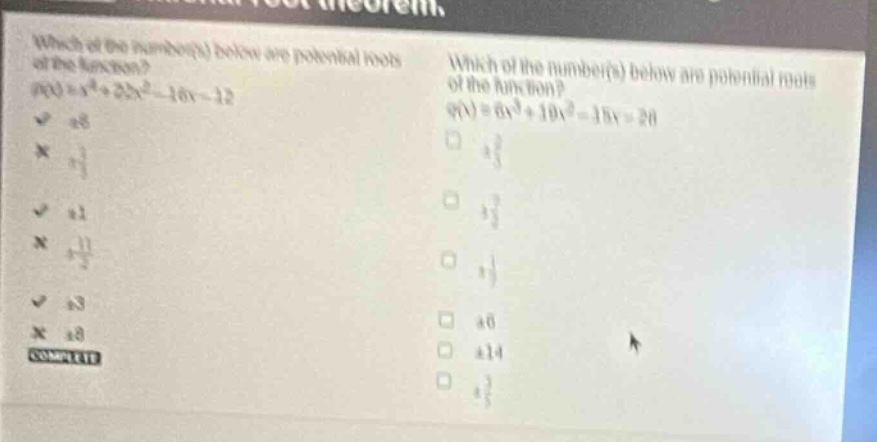
which of the number(s) below are potential roots of the function?
\\(p(x) = x^4 + 22x^2 - 16x - 12\\)
- x \\(\pm 6\\)
- \\(\pm \frac{1}{3}\\)
- x \\(\pm 1\\)
- \\(\pm \frac{11}{2}\\)
- x \\(\pm 3\\)
- \\(\pm 8\\)
which of the number(s) below are potential roots of the function?
\\(q(x) = 6x^3 + 19x^2 - 15x - 28\\)
- \\(\pm \frac{9}{2}\\)
- \\(\pm \frac{5}{6}\\)
- \\(\pm \frac{1}{3}\\)
- \\(\pm 6\\)
- \\(\pm 14\\)
- \\(\pm \frac{7}{3}\\)
🆕 New Concept Discovered: Rational Root Theorem
Finding possible rational solutions of a polynomial.
Step 1: Identify the constant term and leading coefficient
For the polynomial function \( q(x) = 6x^3 + 19x^2 - 15x - 20 \):
- The constant term \( p \) is \( -20 \).
- The leading coefficient \( q \) is \( 6 \).
Step 2: Find the factors of \( p \) and \( q \)
- Factors of \( p = -20 \) (denoted as \( p \)):
$$ \pm 1, \pm 2, \pm 4, \pm 5, \pm 10, \pm 20 $$
- Factors of \( q = 6 \) (denoted as \( q \)):
$$ \pm 1, \pm 2, \pm 3, \pm 6 $$
Step 3: Form the potential rational roots \( \frac{p}{q} \)
According to the Rational Root Theorem, any potential rational root must be of the form \( \pm \frac{p}{q} \):
- Dividing the factors of \( 20 \) by \( 1 \):
$$ \pm 1, \pm 2, \pm 4, \pm 5, \pm 10, \pm 20 $$
- Dividing the factors of \( 20 \) by \( 2 \):
$$ \pm \frac{1}{2}, \pm \frac{5}{2} \quad (\text{others simplify to integers already listed}) $$
- Dividing the factors of \( 20 \) by \( 3 \):
$$ \pm \frac{1}{3}, \pm \frac{2}{3}, \pm \frac{4}{3}, \pm \frac{5}{3}, \pm \frac{10}{3}, \pm \frac{20}{3} $$
- Dividing the factors of \( 20 \) by \( 6 \):
$$ \pm \frac{1}{6}, \pm \frac{5}{6} \quad (\text{others simplify to fractions already listed}) $$
Step 4: Compare with the given options
Let's evaluate the visible options from the image:
- \( \pm \frac{5}{3} \): This is a valid potential root because \( 5 \) is a factor of \( 20 \) and \( 3 \) is a factor of \( 6 \).
- \( \pm \frac{10}{3} \): This is a valid potential root because \( 10 \) is a factor of \( 20 \) and \( 3 \) is a factor of \( 6 \).
- \( \pm \frac{1}{3} \): This is a valid potential root because \( 1 \) is a factor of \( 20 \) and \( 3 \) is a factor of \( 6 \).
- \( \pm 6 \): Not a potential root because \( 6 \) is not a factor of \( 20 \).
- \( \pm 14 \): Not a potential root because \( 14 \) is not a factor of \( 20 \).
- \( \pm \frac{5}{2} \): This is a valid potential root because \( 5 \) is a factor of \( 20 \) and \( 2 \) is a factor of \( 6 \).

Snap & solve any problem in the app
Get step-by-step solutions on Sovi AI
Photo-based solutions with guided steps
Explore more problems and detailed explanations
The potential roots of the function from the given options are:
- \( \pm \frac{5}{3} \)
- \( \pm \frac{10}{3} \)
- \( \pm \frac{1}{3} \)
- \( \pm \frac{5}{2} \)