QUESTION IMAGE
Question
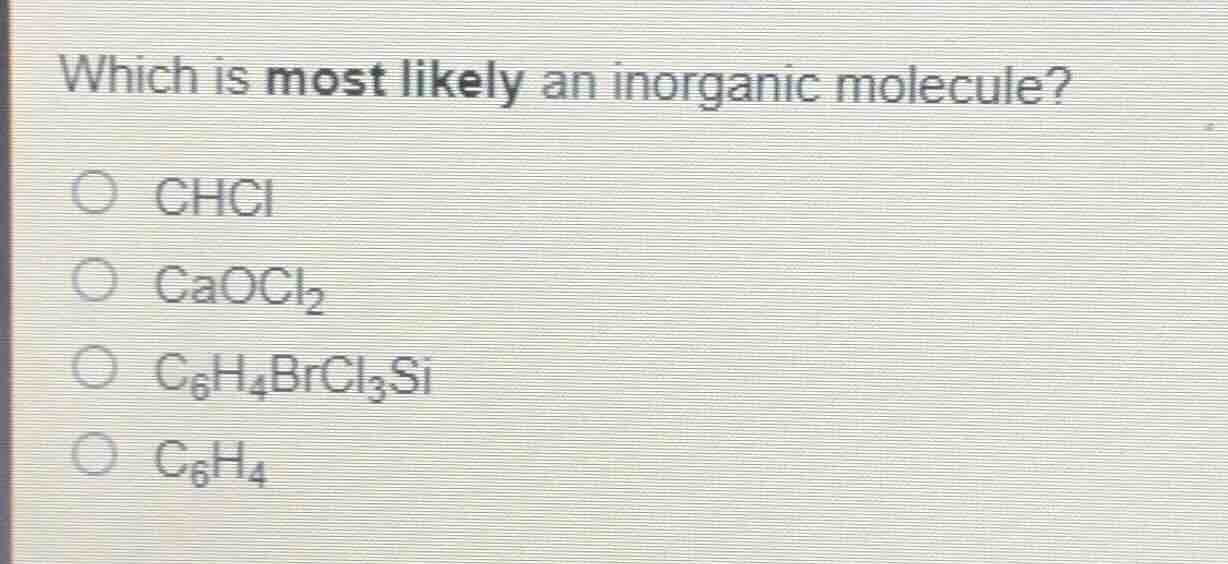
which is most likely an inorganic molecule?
- \\(\text{chcl}\\)
- \\(\text{caocl}_2\\)
- \\(\text{c}_6\text{h}_4\text{brcl}_3\text{si}\\)
- \\(\text{c}_6\text{h}_4\\)
Define organic and inorganic compounds
Using the Organic Compounds and Inorganic Compounds knowledge points:
- Organic compounds contain carbon-hydrogen (\(\text{C}-\text{H}\)) bonds.
- Inorganic compounds generally lack carbon-hydrogen bonds and are often mineral-based.
Analyze the first option
Using the Organic Compounds knowledge point:
- \(\text{CHCl}_3\) (chloroform) contains carbon, hydrogen, and chlorine.
- It contains a \(\text{C}-\text{H}\) bond, making it organic.
Analyze the second option
Using the Inorganic Compounds knowledge point:
- \(\text{CaOCl}_2\) (calcium hypochlorite) is an ionic mineral salt.
- It contains no carbon, making it inorganic.
Analyze the third and fourth options
Using the Organic Compounds knowledge point:
- \(\text{C}_6\text{H}_4\text{BrCl}_3\text{Si}\) contains carbon and hydrogen, making it organic.
- \(\text{C}_6\text{H}_4\) (benzyne intermediate) contains carbon and hydrogen, making it organic.

Snap & solve any problem in the app
Get step-by-step solutions on Sovi AI
Photo-based solutions with guided steps
Explore more problems and detailed explanations
- (A) \(\text{CHCl}_3\)
- (B) \(\text{CaOCl}_2\) (Correct answer)
- (C) \(\text{C}_6\text{H}_4\text{BrCl}_3\text{Si}\)
- (D) \(\text{C}_6\text{H}_4\)