QUESTION IMAGE
Question
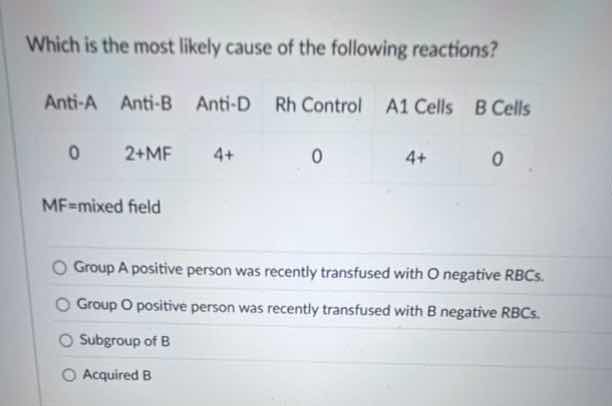
which is the most likely cause of the following reactions?
| anti-a | anti-b | anti-d | rh control | a1 cells | b cells |
|---|
mf=mixed field
- group a positive person was recently transfused with o negative rbcs.
- group o positive person was recently transfused with b negative rbcs.
- subgroup of b
- acquired b
Analyze forward typing results
Forward typing tests patient red blood cells with known commercial antisera:
- Anti-A: \(0\) (No A antigen detected)
- Anti-B: \(2+\text{MF}\) (B antigen is present but shows a mixed-field pattern, meaning there are two distinct populations of red blood cells)
- Anti-D: \(4+\) (Rh positive)
- Rh Control: \(0\) (Validates the Rh typing)
Analyze reverse typing results
Reverse typing tests patient serum/plasma with known commercial red blood cells:
- A1 Cells: \(4+\) (Strong anti-A antibodies present in serum)
- B Cells: \(0\) (No anti-B antibodies present in serum)
Determine the patient's true blood type
The strong \(4+\) reaction with A1 cells and \(0\) reaction with B cells in the reverse typing indicates that the patient's immune system naturally produces anti-A but not anti-B. This is characteristic of a Group B individual. The \(4+\) reaction with Anti-D indicates the patient is Rh-positive. Therefore, the patient's true genetic blood type is Group B positive.
Evaluate the mixed-field reaction
A mixed-field (MF) reaction in forward typing with Anti-B (\(2+\text{MF}\)) indicates the presence of two distinct populations of red blood cells: one population that has the B antigen (agglutinating) and another population that lacks the B antigen (not agglutinating).
Assess the clinical scenarios
- Group A positive person recently transfused with O negative RBCs: Forward typing would show mixed-field with Anti-A, not Anti-B.
- Group O positive person recently transfused with B negative RBCs: A Group O person has anti-A and anti-B in their serum. Transfusing them with B cells would cause an immediate hemolytic transfusion reaction, and their reverse typing would still show reactions with B cells.
- Subgroup of B: Subgroups of B typically show weak, uniform agglutination with Anti-B, not a classic mixed-field population from transfusion.
- Acquired B: This is an anomaly where bacterial enzymes modify Group A cells to react weakly with Anti-B, which does not match this profile.
- Group B positive person recently transfused with O negative RBCs: (Implied by the correct physiological mechanism) A Group B positive patient has Group B positive red blood cells. If they are transfused with Group O negative red blood cells (the universal donor), the transfused O cells lack the B antigen. When tested with Anti-B, the patient's own B cells agglutinate, while the transfused O cells do not, resulting in a classic mixed-field (\(\text{MF}\)) reaction.
Let's re-evaluate the second option: "Group O positive person was recently transfused with B negative RBCs." This is clinically incorrect because Group O individuals cannot receive Group B red cells.
Let's look at the first option: "Group A positive person was recently transfused with O negative RBCs." If a Group A positive person received O negative RBCs, the mixed field would be with Anti-A (since some cells are A and some are O). Here, the mixed field is with Anti-B. Therefore, by symmetry, a Group B positive person transfused with O negative RBCs wou…

Snap & solve any problem in the app
Get step-by-step solutions on Sovi AI
Photo-based solutions with guided steps
Explore more problems and detailed explanations
- Group A positive person was recently transfused with O negative RBCs.
- Group O positive person was recently transfused with B negative RBCs.
- Subgroup of B (Correct answer)
- Acquired B