QUESTION IMAGE
Question
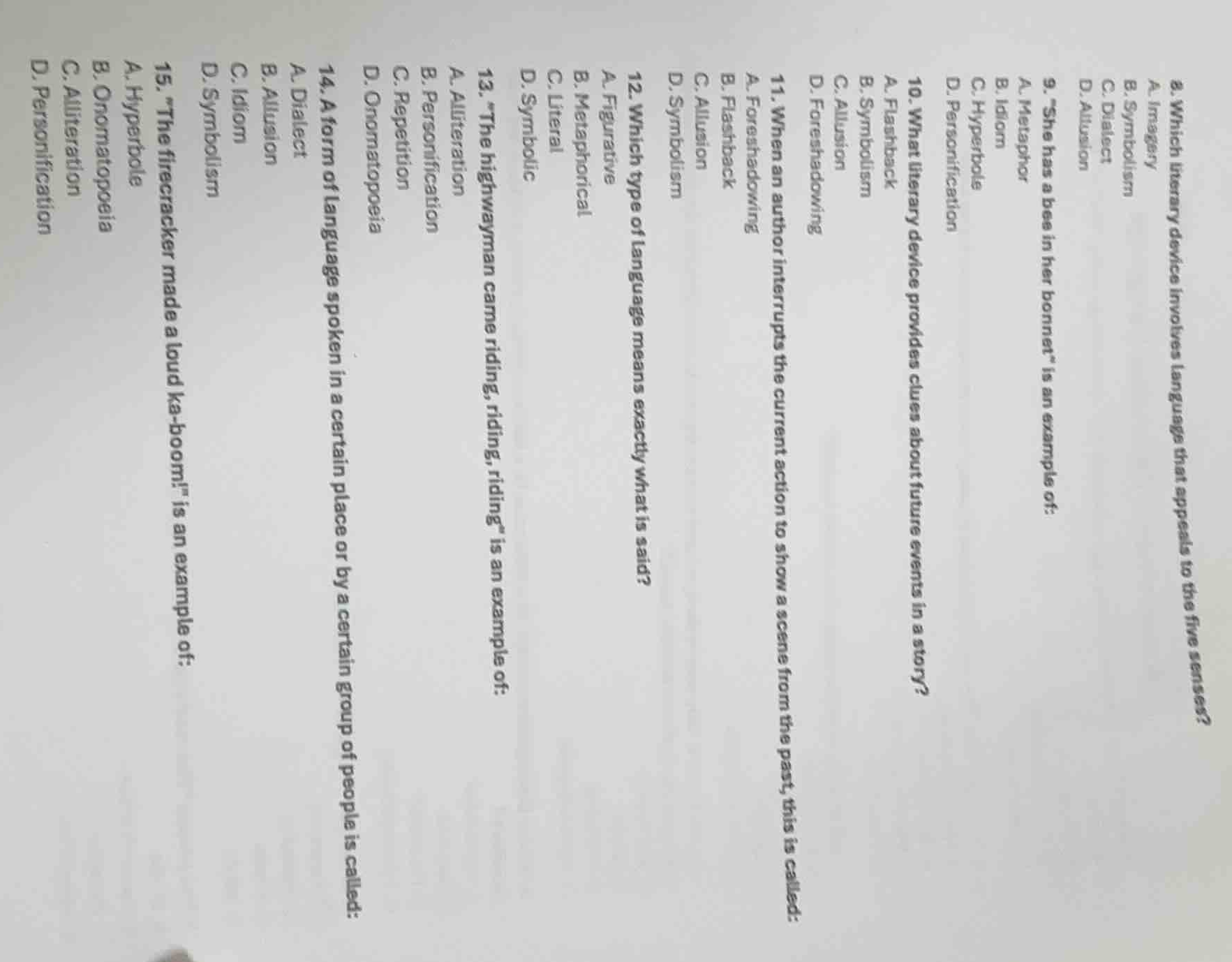
- which literary device involves language that appeals to the five senses?
a. imagery
b. symbolism
c. dialect
d. allusion
- \she has a bee in her bonnet\ is an example of:
a. metaphor
b. idiom
c. hyperbole
d. personification
- what literary device provides clues about future events in a story?
a. flashback
b. symbolism
c. allusion
d. foreshadowing
- when an author interrupts the current action to show a scene from the past, this is called:
a. foreshadowing
b. flashback
c. allusion
d. symbolism
- which type of language means exactly what is said?
a. figurative
b. metaphorical
c. literal
d. symbolic
- \the highwayman came riding, riding, riding\ is an example of:
a. alliteration
b. personification
c. repetition
d. onomatopoeia
- a form of language spoken in a certain place or by a certain group of people is called:
a. dialect
b. allusion
c. idiom
d. symbolism
- \the firecracker made a loud ka-boom!\ is an example of:
a. hyperbole
b. onomatopoeia
c. alliteration
d. personification
Analyze Question 8
Using the Imagery knowledge point
The question asks which literary device involves language appealing to the five senses. Imagery is explicitly defined as vivid sensory description that helps readers visualize or feel the scene.
- (A) Imagery: Correct.
- (B) Symbolism: Represents ideas beyond literal meaning.
- (C) Dialect: A regional variety of language.
- (D) Allusion: An indirect reference to another work or event.
Analyze Question 9
Using the Metaphor and Hyperbole knowledge points
The phrase "She has a bee in her bonnet" is a well-known expression meaning someone is obsessed or preoccupied with an idea. Since it cannot be understood literally and is a common cultural expression, it is an idiom.
- (A) Metaphor: A direct comparison without "like" or "as".
- (B) Idiom: Correct, as it is an established expression with a figurative meaning.
- (C) Hyperbole: An extreme exaggeration.
- (D) Personification: Giving human traits to non-human things.
Analyze Question 10
Using the Foreshadowing and Flashback knowledge points
The question asks for the device that provides clues about future events in a story. This is the definition of foreshadowing.
- (A) Flashback: Interruption to show past events.
- (B) Symbolism: Using symbols to represent ideas.
- (C) Allusion: Reference to external people, places, or events.
- (D) Foreshadowing: Correct.
Analyze Question 11
Using the Flashback and Foreshadowing knowledge points
The question describes an author interrupting the current action to show a scene from the past. This is the definition of a flashback.
- (A) Foreshadowing: Clues about the future.
- (B) Flashback: Correct.
- (C) Allusion: Reference to another work.
- (D) Symbolism: Representing deeper meanings.
Analyze Question 12
We need to identify the type of language that means exactly what is said.
- (A) Figurative: Uses figures of speech to mean something deeper.
- (B) Metaphorical: Uses comparisons.
- (C) Literal: Means exactly what is written or spoken without exaggeration or subtext. Correct.
- (D) Symbolic: Uses symbols to represent other concepts.
Analyze Question 13
Using the Alliteration and Personification knowledge points
The line "The highwayman came riding, riding, riding" repeats the word "riding" multiple times to emphasize the action and create rhythm. This is a clear example of repetition.
- (A) Alliteration: Repetition of initial consonant sounds.
- (B) Personification: Giving human qualities to non-human things.
- (C) Repetition: Correct.
- (D) Onomatopoeia: Words that mimic sounds.
Analyze Question 14
We need to identify the term for a form of language spoken in a certain place or by a certain group of people.
- (A) Dialect: A regional or social variety of a language distinguished by pronunciation, grammar, or vocabulary. Correct…

Snap & solve any problem in the app
Get step-by-step solutions on Sovi AI
Photo-based solutions with guided steps
Explore more problems and detailed explanations
Question 8
- (A) Imagery (Correct answer)
- (B) Symbolism
- (C) Dialect
- (D) Allusion
Question 9
- (A) Metaphor
- (B) Idiom (Correct answer)
- (C) Hyperbole
- (D) Personification
Question 10
- (A) Flashback
- (B) Symbolism
- (C) Allusion
- (D) Foreshadowing (Correct answer)
Question 11
- (A) Foreshadowing
- (B) Flashback (Correct answer)
- (C) Allusion
- (D) Symbolism
Question 12
- (A) Figurative
- (B) Metaphorical
- (C) Literal (Correct answer)
- (D) Symbolic
Question 13
- (A) Alliteration
- (B) Personification
- (C) Repetition (Correct answer)
- (D) Onomatopoeia
Question 14
- (A) Dialect (Correct answer)
- (B) Allusion
- (C) Idiom
- (D) Symbolism
Question 15
- (A) Hyperbole
- (B) Onomatopoeia (Correct answer)
- (C) Alliteration
- (D) Personification