QUESTION IMAGE
Question
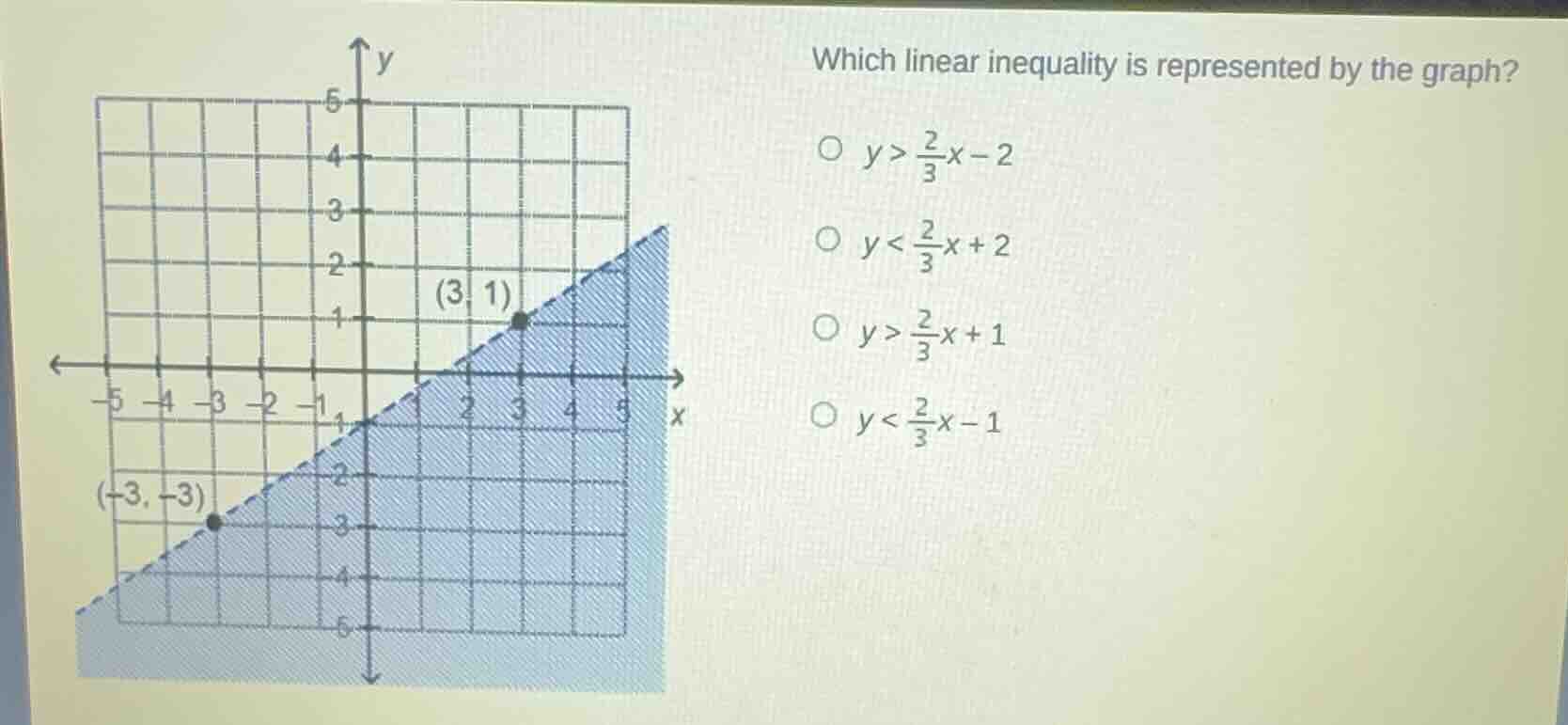
which linear inequality is represented by the graph?
options:
- $y > \frac{2}{3}x - 2$
- $y < \frac{2}{3}x + 2$
- $y > \frac{2}{3}x + 1$
- $y < \frac{2}{3}x - 1$
graph has points (-3, -3) and (3, 1), shaded region, grid with x and y axes.
Step1: Find the slope of the line
The two points on the line are \((-3, -3)\) and \((3, 1)\). The slope \(m\) is calculated as \(m=\frac{y_2 - y_1}{x_2 - x_1}=\frac{1 - (-3)}{3 - (-3)}=\frac{4}{6}=\frac{2}{3}\).
Step2: Find the y - intercept
Using the point - slope form \(y - y_1=m(x - x_1)\) with the point \((3,1)\) and \(m = \frac{2}{3}\).
\(y-1=\frac{2}{3}(x - 3)\)
\(y-1=\frac{2}{3}x-2\)
\(y=\frac{2}{3}x - 1\)
The line is dashed, so the inequality is either \(y>\frac{2}{3}x - 1\) or \(y<\frac{2}{3}x - 1\).
We test a point in the shaded region. Let's take the origin \((0,0)\).
Substitute \(x = 0\) and \(y = 0\) into the inequality \(y<\frac{2}{3}x-1\):
\(0<\frac{2}{3}(0)-1\)
\(0 < - 1\), which is false.
Substitute \(x = 0\) and \(y = 0\) into the inequality \(y>\frac{2}{3}x - 1\):
\(0>\frac{2}{3}(0)-1\)
\(0>-1\), which is true. Wait, no, wait. Wait, the shaded region: let's check the point \((0, - 1.5)\) (not on the line). Wait, maybe I made a mistake. Wait, the two points are \((-3,-3)\) and \((3,1)\). Wait, let's recalculate the equation.
Wait, another way: the line passes through \((0,-1)\) (when \(x = 0\), from the graph, the line crosses the y - axis at \((0,-1)\)) and \((3,1)\). So slope \(m=\frac{1-(-1)}{3 - 0}=\frac{2}{3}\). So the equation of the line is \(y=\frac{2}{3}x-1\).
Now, the shaded region: let's take the point \((3,1)\) is on the line. Let's take a point in the shaded region, say \((0,0)\). Wait, no, the shaded region is below or above? Wait, the graph: the line goes from \((-3,-3)\) to \((3,1)\) to \((0,-1)\). Wait, when \(x = 0\), \(y=-1\). The shaded region: let's check the inequality sign. The line is dashed, so the inequality is strict. Let's take the point \((0,0)\). If we plug into \(y>\frac{2}{3}x - 1\), \(0>-1\) (true). But wait, the options: the first option is \(y>\frac{2}{3}x-2\), second \(y<\frac{2}{3}x + 2\), third \(y>\frac{2}{3}x+1\), fourth \(y<\frac{2}{3}x-1\). Wait, I think I made a mistake in the point selection. Wait, let's check the point \((3,1)\) in the options.
Wait, let's re - do the slope calculation. The two points are \((-3,-3)\) and \((3,1)\). The slope \(m=\frac{1-(-3)}{3-(-3)}=\frac{4}{6}=\frac{2}{3}\). The equation of the line using point - slope form with \((-3,-3)\): \(y + 3=\frac{2}{3}(x + 3)\), \(y+3=\frac{2}{3}x + 2\), \(y=\frac{2}{3}x-1\). Correct.
Now, the inequality: the shaded region. Let's take the point \((0,-2)\) (in the shaded region). Plug into \(y<\frac{2}{3}x-1\): \(-2<\frac{2}{3}(0)-1=-1\), which is true. Plug into \(y>\frac{2}{3}x - 1\): \(-2>\frac{2}{3}(0)-1=-1\), which is false. Wait, so maybe the line is \(y=\frac{2}{3}x-1\) and the shaded region is below the line, so \(y<\frac{2}{3}x-1\)? But when we plug \((0,0)\) into \(y<\frac{2}{3}x-1\), \(0<-1\) is false. Plug \((0,-2)\) into \(y<\frac{2}{3}x-1\): \(-2<-1\) is true. Plug \((0,-2)\) into \(y>\frac{2}{3}x-1\): \(-2>-1\) is false. So the correct inequality is \(y<\frac{2}{3}x-1\)? Wait, but the options: the fourth option is \(y<\frac{2}{3}x-1\). Wait, but let's check the point \((3,1)\) in the fourth option: \(1<\frac{2}{3}(3)-1=2 - 1 = 1\), which is false. Wait, that's a problem. Wait, the point \((3,1)\) is on the line, so it should satisfy the equality, but the inequality is strict, so \((3,1)\) is not in the solution set. Wait, maybe I made a mistake in the line equation.
Wait, let's find two points correctly. From the graph, the line passes through \((-3,-3)\) and \((3,1)\). Let's find the equation again. The slope \(m=\frac{1 - (-3)}{3-(-3)}=\frac{4}{6}=\frac{2}{3}\). Using point - slope form wi…

Snap & solve any problem in the app
Get step-by-step solutions on Sovi AI
Photo-based solutions with guided steps
Explore more problems and detailed explanations
\(y>\frac{2}{3}x - 2\) (the first option: \(y>\frac{2}{3}x-2\))