Sovi.AI - AI Math Tutor

Scan to solve math questions

QUESTION IMAGE

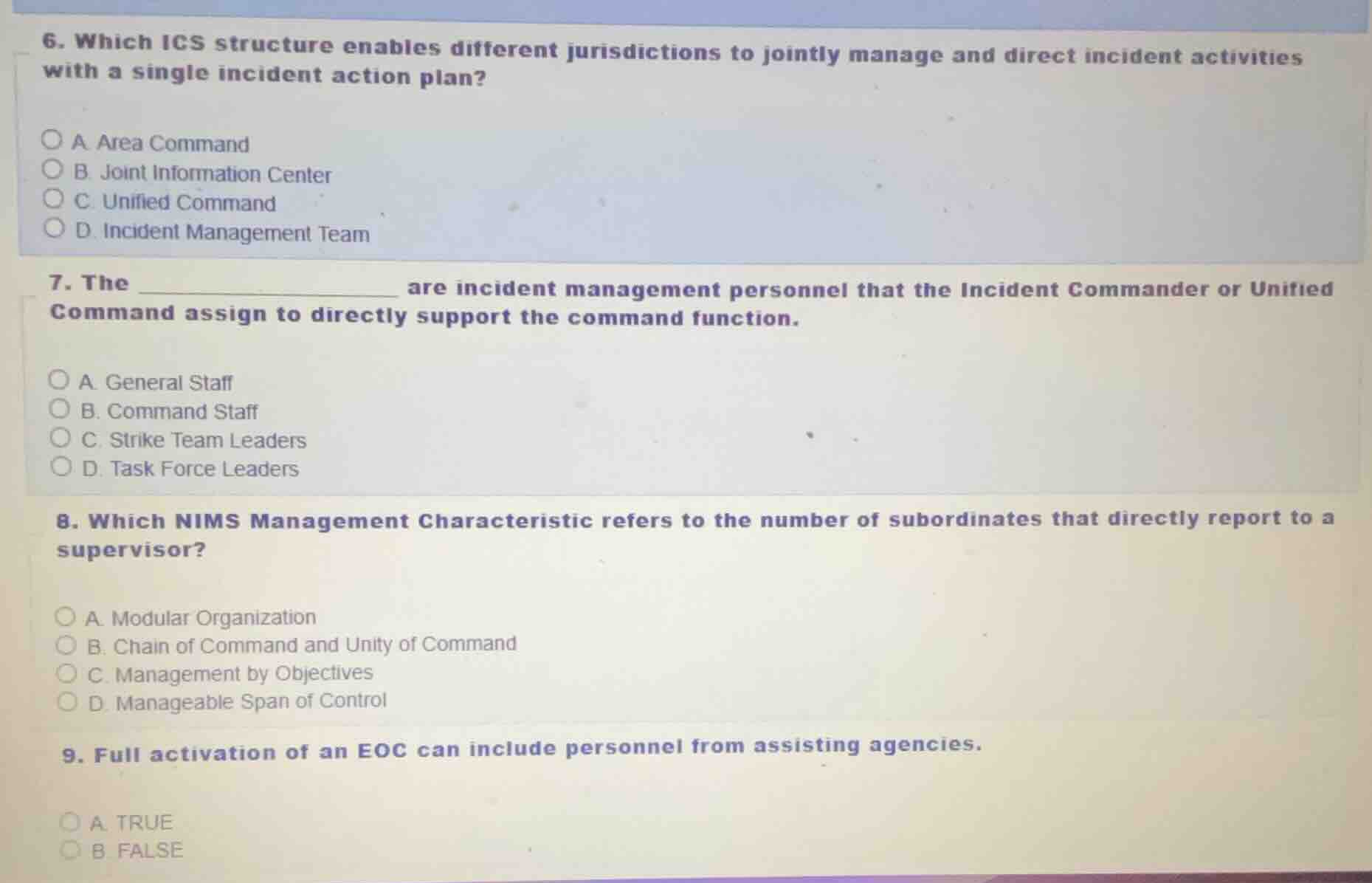
6. which ics structure enables different jurisdictions to jointly manag…

Question

  1. which ics structure enables different jurisdictions to jointly manage and direct incident activities with a single incident action plan?

a. area command
b. joint information center
c. unified command
d. incident management team

  1. the ________ are incident management personnel that the incident commander or unified command assign to directly support the command function.

a. general staff
b. command staff
c. strike team leaders
d. task force leaders

  1. which nims management characteristic refers to the number of subordinates that directly report to a supervisor?

a. modular organization
b. chain of command and unity of command
c. management by objectives
d. manageable span of control

  1. full activation of an eoc can include personnel from assisting agencies.

a. true
b. false

Explanation:

Response

<pre_analysis>
{
"quality": "clear",
"question_count": 4,
"skills_matched": [
"direct_cot",
"multiple_choice_formatter",
"explain_then_answer",
"tutor",
"mastery_adaptive_brevity"
],
"needs_drawing": false,
"concepts_used": [
"Incident Command System",
"EOC Activation Levels"
],
"new_concepts": [
"Command Staff",
"Manageable Span of Control"
],
"current_concepts": [
"Incident Command System",
"EOC Activation Levels",
"Command Staff",
"Manageable Span of Control"
]
}
</pre_analysis>

<reasoning>

Analyze Question 6

Using the Incident Command System knowledge point, we identify the structure that allows multiple jurisdictions to jointly manage an incident. Unified Command is specifically designed to enable agencies with different legal, geographic, or functional responsibilities to coordinate, plan, and interact effectively under a single Incident Action Plan without relinquishing individual agency authority.

Analyze Question 7

We identify the personnel assigned to directly support the command function. The Command Staff consists of the Public Information Officer, Safety Officer, and Liaison Officer, who report directly to the Incident Commander or Unified Command to support command functions. General Staff, on the other hand, represent the functional sections (Operations, Planning, Logistics, Finance/Administration).

Analyze Question 8

We identify the NIMS characteristic regarding reporting structures. Manageable Span of Control refers to the number of individuals or resources that one supervisor can effectively manage, typically recommended as a ratio of 1 supervisor to 5 subordinates (ranging from 3 to 7).

Analyze Question 9

Using the EOC Activation Levels knowledge point, we evaluate the statement regarding Emergency Operations Center (EOC) staffing. During a full activation, all EOC positions are filled, and personnel from assisting or cooperating agencies are integrated to coordinate a comprehensive response. Thus, the statement is true.
</reasoning>

<answer>

Question 6

<mcq-option>A. Area Command</mcq-option>
<mcq-option>B. Joint Information Center</mcq-option>
<mcq-correct>C. Unified Command</mcq-correct>
<mcq-option>D. Incident Management Team</mcq-option>

Question 7

<mcq-option>A. General Staff</mcq-option>
<mcq-correct>B. Command Staff</mcq-correct>
<mcq-option>C. Strike Team Leaders</mcq-option>
<mcq-option>D. Task Force Leaders</mcq-option>

Question 8

<mcq-option>A. Modular Organization</mcq-option>
<mcq-option>B. Chain of Command and Unity of Command</mcq-option>
<mcq-option>C. Management by Objectives</mcq-option>
<mcq-correct>D. Manageable Span of Control</mcq-correct>

Question 9

<mcq-correct>A. TRUE</mcq-correct>
<mcq-option>B. FALSE</mcq-option>
</answer>

<post_analysis>
{
"subject": "Social Science",
"question_type": "Multiple Choice",
"knowledge_point": [
"Social Science",
"Emergency Management",
"Incident Command System"
]
}
</post_analysis>

Answer:

<pre_analysis>
{
"quality": "clear",
"question_count": 4,
"skills_matched": [
"direct_cot",
"multiple_choice_formatter",
"explain_then_answer",
"tutor",
"mastery_adaptive_brevity"
],
"needs_drawing": false,
"concepts_used": [
"Incident Command System",
"EOC Activation Levels"
],
"new_concepts": [
"Command Staff",
"Manageable Span of Control"
],
"current_concepts": [
"Incident Command System",
"EOC Activation Levels",
"Command Staff",
"Manageable Span of Control"
]
}
</pre_analysis>

<reasoning>

Analyze Question 6

Using the Incident Command System knowledge point, we identify the structure that allows multiple jurisdictions to jointly manage an incident. Unified Command is specifically designed to enable agencies with different legal, geographic, or functional responsibilities to coordinate, plan, and interact effectively under a single Incident Action Plan without relinquishing individual agency authority.

Analyze Question 7

We identify the personnel assigned to directly support the command function. The Command Staff consists of the Public Information Officer, Safety Officer, and Liaison Officer, who report directly to the Incident Commander or Unified Command to support command functions. General Staff, on the other hand, represent the functional sections (Operations, Planning, Logistics, Finance/Administration).

Analyze Question 8

We identify the NIMS characteristic regarding reporting structures. Manageable Span of Control refers to the number of individuals or resources that one supervisor can effectively manage, typically recommended as a ratio of 1 supervisor to 5 subordinates (ranging from 3 to 7).

Analyze Question 9

Using the EOC Activation Levels knowledge point, we evaluate the statement regarding Emergency Operations Center (EOC) staffing. During a full activation, all EOC positions are filled, and personnel from assisting or cooperating agencies are integrated to coordinate a comprehensive response. Thus, the statement is true.
</reasoning>

<answer>

Question 6

<mcq-option>A. Area Command</mcq-option>
<mcq-option>B. Joint Information Center</mcq-option>
<mcq-correct>C. Unified Command</mcq-correct>
<mcq-option>D. Incident Management Team</mcq-option>

Question 7

<mcq-option>A. General Staff</mcq-option>
<mcq-correct>B. Command Staff</mcq-correct>
<mcq-option>C. Strike Team Leaders</mcq-option>
<mcq-option>D. Task Force Leaders</mcq-option>

Question 8

<mcq-option>A. Modular Organization</mcq-option>
<mcq-option>B. Chain of Command and Unity of Command</mcq-option>
<mcq-option>C. Management by Objectives</mcq-option>
<mcq-correct>D. Manageable Span of Control</mcq-correct>

Question 9

<mcq-correct>A. TRUE</mcq-correct>
<mcq-option>B. FALSE</mcq-option>
</answer>

<post_analysis>
{
"subject": "Social Science",
"question_type": "Multiple Choice",
"knowledge_point": [
"Social Science",
"Emergency Management",
"Incident Command System"
]
}
</post_analysis>