QUESTION IMAGE
Question
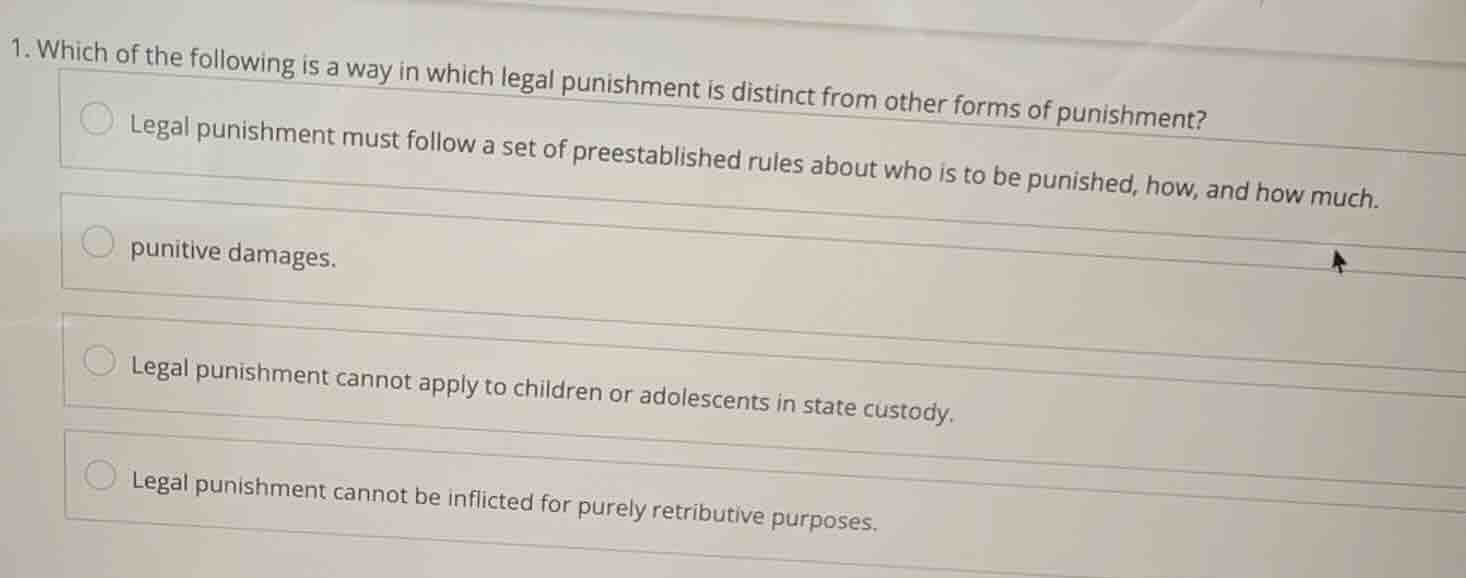
- which of the following is a way in which legal punishment is distinct from other forms of punishment?
legal punishment must follow a set of preestablished rules about who is to be punished, how, and how much.
punitive damages.
legal punishment cannot apply to children or adolescents in state custody.
legal punishment cannot be inflicted for purely retributive purposes.
<pre_analysis>
{
"quality": "clear",
"question_count": 1,
"skills_matched": [
"direct_cot",
"multiple_choice_formatter",
"explain_then_answer",
"tutor"
],
"needs_drawing": false,
"concepts_used": [],
"new_concepts": [
"Philosophy of Law",
"Legal Punishment",
"Procedural Justice"
],
"current_concepts": [
"Philosophy of Law",
"Legal Punishment",
"Procedural Justice"
]
}
</pre_analysis>
<reasoning>
Analyze the core question
The question asks for a defining characteristic that distinguishes legal punishment from other forms of punishment (such as parental, social, or informal punishment).
Evaluate the first option
The first option states: "Legal punishment must follow a set of preestablished rules about who is to be punished, how, and how much."
In legal philosophy, a defining feature of legal punishment is that it is institutionalized and bound by the principle of legality (nulla poena sine lege). It requires established laws, authorized institutions, and predetermined procedures, which distinguishes it from informal or arbitrary punishments.
Evaluate the remaining options
- "punitive damages": This is a specific legal remedy in civil law, not a general distinguishing characteristic of legal punishment itself.
- "Legal punishment cannot apply to children or adolescents in state custody": This is factually incorrect, as juvenile justice systems do administer legal punishments to minors.
- "Legal punishment cannot be inflicted for purely retributive purposes": This is incorrect, as retributivism is one of the major philosophical justifications for legal punishment.
Synthesize the final conclusion
The requirement of following preestablished rules and procedures is the fundamental distinguishing feature of legal punishment compared to informal social sanctions.
</reasoning>
<answer>
<mcq-correct>(A) Legal punishment must follow a set of preestablished rules about who is to be punished, how, and how much.</mcq-correct>
<mcq-option>(B) punitive damages.</mcq-option>
<mcq-option>(C) Legal punishment cannot apply to children or adolescents in state custody.</mcq-option>
<mcq-option>(D) Legal punishment cannot be inflicted for purely retributive purposes.</mcq-option>
</answer>
<post_analysis>
{
"subject": "Social Science",
"question_type": "Multiple Choice",
"knowledge_point": [
"Social Science",
"Political Science",
"Philosophy of Law"
]
}
</post_analysis>
Snap & solve any problem in the app
Get step-by-step solutions on Sovi AI
Photo-based solutions with guided steps
Explore more problems and detailed explanations
<pre_analysis>
{
"quality": "clear",
"question_count": 1,
"skills_matched": [
"direct_cot",
"multiple_choice_formatter",
"explain_then_answer",
"tutor"
],
"needs_drawing": false,
"concepts_used": [],
"new_concepts": [
"Philosophy of Law",
"Legal Punishment",
"Procedural Justice"
],
"current_concepts": [
"Philosophy of Law",
"Legal Punishment",
"Procedural Justice"
]
}
</pre_analysis>
<reasoning>
Analyze the core question
The question asks for a defining characteristic that distinguishes legal punishment from other forms of punishment (such as parental, social, or informal punishment).
Evaluate the first option
The first option states: "Legal punishment must follow a set of preestablished rules about who is to be punished, how, and how much."
In legal philosophy, a defining feature of legal punishment is that it is institutionalized and bound by the principle of legality (nulla poena sine lege). It requires established laws, authorized institutions, and predetermined procedures, which distinguishes it from informal or arbitrary punishments.
Evaluate the remaining options
- "punitive damages": This is a specific legal remedy in civil law, not a general distinguishing characteristic of legal punishment itself.
- "Legal punishment cannot apply to children or adolescents in state custody": This is factually incorrect, as juvenile justice systems do administer legal punishments to minors.
- "Legal punishment cannot be inflicted for purely retributive purposes": This is incorrect, as retributivism is one of the major philosophical justifications for legal punishment.
Synthesize the final conclusion
The requirement of following preestablished rules and procedures is the fundamental distinguishing feature of legal punishment compared to informal social sanctions.
</reasoning>
<answer>
<mcq-correct>(A) Legal punishment must follow a set of preestablished rules about who is to be punished, how, and how much.</mcq-correct>
<mcq-option>(B) punitive damages.</mcq-option>
<mcq-option>(C) Legal punishment cannot apply to children or adolescents in state custody.</mcq-option>
<mcq-option>(D) Legal punishment cannot be inflicted for purely retributive purposes.</mcq-option>
</answer>
<post_analysis>
{
"subject": "Social Science",
"question_type": "Multiple Choice",
"knowledge_point": [
"Social Science",
"Political Science",
"Philosophy of Law"
]
}
</post_analysis>