QUESTION IMAGE
Question
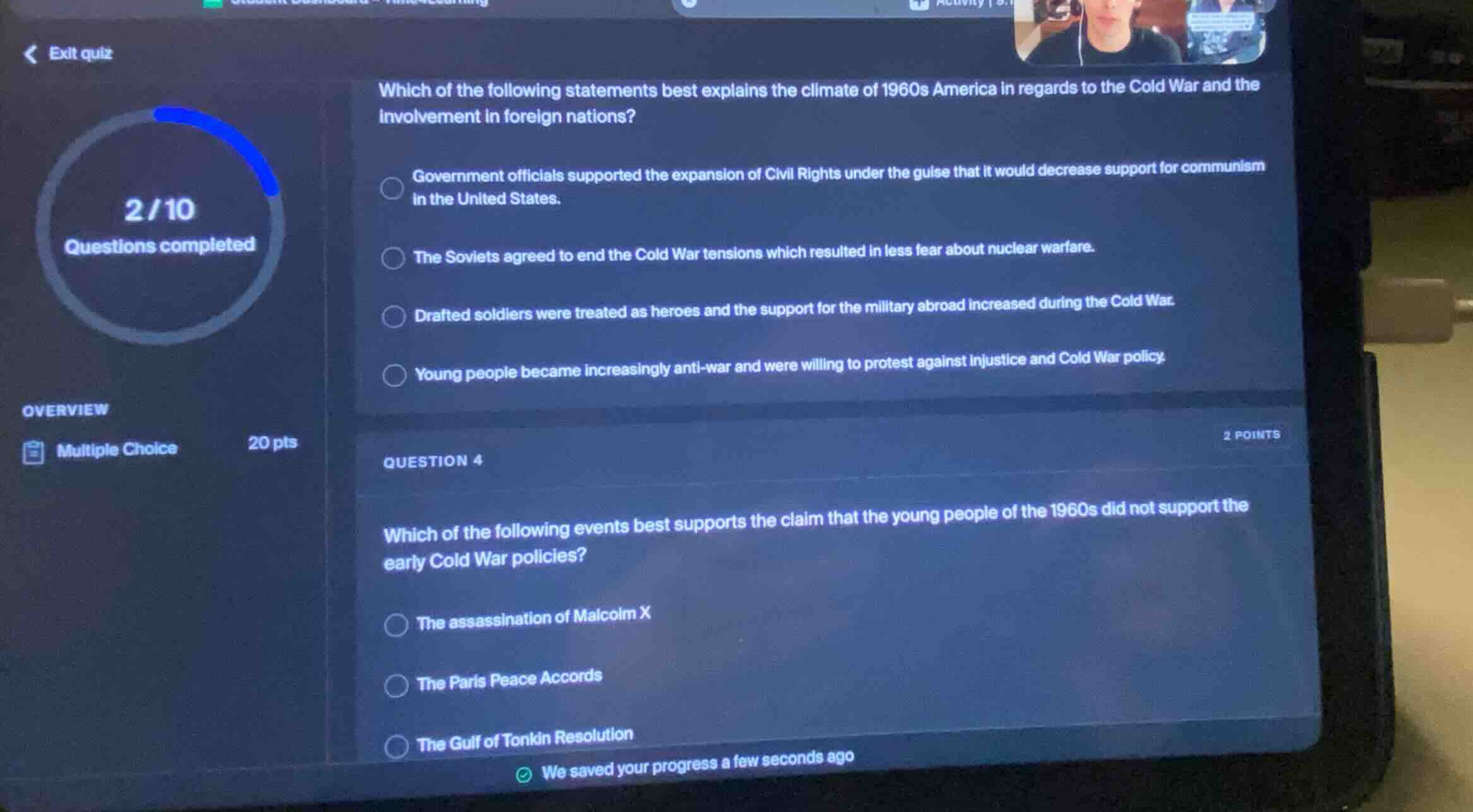
which of the following statements best explains the climate of 1960s america in regards to the cold war and the involvement in foreign nations?
- government officials supported the expansion of civil rights under the guise that it would decrease support for communism in the united states.
- the soviets agreed to end the cold war tensions which resulted in less fear about nuclear warfare.
- drafted soldiers were treated as heroes and the support for the military abroad increased during the cold war.
- young people became increasingly anti-war and were willing to protest against injustice and cold war policy.
question 4
which of the following events best supports the claim that the young people of the 1960s did not support the early cold war policies?
- the assassination of malcolm x
- the paris peace accords
- the gulf of tonkin resolution
Analyze the climate of 1960s America
The first question asks which statement best explains the climate of 1960s America regarding the Cold War and foreign involvement. During this era, particularly with the escalation of the Vietnam War, a massive counterculture and anti-war movement emerged. Young people, draft-age students, and activists increasingly protested against US military intervention and Cold War policies. This aligns with the concept of Cold War Containment Policy and its growing domestic opposition. Therefore, the fourth option is the most accurate description of the social climate.
Evaluate the options for Question 1
- Option 1: While civil rights and Cold War geopolitics were linked, this does not broadly characterize the public climate regarding foreign involvement.
- Option 2: Soviet-US tensions did not end in the 1960s; the Cuban Missile Crisis and Vietnam War escalated fears.
- Option 3: Drafted soldiers faced significant hostility or indifference, and domestic support for the military abroad declined as the war progressed.
- Option 4: Correctly identifies the rise of youth-led anti-war protests and resistance to Cold War policies.
Analyze youth opposition to early Cold War policies
The second question (labeled Question 4 in the image) asks which event best supports the claim that young people of the 1960s did not support early Cold War policies. The Gulf of Tonkin Resolution (1964) authorized broad military action in Vietnam, representing a major escalation of the Vietnam War Origins and containment strategy. This escalation directly triggered the widespread draft resistance, campus protests, and organized opposition among American youth.
Evaluate the options for Question 2
- Option 1: The assassination of Malcolm X is a key event in the civil rights and Black Power movements, but it is not directly a protest event against Cold War foreign policy.
- Option 2: The Paris Peace Agreements (1973) marked the withdrawal of US troops, which was a goal of the anti-war movement rather than an event showing youth opposition to early policies.
- Option 3: The Gulf of Tonkin Resolution is the catalyst that escalated US involvement, directly sparking the massive wave of youth-led anti-war protests and draft resistance.

Snap & solve any problem in the app
Get step-by-step solutions on Sovi AI
Photo-based solutions with guided steps
Explore more problems and detailed explanations
Question 1
- (A) Government officials supported the expansion of Civil Rights under the guise that it would decrease support for communism in the United States.
- (B) The Soviets agreed to end the Cold War tensions which resulted in less fear about nuclear warfare.
- (C) Drafted soldiers were treated as heroes and the support for the military abroad increased during the Cold War.
- (D) Young people became increasingly anti-war and were willing to protest against injustice and Cold War policy. (Correct answer)
Question 2
- (A) The assassination of Malcolm X
- (B) The Paris Peace Accords
- (C) The Gulf of Tonkin Resolution (Correct answer)