QUESTION IMAGE
Question
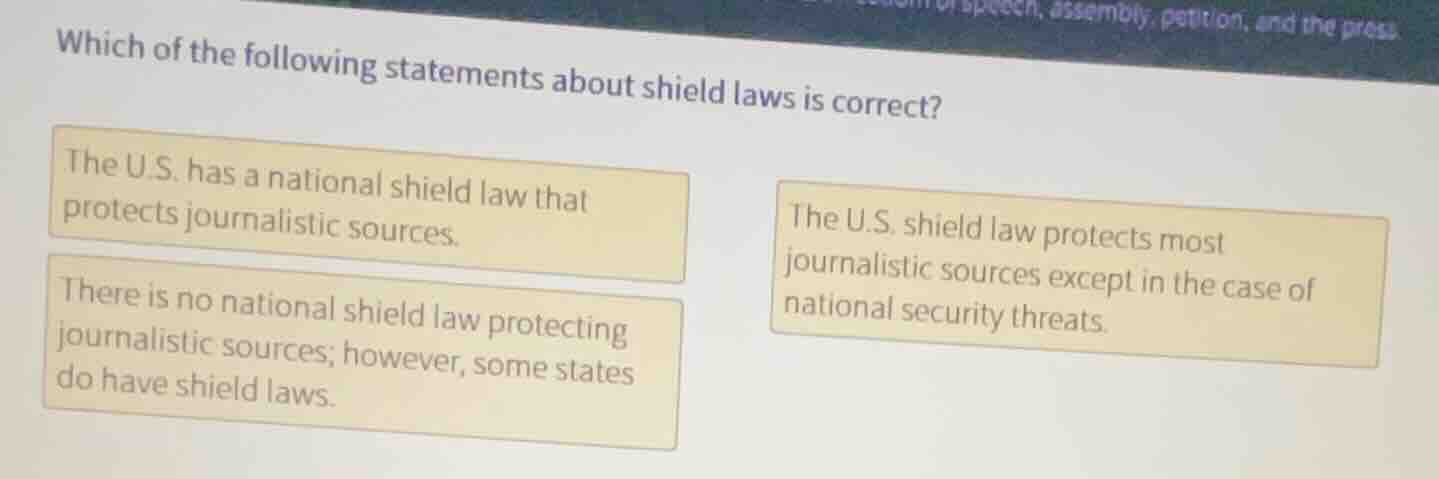
which of the following statements about shield laws is correct?
- the u.s. has a national shield law that protects journalistic sources.
- there is no national shield law protecting journalistic sources; however, some states do have shield laws.
- the u.s. shield law protects most journalistic sources except in the case of national security threats.
Define shield laws and federal status
Shield laws protect journalists from being forced to reveal confidential sources. At the federal level, there is no national shield law in the United States, despite repeated legislative proposals.
Analyze state-level protections
While there is no federal shield law, a majority of U.S. states (along with Washington, D.C.) have enacted their own shield laws or recognize reporter's privilege through common law or state constitutions.
Evaluate the given options
- "The U.S. has a national shield law that protects journalistic sources." (Incorrect: No federal shield law exists.)
- "The U.S. shield law protects most journalistic sources except in the case of national security threats." (Incorrect: Implies a national law exists.)
- "There is no national shield law protecting journalistic sources; however, some states do have shield laws." (Correct: Accurately describes the lack of federal law and the presence of state-level laws.)

Snap & solve any problem in the app
Get step-by-step solutions on Sovi AI
Photo-based solutions with guided steps
Explore more problems and detailed explanations
- The U.S. has a national shield law that protects journalistic sources.
- There is no national shield law protecting journalistic sources; however, some states do have shield laws. (Correct answer)
- The U.S. shield law protects most journalistic sources except in the case of national security threats.