QUESTION IMAGE
Question
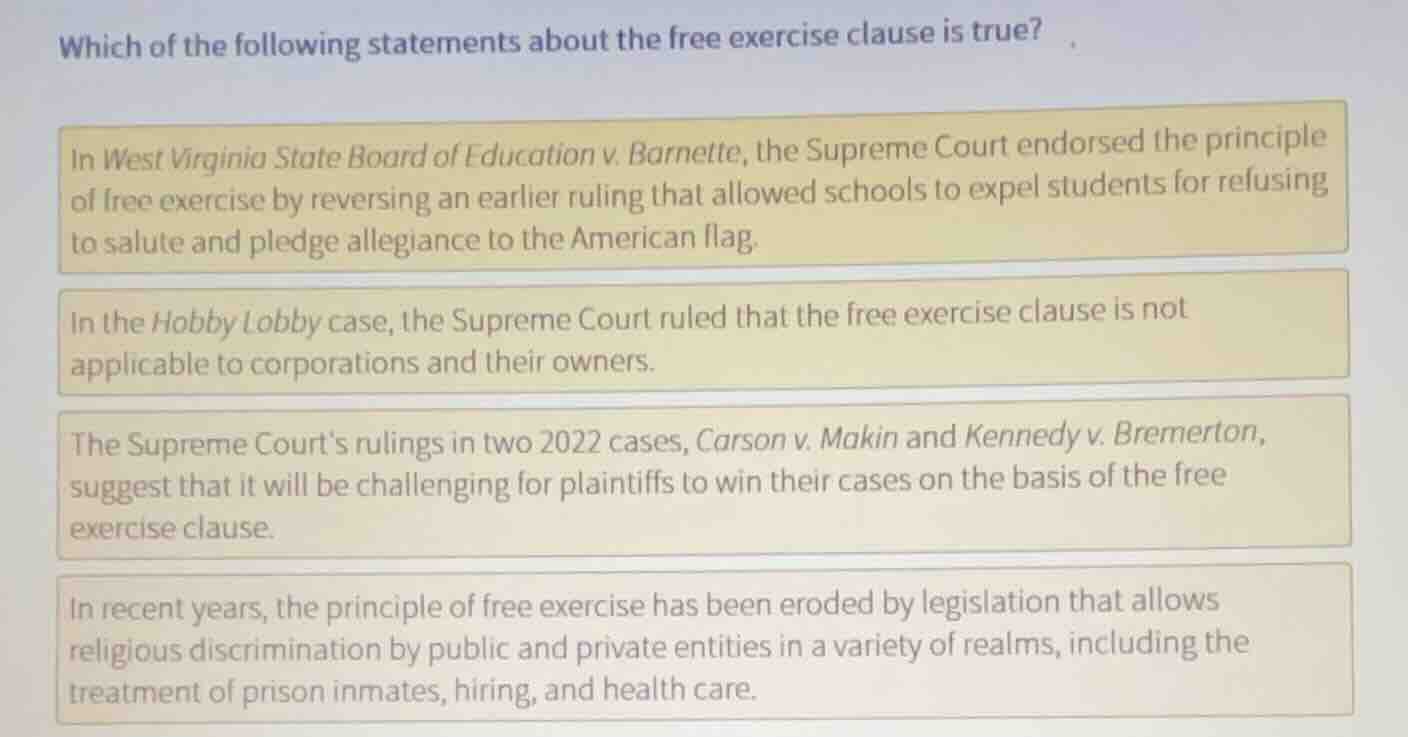
which of the following statements about the free exercise clause is true?
in west virginia state board of education v. barnette, the supreme court endorsed the principle of free exercise by reversing an earlier ruling that allowed schools to expel students for refusing to salute and pledge allegiance to the american flag.
in the hobby lobby case, the supreme court ruled that the free exercise clause is not applicable to corporations and their owners.
the supreme courts rulings in two 2022 cases, carson v. makin and kennedy v. bremerton, suggest that it will be challenging for plaintiffs to win their cases on the basis of the free exercise clause.
in recent years, the principle of free exercise has been eroded by legislation that allows religious discrimination by public and private entities in a variety of realms, including the treatment of prison inmates, hiring, and health care.
Analyze the Barnette ruling
In West Virginia State Board of Education v. Barnette (1943), the Supreme Court protected students (specifically Jehovah's Witnesses) from being forced to salute the American flag, reversing its earlier decision in Minersville School District v. Gobitis (1940) and securing religious free exercise rights.
Evaluate alternative options
- Hobby Lobby (2014) ruled that closely held, for-profit corporations can claim religious exemptions under the Religious Freedom Restoration Act (RFRA), making the second statement false.
- Carson v. Makin and Kennedy v. Bremerton (2022) both ruled in favor of the religious plaintiffs, making the third statement false.
- The fourth statement mischaracterizes the modern legal trajectory of free exercise protections, which have generally expanded rather than eroded.

Snap & solve any problem in the app
Get step-by-step solutions on Sovi AI
Photo-based solutions with guided steps
Explore more problems and detailed explanations
- (A) In West Virginia State Board of Education v. Barnette, the Supreme Court endorsed the principle of free exercise by reversing an earlier ruling that allowed schools to expel students for refusing to salute and pledge allegiance to the American flag. (Correct answer)
- (B) In the Hobby Lobby case, the Supreme Court ruled that the free exercise clause is not applicable to corporations and their owners.
- (C) The Supreme Court's rulings in two 2022 cases, Carson v. Makin and Kennedy v. Bremerton, suggest that it will be challenging for plaintiffs to win their cases on the basis of the free exercise clause.
- (D) In recent years, the principle of free exercise has been eroded by legislation that allows religious discrimination by public and private entities in a variety of realms, including the treatment of prison inmates, hiring, and health care.