QUESTION IMAGE
Question
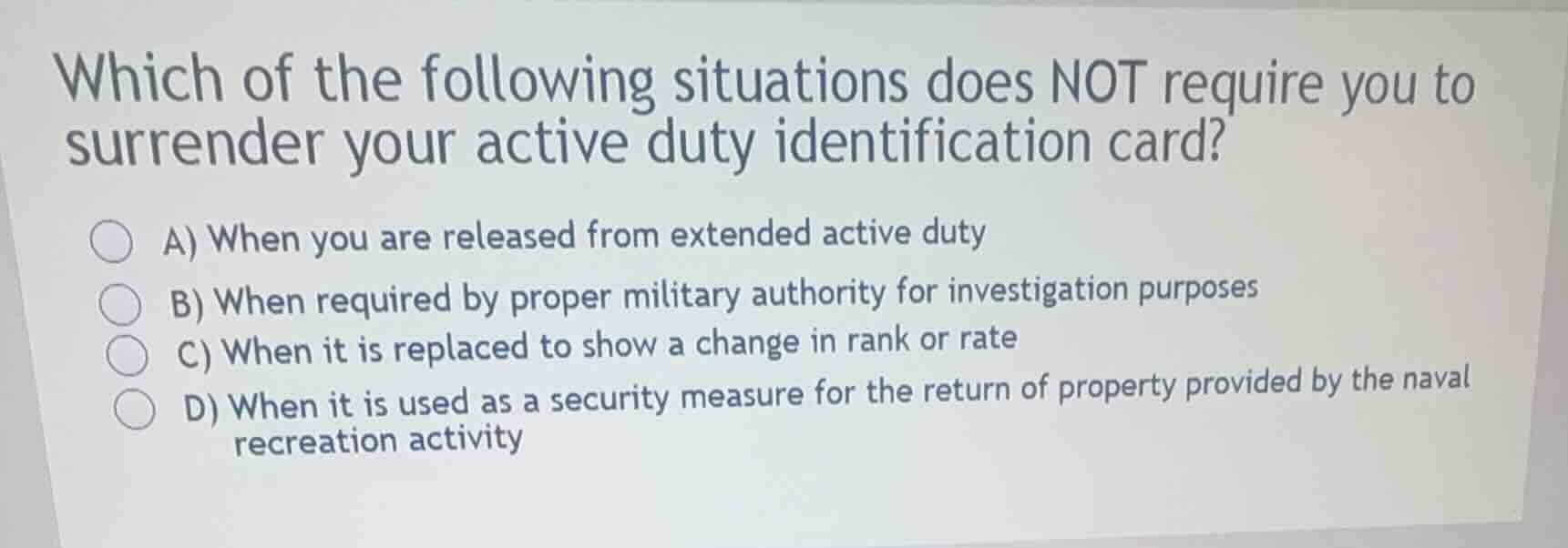
which of the following situations does not require you to surrender your active duty identification card?
a) when you are released from extended active duty
b) when required by proper military authority for investigation purposes
c) when it is replaced to show a change in rank or rate
d) when it is used as a security measure for the return of property provided by the naval recreation activity
Analyze military ID card surrender regulations
According to U.S. military regulations (such as DoD Manual 1000.13), an active duty identification card (Common Access Card or DD Form 2) is government property. It must be surrendered upon discharge, release from active duty, when replaced due to promotion/demotion (change in rank or rate), or when requested by proper military authority for official investigation.
Evaluate the given scenarios
- Option A: Release from active duty requires surrendering the active duty card.
- Option B: Proper military authority can require surrender for investigation.
- Option C: A change in rank or rate requires replacing the card, which means surrendering the old one.
- Option D: Military ID cards must never be surrendered, posted, or deposited as security or collateral for the return of property (such as recreational equipment). This is a violation of federal law and military regulations.
Determine the correct option
Therefore, using the card as a security measure for the return of property does NOT require (and in fact, strictly prohibits) surrendering or leaving the card.

Snap & solve any problem in the app
Get step-by-step solutions on Sovi AI
Photo-based solutions with guided steps
Explore more problems and detailed explanations
- (A) When you are released from extended active duty
- (B) When required by proper military authority for investigation purposes
- (C) When it is replaced to show a change in rank or rate
- (D) When it is used as a security measure for the return of property provided by the naval recreation activity (Correct answer)