QUESTION IMAGE
Question
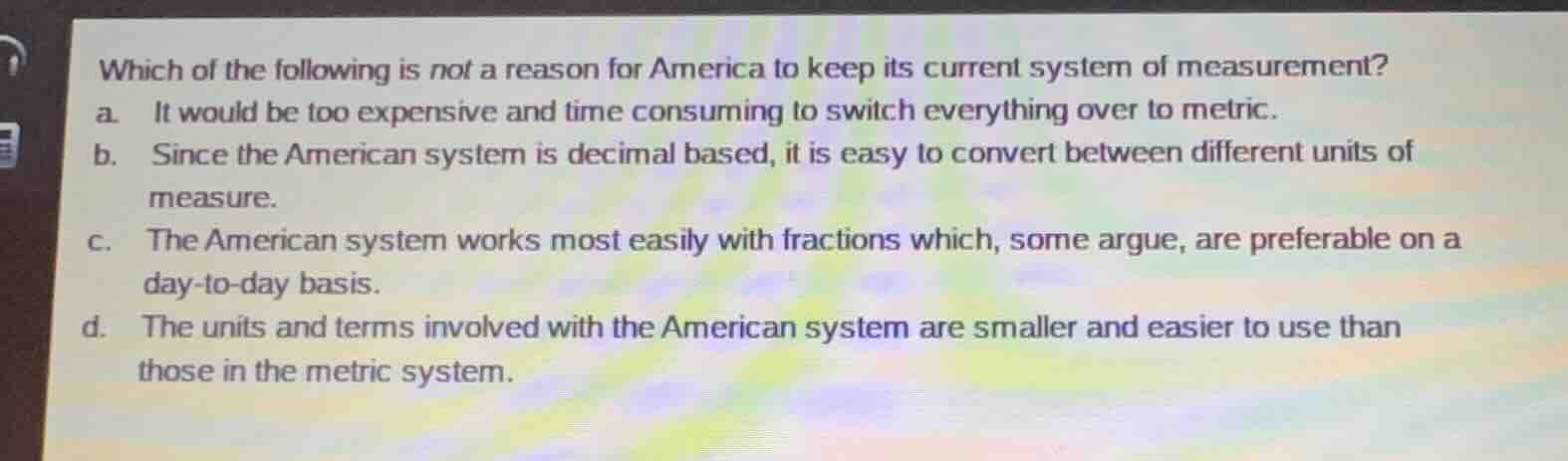
which of the following is not a reason for america to keep its current system of measurement?
a. it would be too expensive and time consuming to switch everything over to metric.
b. since the american system is decimal based, it is easy to convert between different units of measure.
c. the american system works most easily with fractions which, some argue, are preferable on a day-to-day basis.
d. the units and terms involved with the american system are smaller and easier to use than those in the metric system.
<pre_analysis>
{
"quality": "clear",
"question_count": 1,
"skills_matched": [
"direct_cot",
"multiple_choice_formatter",
"explain_then_answer",
"quick"
],
"needs_drawing": false,
"concepts_used": [],
"new_concepts": [
"Measurement Systems",
"Metric vs Imperial"
],
"current_concepts": [
"Measurement Systems",
"Metric vs Imperial"
]
}
</pre_analysis>
<reasoning>
Analyze the question prompt
The question asks to identify which statement is not a reason for America to keep its current system of measurement (the United States customary system).
Evaluate each option
- Option a: Switching to the metric system would indeed be extremely expensive and time-consuming because it requires updating infrastructure, manufacturing tools, signs, and educational materials. This is a valid reason to keep the current system.
- Option b: The American system is not decimal-based (it uses relationships like 12 inches in a foot, 3 feet in a yard, 16 ounces in a pound, etc.). The metric system is the one that is decimal-based (powers of 10). Therefore, this statement is factually incorrect and cannot be a reason to keep the current system.
- Option c: Proponents of the customary system often argue that units like halves, quarters, and eighths of an inch are highly intuitive and easy to use with fractions on a day-to-day basis. This is a commonly cited reason.
- Option d: Many everyday customary units (like cups, pints, feet, and Fahrenheit degrees) are scaled to human-sized, everyday activities, making them arguably easier to relate to than some metric equivalents. This is also a cited reason.
Determine the correct choice
Since option b contains a false premise (the American system is not decimal-based), it is not a valid reason for keeping the current system.
</reasoning>
<answer>
<mcq-option>a. It would be too expensive and time consuming to switch everything over to metric.</mcq-option>
<mcq-correct>b. Since the American system is decimal based, it is easy to convert between different units of measure.</mcq-correct>
<mcq-option>c. The American system works most easily with fractions which, some argue, are preferable on a day-to-day basis.</mcq-option>
<mcq-option>d. The units and terms involved with the American system are smaller and easier to use than those in the metric system.</mcq-option>
</answer>
<post_analysis>
{
"subject": "Mathematics",
"question_type": "Multiple Choice",
"knowledge_point": [
"Mathematics",
"Geometry",
"Measurement Systems"
]
}
</post_analysis>
Snap & solve any problem in the app
Get step-by-step solutions on Sovi AI
Photo-based solutions with guided steps
Explore more problems and detailed explanations
<pre_analysis>
{
"quality": "clear",
"question_count": 1,
"skills_matched": [
"direct_cot",
"multiple_choice_formatter",
"explain_then_answer",
"quick"
],
"needs_drawing": false,
"concepts_used": [],
"new_concepts": [
"Measurement Systems",
"Metric vs Imperial"
],
"current_concepts": [
"Measurement Systems",
"Metric vs Imperial"
]
}
</pre_analysis>
<reasoning>
Analyze the question prompt
The question asks to identify which statement is not a reason for America to keep its current system of measurement (the United States customary system).
Evaluate each option
- Option a: Switching to the metric system would indeed be extremely expensive and time-consuming because it requires updating infrastructure, manufacturing tools, signs, and educational materials. This is a valid reason to keep the current system.
- Option b: The American system is not decimal-based (it uses relationships like 12 inches in a foot, 3 feet in a yard, 16 ounces in a pound, etc.). The metric system is the one that is decimal-based (powers of 10). Therefore, this statement is factually incorrect and cannot be a reason to keep the current system.
- Option c: Proponents of the customary system often argue that units like halves, quarters, and eighths of an inch are highly intuitive and easy to use with fractions on a day-to-day basis. This is a commonly cited reason.
- Option d: Many everyday customary units (like cups, pints, feet, and Fahrenheit degrees) are scaled to human-sized, everyday activities, making them arguably easier to relate to than some metric equivalents. This is also a cited reason.
Determine the correct choice
Since option b contains a false premise (the American system is not decimal-based), it is not a valid reason for keeping the current system.
</reasoning>
<answer>
<mcq-option>a. It would be too expensive and time consuming to switch everything over to metric.</mcq-option>
<mcq-correct>b. Since the American system is decimal based, it is easy to convert between different units of measure.</mcq-correct>
<mcq-option>c. The American system works most easily with fractions which, some argue, are preferable on a day-to-day basis.</mcq-option>
<mcq-option>d. The units and terms involved with the American system are smaller and easier to use than those in the metric system.</mcq-option>
</answer>
<post_analysis>
{
"subject": "Mathematics",
"question_type": "Multiple Choice",
"knowledge_point": [
"Mathematics",
"Geometry",
"Measurement Systems"
]
}
</post_analysis>