QUESTION IMAGE
Question
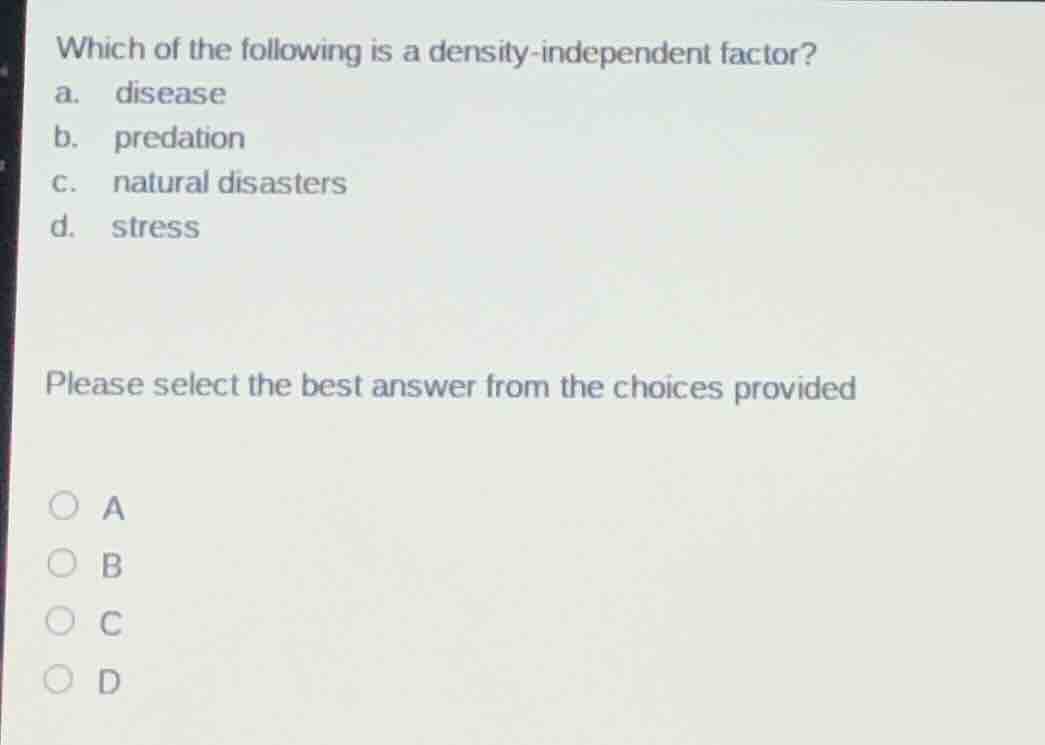
which of the following is a density-independent factor?
a. disease
b. predation
c. natural disasters
d. stress
please select the best answer from the choices provided
a
b
c
d
🆕 New Concept Discovered: Density-Independent vs. Density-Dependent Factors
How environmental factors affect populations regardless of size.
Step 1: Define Density-Independent Factors
A density-independent factor is an environmental variable that affects a population's size regardless of how crowded (dense) the population is. Whether there are 10 individuals or 10,000 individuals in an area, the factor will impact the same percentage of the population. These are typically abiotic (non-living) events, such as weather, climate, and natural disasters.
Step 2: Define Density-Dependent Factors
A density-dependent factor is a variable whose influence on a population changes based on the population's density. These are typically biotic (living) interactions that become more intense as the population grows and crowds together. Examples include:
- Disease: Spreads much faster in crowded populations.
- Predation: Predators can easily find and target prey when they are highly concentrated.
- Stress/Competition: Crowding leads to increased stress and competition for limited resources.
Step 3: Evaluate the Given Options
- a. disease: Density-dependent (spreads faster in dense populations).
- b. predation: Density-dependent (predators hunt more successfully in dense prey populations).
- c. natural disasters: Density-independent (a flood, wildfire, or hurricane will impact an area regardless of how many organisms live there).
- d. stress: Density-dependent (crowding directly increases physiological stress).
Therefore, natural disasters are density-independent.

Snap & solve any problem in the app
Get step-by-step solutions on Sovi AI
Photo-based solutions with guided steps
Explore more problems and detailed explanations
C