QUESTION IMAGE
Question
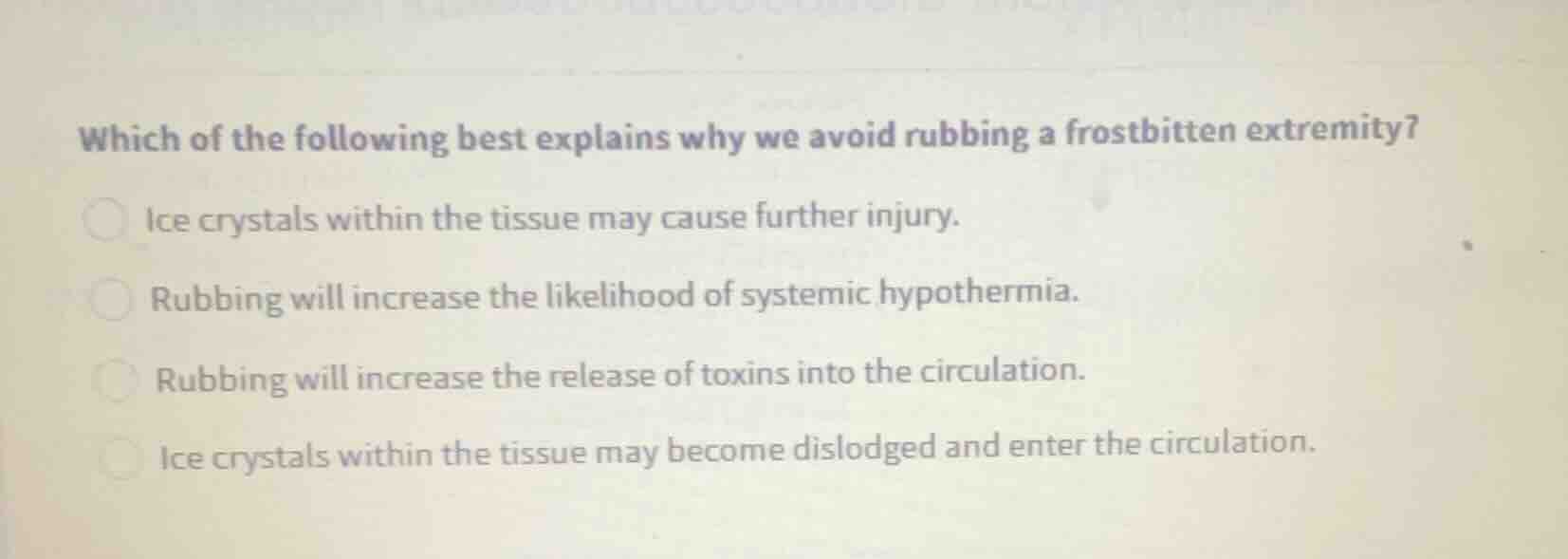
which of the following best explains why we avoid rubbing a frostbitten extremity?
ice crystals within the tissue may cause further injury.
rubbing will increase the likelihood of systemic hypothermia.
rubbing will increase the release of toxins into the circulation.
ice crystals within the tissue may become dislodged and enter the circulation.
Analyze frostbite pathophysiology
Using the Environmental Emergencies knowledge point
Frostbite involves the freezing of tissue fluids, which leads to the formation of microscopic ice crystals within and between cells. These sharp ice crystals physically disrupt cell membranes and delicate structures.
Evaluate the effect of friction
Rubbing or massaging a frozen, frostbitten extremity forces these sharp, microscopic ice crystals to move and scrape against the surrounding frozen cells. This mechanical friction causes severe, irreversible mechanical damage to the already compromised tissues and blood vessels.
Assess the given options
- Ice crystals within the tissue may cause further injury: This is correct because rubbing physically grinds the sharp ice crystals into fragile cell membranes, worsening tissue destruction.
- Rubbing will increase the likelihood of systemic hypothermia: Incorrect. While rewarming can sometimes cause a minor drop in core temperature (afterdrop), rubbing does not directly cause systemic hypothermia.
- Rubbing will increase the release of toxins into the circulation: Incorrect. While reperfusion injury releases metabolic byproducts, the primary reason to avoid rubbing is immediate mechanical tissue damage from ice crystals.
- Ice crystals within the tissue may become dislodged and enter the circulation: Incorrect. Ice crystals do not break off and travel through the bloodstream as emboli; they melt during rewarming.

Snap & solve any problem in the app
Get step-by-step solutions on Sovi AI
Photo-based solutions with guided steps
Explore more problems and detailed explanations
- (A) Ice crystals within the tissue may cause further injury. (Correct answer)
- (B) Rubbing will increase the likelihood of systemic hypothermia.
- (C) Rubbing will increase the release of toxins into the circulation.
- (D) Ice crystals within the tissue may become dislodged and enter the circulation.