QUESTION IMAGE
Question
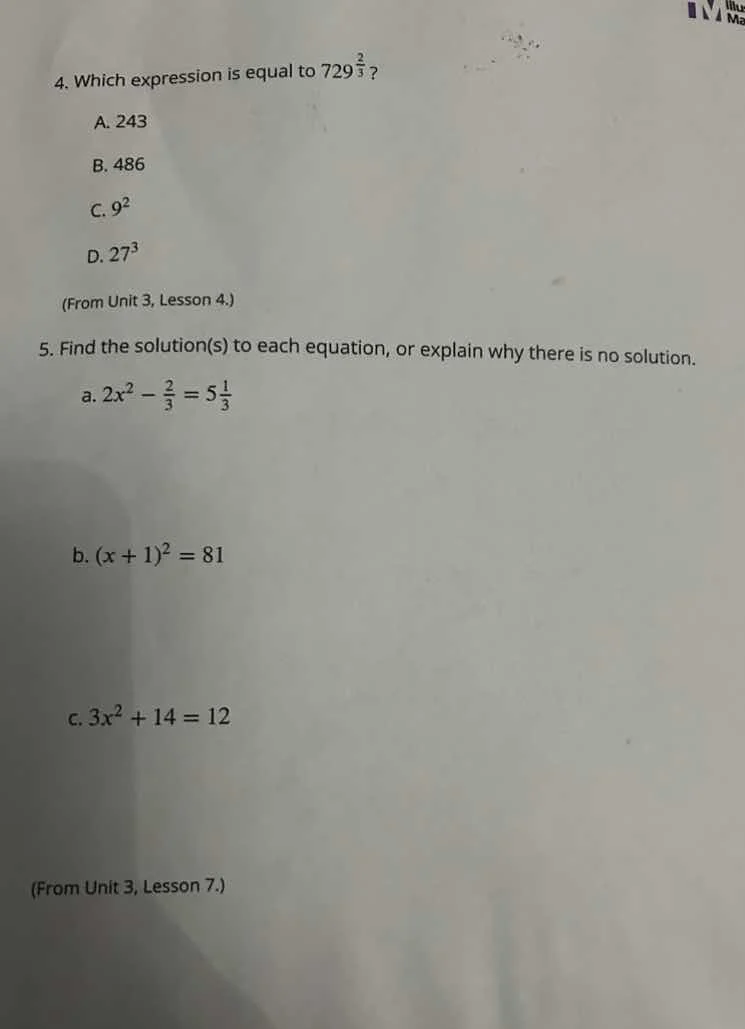
- which expression is equal to $729^{\frac{2}{3}}$?
a. 243
b. 486
c. $9^2$
d. $27^3$
(from unit 3, lesson 4.)
- find the solution(s) to each equation, or explain why there is no solution.
a. $2x^2 - \frac{2}{3} = 5\frac{1}{3}$
b. $(x + 1)^2 = 81$
c. $3x^2 + 14 = 12$
(from unit 3, lesson 7.)
Question 4
Step1: Recall exponent rule \(a^{\frac{m}{n}}=\sqrt[n]{a^m}=(\sqrt[n]{a})^m\)
For \(729^{\frac{2}{3}}\), first find the cube root of 729. Since \(9\times9\times9 = 729\), \(\sqrt[3]{729}=9\). Then we square this result: \(9^2\). Also, \(9^2 = 81\), and let's check the options:
- Option A: 243 is not equal to 81.
- Option B: 486 is not equal to 81.
- Option C: \(9^2=81\), which is equal to \(729^{\frac{2}{3}}\) (since \(729^{\frac{2}{3}}=(\sqrt[3]{729})^2 = 9^2\)).
- Option D: \(27^3=19683\), not equal to 81.
Step1: Isolate the \(x^2\) term
Start with \(2x^2-\frac{2}{3}=5\frac{1}{3}\). First, add \(\frac{2}{3}\) to both sides:
\(2x^2=5\frac{1}{3}+\frac{2}{3}\)
Convert \(5\frac{1}{3}\) to improper fraction: \(5\frac{1}{3}=\frac{16}{3}\), so \(\frac{16}{3}+\frac{2}{3}=\frac{18}{3} = 6\). So \(2x^2=6\).
Step2: Solve for \(x^2\)
Divide both sides by 2: \(x^2=\frac{6}{2}=3\).
Step3: Solve for \(x\)
Take square roots of both sides: \(x=\pm\sqrt{3}\).
Step1: Take square roots of both sides
Given \((x + 1)^2=81\), take square roots: \(x + 1=\pm\sqrt{81}=\pm9\).
Step2: Solve for \(x\) in two cases
- Case 1: \(x + 1=9\), subtract 1: \(x=9 - 1 = 8\).
- Case 2: \(x + 1=-9\), subtract 1: \(x=-9 - 1=-10\).

Snap & solve any problem in the app
Get step-by-step solutions on Sovi AI
Photo-based solutions with guided steps
Explore more problems and detailed explanations
C. \(9^2\)