QUESTION IMAGE
Question
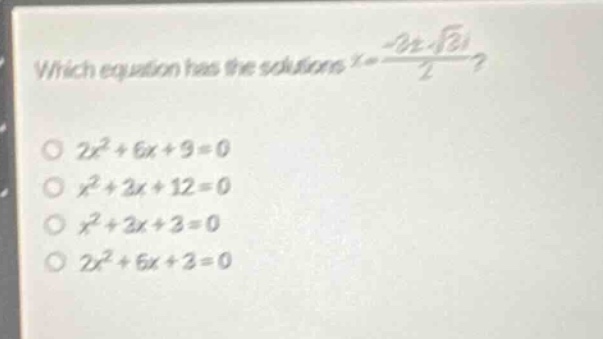
which equation has the solutions \\(x = \frac{-3 \pm \sqrt{3}i}{2}\\)?
\\(2x^2 + 6x + 9 = 0\\)
\\(x^2 + 3x + 12 = 0\\)
\\(x^2 + 3x + 3 = 0\\)
\\(2x^2 + 6x + 3 = 0\\)
⚡ Using what you learned: quadratic formula and its applications
Step 1: Identify the given solutions and the quadratic formula
The given solutions are:
The quadratic formula for an equation of the form \(ax^2 + bx + c = 0\) is:
Step 2: Compare the denominators to find \(a\)
Comparing the denominators:
Step 3: Compare the linear terms to find \(b\)
Comparing the first term in the numerator:
Step 4: Use the discriminant to find \(c\)
Comparing the terms under the square root:
Since \(i = \sqrt{-1}\), we can rewrite the right side:
Now, equate the expressions inside the square roots:
Substitute \(a = 1\) and \(b = 3\):
Step 5: Write the quadratic equation
Using \(a = 1\), \(b = 3\), and \(c = 3\):

Snap & solve any problem in the app
Get step-by-step solutions on Sovi AI
Photo-based solutions with guided steps
Explore more problems and detailed explanations
\( x^2 + 3x + 3 = 0 \) (the third option)