QUESTION IMAGE
Question
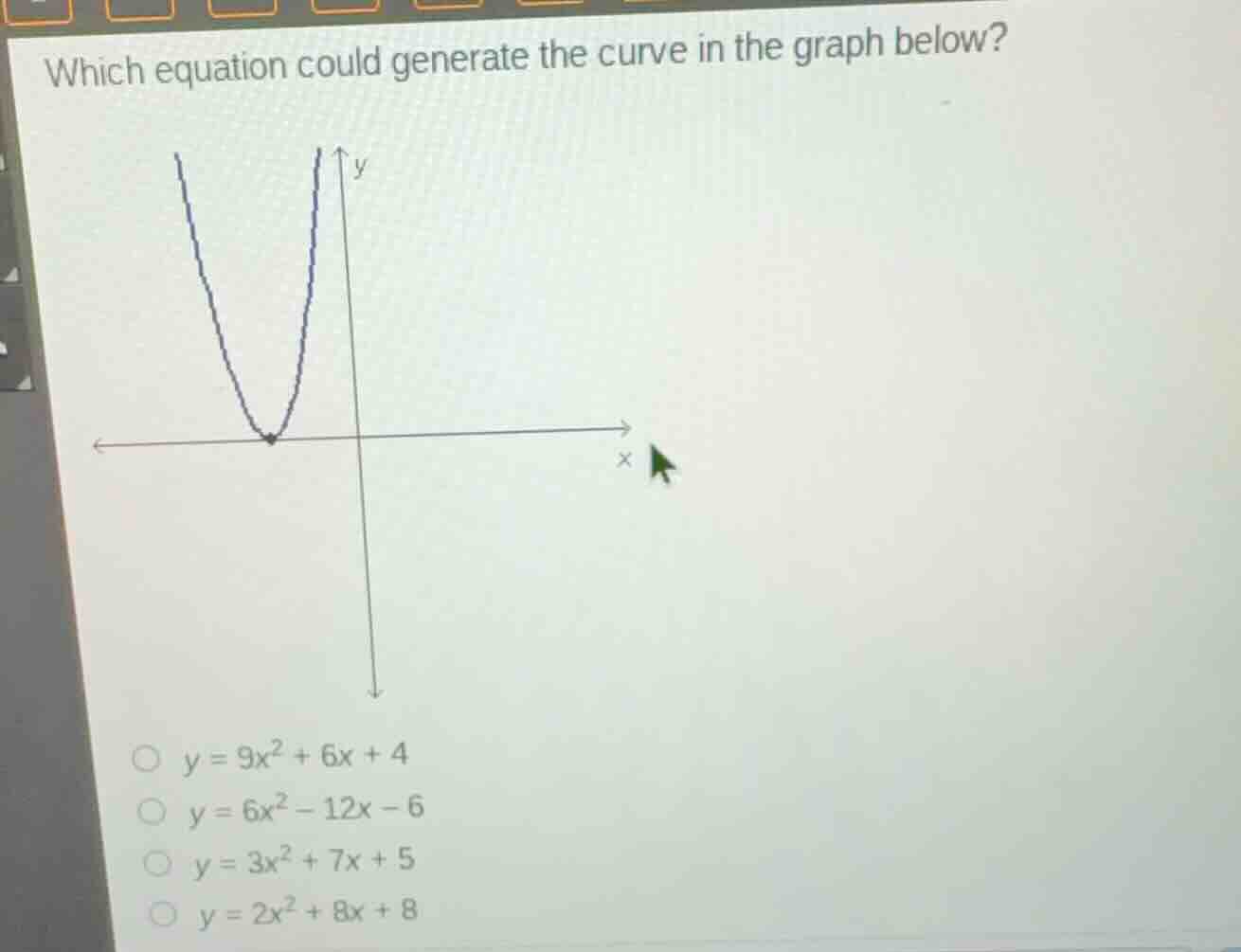
which equation could generate the curve in the graph below?
\\(y = 9x^2 + 6x + 4\\)
\\(y = 6x^2 - 12x - 6\\)
\\(y = 3x^2 + 7x + 5\\)
\\(y = 2x^2 + 8x + 8\\)
<pre_analysis>
{
"quality": "clear",
"question_count": 1,
"skills_matched": [
"step_cot",
"multiple_choice_formatter",
"explain_then_answer",
"tutor",
"mastery_adaptive_brevity"
],
"needs_drawing": false,
"concepts_used": [
"Perfect Square Trinomials",
"Factoring Quadratics",
"Roots of Polynomials",
"Multiplicity of Roots"
],
"new_concepts": [],
"current_concepts": [
"Perfect Square Trinomials",
"Factoring Quadratics",
"Roots of Polynomials",
"Multiplicity of Roots",
"Graph Interpretation"
]
}
</pre_analysis>
<reasoning>
Analyze the graph features
Using the Graph Interpretation knowledge point, we observe:
- The curve is a parabola opening upwards, which means the leading coefficient \(a\) of the quadratic equation \(y = ax^2 + bx + c\) must be positive (\(a > 0\)).
- The vertex of the parabola lies exactly on the negative \(x\)-axis. This means the quadratic equation has exactly one real root (a double root) on the negative \(x\)-axis.
- Since there is only one real root, the quadratic must be a perfect square trinomial of the form \(y = a(x - h)^2\) where the vertex is at \((h, 0)\).
- Since the vertex is on the negative \(x\)-axis, we have \(h < 0\), which means the factored form is \(y = a(x + |h|)^2 = a(x^2 + 2|h|x + |h|^2)\). Thus, both the linear coefficient \(b\) and the constant term \(c\) must be positive.
Test the given options
Using the Perfect Square Trinomials and Factoring Quadratics knowledge points:
- Option 1: \(y = 9x^2 + 6x + 4\)
Using the Roots of Polynomials knowledge point
\[
D = b^2 - 4ac = 6^2 - 4(9)(4) = 36 - 144 = -108 < 0
\]
This has no real roots.
- Option 2: \(y = 6x^2 - 12x - 6\)
The constant term is negative, and it is not a perfect square.
- Option 3: \(y = 3x^2 + 7x + 5\)
Using the Roots of Polynomials knowledge point
\[
D = b^2 - 4ac = 7^2 - 4(3)(5) = 49 - 60 = -11 < 0
\]
This has no real roots.
- Option 4: \(y = 2x^2 + 8x + 8\)
Using the Factoring Quadratics and Perfect Square Trinomials knowledge points
\[
y = 2(x^2 + 4x + 4) = 2(x + 2)^2
\]
This is a perfect square with a single root (multiplicity 2) at \(x = -2\), which matches a vertex on the negative \(x\)-axis.
</reasoning>
<answer>
<mcq-option>(A) \(y = 9x^2 + 6x + 4\)</mcq-option>
<mcq-option>(B) \(y = 6x^2 - 12x - 6\)</mcq-option>
<mcq-option>(C) \(y = 3x^2 + 7x + 5\)</mcq-option>
<mcq-correct>(D) \(y = 2x^2 + 8x + 8\)</mcq-correct>
</answer>
<post_analysis>
{
"subject": "Mathematics",
"question_type": "Multiple Choice",
"knowledge_point": [
"Mathematics",
"Algebra",
"Perfect Square Trinomials"
]
}
</post_analysis>
Snap & solve any problem in the app
Get step-by-step solutions on Sovi AI
Photo-based solutions with guided steps
Explore more problems and detailed explanations
<pre_analysis>
{
"quality": "clear",
"question_count": 1,
"skills_matched": [
"step_cot",
"multiple_choice_formatter",
"explain_then_answer",
"tutor",
"mastery_adaptive_brevity"
],
"needs_drawing": false,
"concepts_used": [
"Perfect Square Trinomials",
"Factoring Quadratics",
"Roots of Polynomials",
"Multiplicity of Roots"
],
"new_concepts": [],
"current_concepts": [
"Perfect Square Trinomials",
"Factoring Quadratics",
"Roots of Polynomials",
"Multiplicity of Roots",
"Graph Interpretation"
]
}
</pre_analysis>
<reasoning>
Analyze the graph features
Using the Graph Interpretation knowledge point, we observe:
- The curve is a parabola opening upwards, which means the leading coefficient \(a\) of the quadratic equation \(y = ax^2 + bx + c\) must be positive (\(a > 0\)).
- The vertex of the parabola lies exactly on the negative \(x\)-axis. This means the quadratic equation has exactly one real root (a double root) on the negative \(x\)-axis.
- Since there is only one real root, the quadratic must be a perfect square trinomial of the form \(y = a(x - h)^2\) where the vertex is at \((h, 0)\).
- Since the vertex is on the negative \(x\)-axis, we have \(h < 0\), which means the factored form is \(y = a(x + |h|)^2 = a(x^2 + 2|h|x + |h|^2)\). Thus, both the linear coefficient \(b\) and the constant term \(c\) must be positive.
Test the given options
Using the Perfect Square Trinomials and Factoring Quadratics knowledge points:
- Option 1: \(y = 9x^2 + 6x + 4\)
Using the Roots of Polynomials knowledge point
\[
D = b^2 - 4ac = 6^2 - 4(9)(4) = 36 - 144 = -108 < 0
\]
This has no real roots.
- Option 2: \(y = 6x^2 - 12x - 6\)
The constant term is negative, and it is not a perfect square.
- Option 3: \(y = 3x^2 + 7x + 5\)
Using the Roots of Polynomials knowledge point
\[
D = b^2 - 4ac = 7^2 - 4(3)(5) = 49 - 60 = -11 < 0
\]
This has no real roots.
- Option 4: \(y = 2x^2 + 8x + 8\)
Using the Factoring Quadratics and Perfect Square Trinomials knowledge points
\[
y = 2(x^2 + 4x + 4) = 2(x + 2)^2
\]
This is a perfect square with a single root (multiplicity 2) at \(x = -2\), which matches a vertex on the negative \(x\)-axis.
</reasoning>
<answer>
<mcq-option>(A) \(y = 9x^2 + 6x + 4\)</mcq-option>
<mcq-option>(B) \(y = 6x^2 - 12x - 6\)</mcq-option>
<mcq-option>(C) \(y = 3x^2 + 7x + 5\)</mcq-option>
<mcq-correct>(D) \(y = 2x^2 + 8x + 8\)</mcq-correct>
</answer>
<post_analysis>
{
"subject": "Mathematics",
"question_type": "Multiple Choice",
"knowledge_point": [
"Mathematics",
"Algebra",
"Perfect Square Trinomials"
]
}
</post_analysis>