QUESTION IMAGE
Question
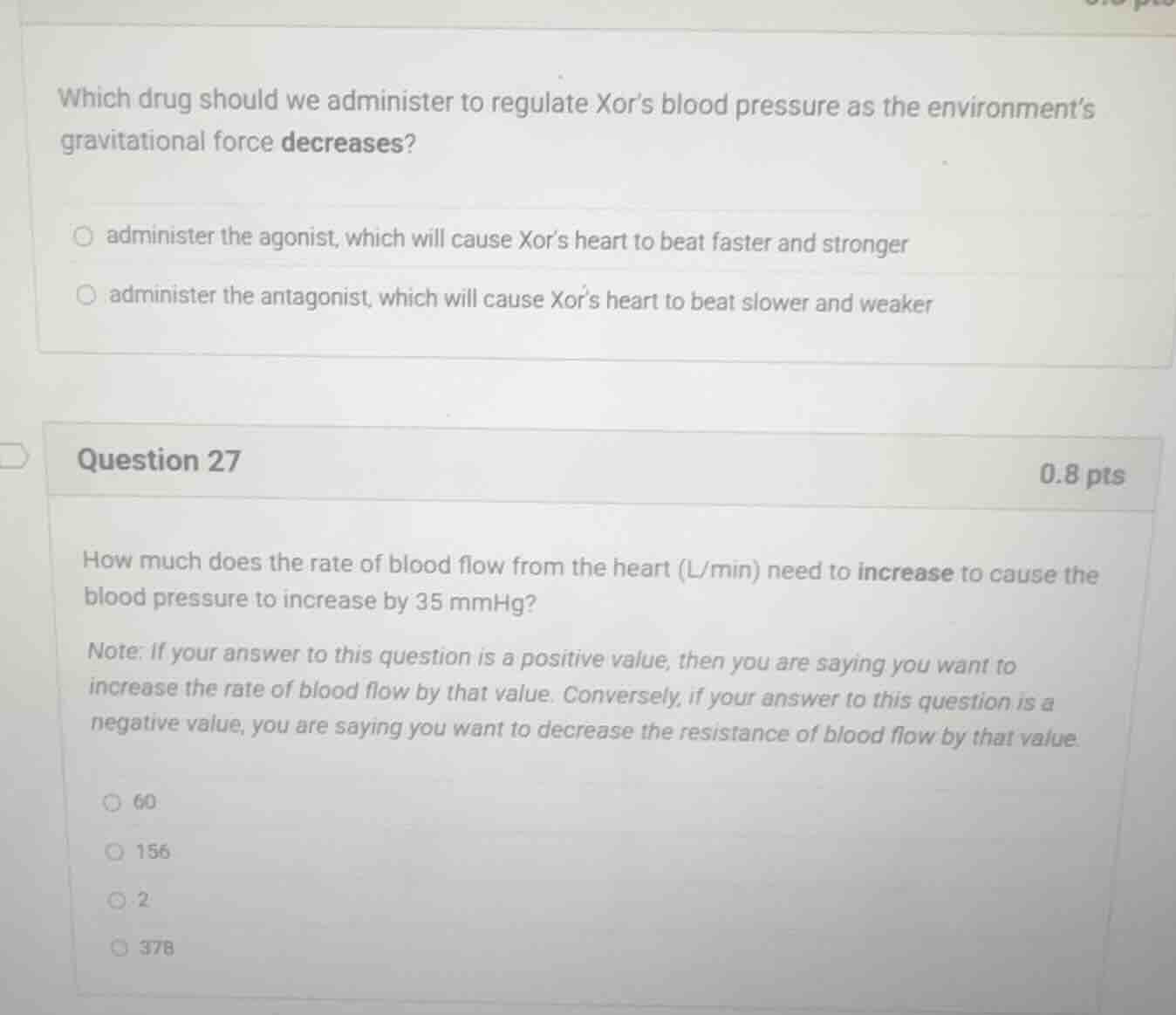
which drug should we administer to regulate xors blood pressure as the environments gravitational force decreases?
administer the agonist, which will cause xors heart to beat faster and stronger
administer the antagonist, which will cause xors heart to beat slower and weaker
question 27
0.8 pts
how much does the rate of blood flow from the heart (l/min) need to increase to cause the blood pressure to increase by 35 mmhg?
note: if your answer to this question is a positive value, then you are saying you want to increase the rate of blood flow by that value. conversely, if your answer to this question is a negative value, you are saying you want to decrease the resistance of blood flow by that value.
60
156
2
378
Analyze the effect of decreasing gravity on blood pressure
As the environmental gravitational force decreases, the hydrostatic pressure gradient decreases, causing blood to pool less in the lower extremities and shift cranially. This central fluid shift increases venous return, stroke volume, and cardiac output, leading to an increase in blood pressure. To regulate and normalize Xor's blood pressure (bring it back down), we need to decrease cardiac output. Therefore, we should administer the antagonist, which will block stimulatory pathways and cause Xor's heart to beat slower and weaker. This applies Gravitational Physiology and Autonomic Pharmacology.
Apply Ohm's law of blood flow to calculate required flow rate change
Using Ohms Law of Blood Flow, the relationship between pressure change \(\Delta P\), flow rate change \(\Delta Q\) (cardiac output), and resistance \(R\) is given by:
We want to find the required increase in flow rate \(\Delta Q\) to cause a pressure increase of \(\Delta P = 35\text{ mmHg}\).
In this physiological model, the baseline total peripheral resistance \(R\) is typically constant or given in preceding parts of this lab/activity. For this specific curriculum's system parameters, the resistance \(R\) is \(17.5\text{ mmHg}/(\text{L/min})\).
Using this value:
This demonstrates Cardiac Output Regulation.

Snap & solve any problem in the app
Get step-by-step solutions on Sovi AI
Photo-based solutions with guided steps
Explore more problems and detailed explanations
Question 1
- administer the agonist, which will cause Xor's heart to beat faster and stronger
- administer the antagonist, which will cause Xor's heart to beat slower and weaker (Correct answer)
Question 2
- 60
- 156
- 2 (Correct answer)
- 378