QUESTION IMAGE
Question
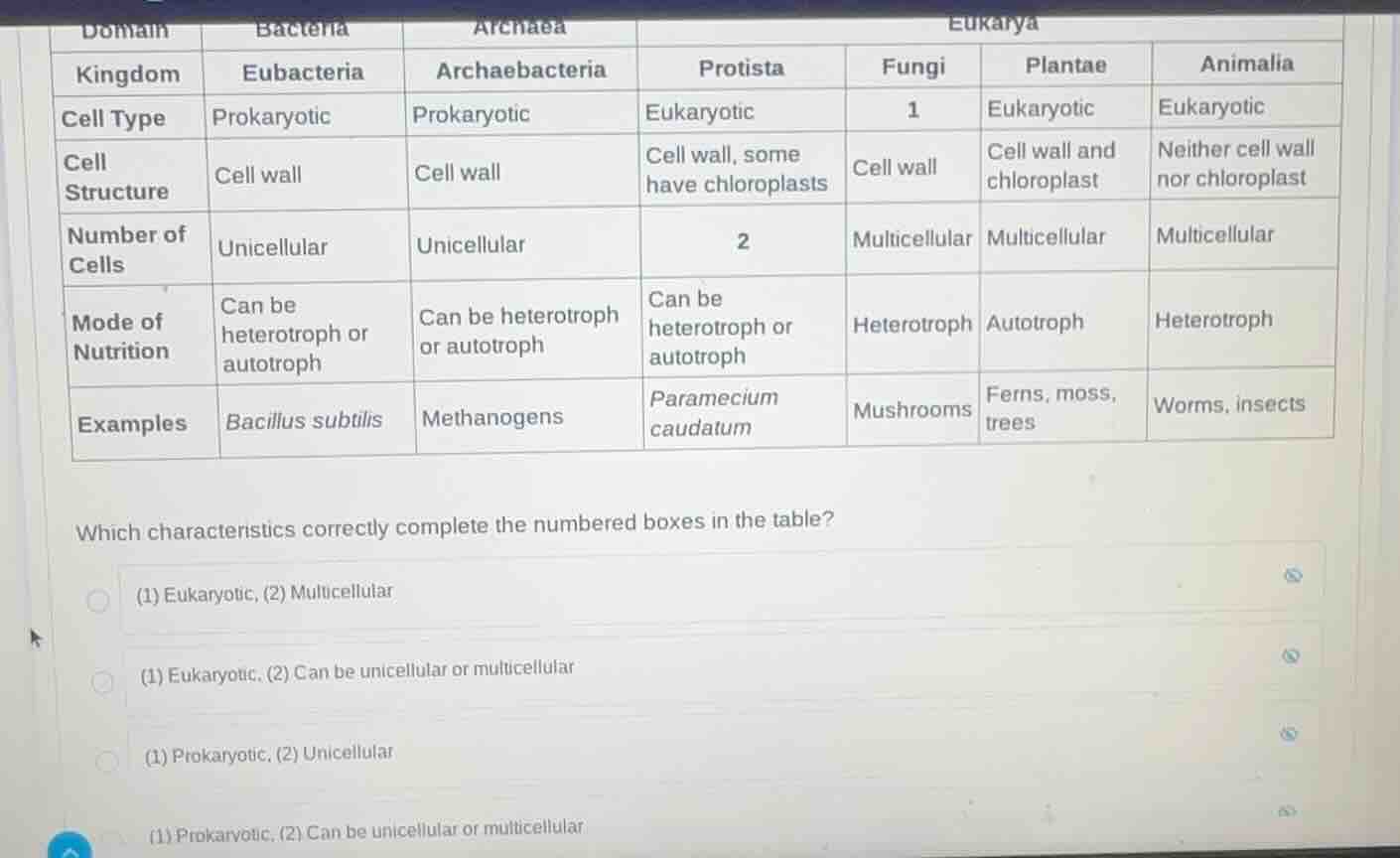
which characteristics correctly complete the numbered boxes in the table?
(1) eukaryotic, (2) multicellular
(1) eukaryotic, (2) can be unicellular or multicellular
(1) prokaryotic, (2) unicellular
(1) prokaryotic, (2) can be unicellular or multicellular
🆕 New Concept Discovered: Taxonomic Classification of Kingdoms
Grouping organisms by cell type, structure, and body plan.
Step 1: Identify the characteristics of Kingdom Fungi (Box 1)
Box 1 is located in the column for Fungi under the row Cell Type.
- All organisms in the domain Eukarya (which includes Protista, Fungi, Plantae, and Animalia) are made of eukaryotic cells.
- Eukaryotic cells contain a membrane-bound nucleus and organelles.
- Therefore, the cell type for Fungi (Box 1) must be Eukaryotic.
Step 2: Identify the characteristics of Kingdom Protista (Box 2)
Box 2 is located in the column for Protista under the row Number of Cells.
- Kingdom Protista is a highly diverse group of eukaryotic organisms.
- While many protists are single-celled (unicellular) like the Paramecium listed in the examples, others (such as multicellular algae like kelp) are multicellular.
- Therefore, the number of cells for Protista (Box 2) is Can be unicellular or multicellular.

Snap & solve any problem in the app
Get step-by-step solutions on Sovi AI
Photo-based solutions with guided steps
Explore more problems and detailed explanations
(1) Eukaryotic, (2) Can be unicellular or multicellular